The Foundation of the Enterprise AI Operating Framework (EAIOF)
Artificial Intelligence has moved rapidly from an emerging technological trend to a strategic capability with direct impact on business performance, operational efficiency, customer experience, product innovation, decision support, and organizational competitiveness.
Across industries, organizations are investing in Generative AI, Large Language Models, AI Agents, Agentic Systems, intelligent automation, predictive analytics, and AI-assisted decision-making. These technologies create new opportunities to redesign processes, augment employees, improve customer interactions, optimize operations, and generate new forms of business value.
However, the speed of technological advancement has not been matched by the same level of maturity in organizational structures, architectural practices, governance mechanisms, operating models, and engineering standards required to adopt AI safely and consistently at enterprise scale.
Many organizations begin their AI journey through isolated initiatives. One department may create a chatbot to support customer service. Another team may build a document assistant for legal or compliance activities. An engineering group may introduce a coding assistant. A business operations unit may develop a predictive analytics model. A marketing team may experiment with content generation. A data science team may deploy a machine learning model to improve forecasting.
These initiatives are valuable. They help organizations learn, experiment, validate business hypotheses, and demonstrate the potential of AI. In the early stages, this decentralized experimentation can be useful because it accelerates discovery and creates organizational awareness.
The problem emerges when these isolated initiatives start to grow without a common enterprise foundation.
Different departments may select different models without shared evaluation criteria. Engineering teams may design different agent architectures without reusable patterns. Prompts may be embedded directly into application source code, making them difficult to version, test, review, reuse, or govern. Knowledge bases may be duplicated across projects, creating inconsistent answers and increasing maintenance effort. Retrieval-Augmented Generation implementations may follow different chunking strategies, metadata models, embedding approaches, and evaluation methods. Security controls may vary from one solution to another. Cost monitoring may be implemented inconsistently or not implemented at all. Human approval may exist in some processes but be absent in others. Business terminology may differ across domains, creating ambiguity in requirements, design decisions, and operating procedures.
Over time, this situation creates AI fragmentation.
AI fragmentation occurs when multiple AI initiatives exist across an organization but are not connected by shared terminology, common principles, reusable capabilities, standard patterns, consistent governance, unified observability, or an agreed operating model.
In a fragmented environment, each AI solution becomes a local implementation rather than part of a broader organizational capability. Each project may solve its immediate problem, but the enterprise as a whole accumulates duplicated components, inconsistent practices, unclear ownership, operational risk, security exposure, uncontrolled costs, and limited reuse.
This fragmentation also reduces strategic scalability. The organization may have many AI use cases, but it does not yet have an enterprise AI capability. It may have AI applications, but it does not yet have a structured way to design, govern, operate, evaluate, and continuously improve AI across business domains.
Therefore, the central challenge is no longer only how to build individual AI applications.
The central challenge is how to build an organization capable of adopting Artificial Intelligence as a repeatable, governed, measurable, secure, and continuously evolving enterprise capability.
This is the purpose of the Enterprise AI Operating Framework, or EAIOF.
The EAIOF defines how an organization establishes, structures, governs, engineers, operates, scales, and continuously improves Artificial Intelligence across the enterprise. It provides the common foundation required to move from isolated experimentation to coordinated enterprise adoption.
The EAIOF is not a technology stack. A technology stack defines tools, platforms, programming languages, infrastructure, and implementation choices. The EAIOF is broader than that.
The EAIOF is not only an AI platform. An AI platform provides technical capabilities such as AI gateways, prompt management, model access, agent runtime, vector search, observability, and evaluation services. These capabilities are important, but they are only one part of the enterprise operating model for AI.
The EAIOF is not merely an implementation guide. An implementation guide explains how to build or configure specific components. The EAIOF defines the wider organizational system in which those components are selected, designed, governed, deployed, operated, measured, and improved.
Instead, the EAIOF is a comprehensive operating framework for enterprise AI. It connects strategy, architecture, platform capabilities, governance, security, engineering practices, lifecycle processes, operating model, adoption mechanisms, and continuous improvement into a coherent whole.
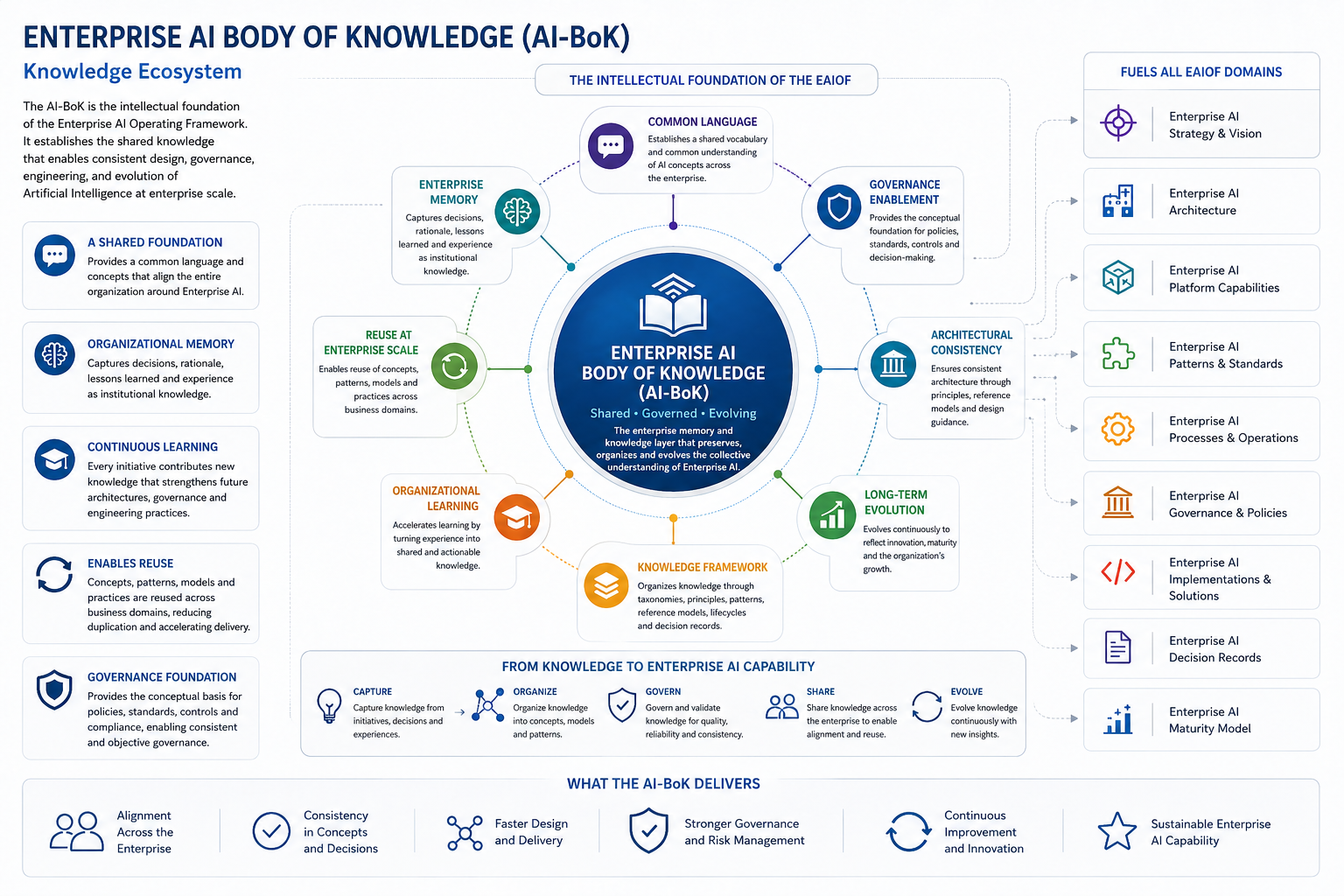
Within this framework, the Enterprise AI Body of Knowledge, or AI-BoK, is the foundational layer.
The AI-BoK establishes the shared knowledge base required for the EAIOF to function consistently. It defines the common language, concepts, terminology, principles, taxonomies, reference models, architectural patterns, governance concepts, lifecycle definitions, and decision records that will be used across all other EAIOF domains.
Without a Body of Knowledge, each team may interpret AI concepts differently. One team may use the term “agent” to mean a chatbot, another may use it to describe an autonomous workflow, and another may use it to refer to a tool-calling LLM component. One team may define “RAG” as simple vector search, while another may include hybrid retrieval, reranking, metadata filtering, grounding, citation, and evaluation. One project may treat prompts as configuration, while another treats them as source code. One domain may require human approval for high-impact decisions, while another may not define autonomy boundaries at all.
The AI-BoK prevents this inconsistency by creating a shared conceptual foundation for the enterprise.
It answers a simple but critical question:
What does it mean to do AI in a standardized, governed, and enterprise-ready way within this organization?
By answering this question, the AI-BoK becomes the official knowledge foundation of the EAIOF. Every subsequent domain in the framework depends on it.
The Enterprise Strategy & Vision domain depends on the AI-BoK to define strategic language, maturity levels, value drivers, principles, and enterprise objectives.
The Enterprise AI Reference Architecture domain depends on the AI-BoK to define consistent reference models, architectural building blocks, integration patterns, and design principles.
The Enterprise AI Platform Capabilities domain depends on the AI-BoK to define what capabilities such as AI Gateway, Prompt Management, Agent Registry, Model Registry, Tool Registry, Knowledge Platform, Vector Platform, Memory Platform, Guardrails, Policy Engine, Observability, Cost Management, and Evaluation mean in the enterprise context.
The Enterprise AI Governance domain depends on the AI-BoK to define policy concepts, risk classifications, approval models, autonomy levels, audit requirements, and responsible AI principles.
The Enterprise AI Operating Model domain depends on the AI-BoK to define roles, responsibilities, ownership models, governance forums, and collaboration mechanisms.
The Enterprise AI Lifecycle & Processes domain depends on the AI-BoK to define standard lifecycle stages for use cases, prompts, agents, models, tools, knowledge assets, evaluations, releases, incidents, and retirement.
The Enterprise AI Engineering Framework domain depends on the AI-BoK to define reusable engineering patterns, design guidelines, development practices, testing approaches, and quality standards.
The Enterprise AI Operations domain depends on the AI-BoK to define operational metrics, observability concepts, incident categories, evaluation criteria, reliability expectations, cost controls, and continuous improvement mechanisms.
The Enterprise AI Adoption & Enablement domain depends on the AI-BoK to create training materials, playbooks, communities of practice, internal documentation, and certification paths based on common concepts.
The Enterprise AI Reference Implementation domain depends on the AI-BoK to ensure that the practical implementation reflects the same concepts, patterns, policies, and architectural principles defined by the framework.
For this reason, the AI-BoK should be created before the other EAIOF domains are fully developed. It provides the conceptual alignment required to avoid ambiguity, duplication, inconsistent design, and fragmented execution.
In practical terms, the AI-BoK is the intellectual foundation of the Enterprise AI Operating Framework.
It does not replace architecture, governance, engineering, operations, or platform implementation. Instead, it makes all of them coherent.
It ensures that every team speaks the same language, follows the same principles, applies the same patterns, understands the same lifecycle, and contributes to the same enterprise AI capability.
This is why the AI-BoK is Domain 0 of the EAIOF.
It is the starting point from which the organization begins to transform Artificial Intelligence from a collection of isolated initiatives into a structured, governed, scalable, and continuously improving enterprise capability.
Why an AI Body of Knowledge?
Every mature professional discipline is built upon a shared body of knowledge.
Before organizations can establish standards, define architectures, implement technologies, or adopt best practices, they must first agree on the fundamental concepts that describe the discipline itself.
This pattern can be observed across virtually every established engineering and management domain.
Civil Engineering is built upon centuries of standardized terminology, engineering principles, design methods, material classifications, and construction practices.
Software Engineering relies on common concepts such as requirements, architecture, design patterns, testing, quality assurance, and software lifecycle management.
Project Management established common terminology for projects, programs, portfolios, stakeholders, governance, risk management, scheduling, and delivery methodologies.
Enterprise Architecture evolved around shared concepts such as business capabilities, architectural domains, reference architectures, principles, governance, and architecture development methods.
Cybersecurity defines common models for identity, authentication, authorization, risk, threats, vulnerabilities, controls, and incident response.
Data Management standardizes concepts such as data ownership, metadata, lineage, governance, quality, lifecycle, and stewardship.
None of these disciplines became mature by starting with technology.
They became mature by first establishing a common language that allowed professionals, architects, engineers, business leaders, and governance teams to communicate using the same concepts and the same definitions.
Only after this conceptual foundation was established did organizations begin developing standards, methodologies, frameworks, technologies, and implementation practices.
Artificial Intelligence is following the same path.
Although AI technologies are advancing at an unprecedented pace, the conceptual foundations required for enterprise adoption are still evolving. Organizations are rapidly introducing Large Language Models, AI Agents, Retrieval-Augmented Generation, AI Copilots, autonomous workflows, reasoning models, multimodal systems, and Agentic AI into their business processes. However, these technologies are often adopted before the organization has established a shared understanding of what these concepts actually mean.
As a result, different teams frequently develop different interpretations of the same terminology.
One engineering team may define an AI Agent as any application that uses a Large Language Model.
Another team may reserve the term only for autonomous systems capable of planning, reasoning, and executing actions.
A business department may describe a conversational assistant as a Copilot, while another team classifies the same solution as an Agent.
One project may describe Retrieval-Augmented Generation simply as semantic search over a vector database, while another considers RAG to include ingestion pipelines, document chunking, metadata enrichment, hybrid retrieval, reranking, grounding strategies, citations, and evaluation.
The concept of Memory may refer to conversation history in one solution, long-term user preferences in another, or organizational knowledge in a third.
Even seemingly simple concepts such as Tool, Workflow, Capability, Reasoning, Reflection, Planning, Autonomy, Supervision, or Human-in-the-Loop can have significantly different interpretations depending on the project, engineering team, vendor, or technology being used.
These differences may appear harmless during the early stages of adoption.
However, as AI initiatives grow across multiple business domains, conceptual inconsistency becomes an architectural problem rather than merely a documentation issue.
Without common definitions, architecture reviews become subjective because different reviewers evaluate different interpretations of the same concepts.
Engineering standards become inconsistent because teams apply different design assumptions.
Reusable components become more difficult to identify because similar capabilities are implemented under different names.
Knowledge sharing becomes inefficient because documentation assumes different terminology.
Governance policies become difficult to enforce because responsibilities and boundaries are not consistently defined.
Training programs become fragmented because different instructors teach different conceptual models.
Communication between business and engineering teams becomes increasingly ambiguous, slowing decision-making and increasing implementation risk.
Eventually, the organization reaches a point where it no longer lacks AI technology.
Instead, it lacks conceptual consistency.
This is precisely the problem that an Enterprise AI Body of Knowledge is designed to solve.
The AI-BoK establishes the conceptual foundation upon which every other element of the Enterprise AI Operating Framework is built.
Its primary purpose is not to prescribe technologies, programming languages, platforms, or implementation choices.
Its purpose is to define the knowledge that allows an organization to think, communicate, design, govern, and operate Artificial Intelligence consistently.
To achieve this objective, the AI-BoK establishes a common language for the entire enterprise.
It defines shared terminology, standard concepts, architectural principles, taxonomies, classifications, reference models, lifecycle definitions, governance concepts, engineering patterns, and decision frameworks that become the official vocabulary of the organization.
From that point forward, every EAIOF domain references the same definitions.
Architects design using the same concepts.
Engineers implement using the same patterns.
Governance teams evaluate solutions using the same criteria.
Business stakeholders communicate using the same terminology.
Training materials teach the same conceptual model.
Documentation follows the same language.
Enterprise decisions become consistent because the organization has established a single authoritative source of knowledge.
In this sense, the AI-BoK is much more than a documentation repository.
It is the intellectual foundation of Enterprise AI.
Just as architecture cannot exist without architectural principles, governance cannot exist without governance concepts, and engineering cannot exist without engineering standards, Enterprise AI cannot mature without a shared Body of Knowledge.
For this reason, the AI-BoK is intentionally positioned as the first domain of the Enterprise AI Operating Framework.
Before an organization defines its architecture, builds an AI platform, creates AI Agents, establishes governance processes, or deploys solutions into production, it must first define what those concepts mean.
Only then can Artificial Intelligence evolve from isolated experimentation into a disciplined, standardized, governed, and scalable enterprise capability.
Beyond Documentation
One of the most common misconceptions about a Body of Knowledge is to regard it as simply another documentation repository. Although both documentation and a Body of Knowledge deal with organizational knowledge, they serve fundamentally different purposes and operate at different levels of abstraction.
Documentation primarily records information about specific artifacts, systems, or processes. It explains how a solution has been implemented, how a particular component should be configured, how an operational procedure is executed, or how a business process currently functions. In other words, documentation describes the current state of a particular implementation. As systems evolve, documentation evolves alongside them, reflecting changes in technologies, configurations, and operational practices.
A Body of Knowledge serves a much broader purpose. Rather than describing individual implementations, it establishes the conceptual foundation of an entire discipline. It provides the structure through which knowledge is organized, classified, standardized, governed, maintained, and continuously evolved across the organization. Instead of documenting what has been built, it defines the intellectual framework that guides how future solutions should be understood, designed, governed, and improved.
This distinction becomes particularly important in the context of Artificial Intelligence. Unlike many traditional technology domains, AI is evolving at an unprecedented pace. New foundation models emerge continuously, reasoning capabilities advance rapidly, orchestration techniques become more sophisticated, regulatory requirements evolve, and new engineering practices are introduced on a regular basis. Technologies that represent current best practices today may become obsolete within a relatively short period of time.
In such an environment, organizations cannot rely solely on documentation to establish consistency. Documentation naturally reflects the technologies and implementation decisions of a given moment, whereas enterprise knowledge must remain stable enough to provide continuity despite constant technological change. Organizations therefore require a structured mechanism capable of preserving the concepts, principles, architectural foundations, and governance models that remain valid even as individual technologies evolve.
The Enterprise AI Body of Knowledge fulfills this role. Rather than focusing on specific products, vendors, frameworks, or implementation choices, it establishes a stable conceptual foundation that enables the organization to adopt new technologies without continuously redefining its understanding of Artificial Intelligence.
For example, Large Language Models will continue to evolve, new reasoning architectures will emerge, orchestration frameworks will mature, and entirely new categories of AI systems will appear over time. Despite these technological changes, the organization will continue to require consistent approaches to governance, architecture, lifecycle management, knowledge management, evaluation, observability, security, autonomy, and human oversight. These concepts represent enduring organizational capabilities that should remain independent of any particular technology or vendor.
The AI-BoK captures and formalizes these enduring concepts, providing a stable intellectual layer upon which the Enterprise AI Operating Framework is built. In doing so, it enables the organization to evolve technologically while maintaining consistency in its architectural thinking, governance practices, engineering standards, and operational models.
Beyond establishing conceptual consistency, the AI-BoK also serves as a strategic organizational asset. It captures institutional knowledge generated throughout the organization's AI journey, preserving not only technical knowledge but also architectural rationale, governance decisions, design patterns, and lessons learned. As projects evolve and teams change over time, this accumulated knowledge remains available to future initiatives, reducing the dependence on individual experience and minimizing the loss of organizational expertise.
The AI-BoK also establishes a common mental model for the enterprise. Architects, engineers, business stakeholders, governance teams, and executive leadership are able to communicate using a shared vocabulary and a common conceptual framework. This shared understanding significantly improves collaboration, reduces ambiguity during architectural discussions, facilitates decision-making, and enables different business domains to work together using consistent definitions and principles.
From an engineering perspective, the AI-BoK promotes standardization and reuse. By defining common terminology, reference models, architectural patterns, capability definitions, lifecycle concepts, and governance principles, it provides a consistent foundation upon which reusable solutions can be designed. This consistency reduces duplication of effort, accelerates solution development, simplifies architecture reviews, and improves interoperability between projects across the enterprise.
The existence of a formal Body of Knowledge also contributes directly to organizational learning. New architects, engineers, product owners, and business professionals can develop a comprehensive understanding of the organization's Enterprise AI model through a single authoritative source of knowledge rather than relying on fragmented documentation or informal knowledge transfer. As a result, onboarding becomes more efficient, training becomes more consistent, and expertise can be developed in a structured and repeatable manner.
Perhaps the most significant contribution of the AI-BoK is that it transforms knowledge itself into a managed enterprise capability. Knowledge is no longer treated as a collection of isolated documents, presentations, project artifacts, or individual experience. Instead, it becomes an organizational asset that is intentionally governed, versioned, reviewed, continuously improved, and aligned with the strategic objectives of the Enterprise AI Operating Framework.
For this reason, the Enterprise AI Body of Knowledge should not be viewed as documentation about Artificial Intelligence. It should be understood as the enterprise knowledge framework that defines how Artificial Intelligence is conceptualized across the organization. While the Enterprise AI Platform provides the technical capabilities required to build and operate AI solutions, the AI-BoK provides the conceptual capabilities that enable those solutions to be designed, governed, engineered, and evolved consistently.
Together, these complementary foundations ensure that both technology and organizational knowledge evolve in a coordinated manner. The result is an enterprise that is capable not only of implementing Artificial Intelligence, but of managing it as a disciplined, standardized, governed, and continuously evolving organizational capability.
Establishing a Common Language Across the Enterprise
One of the primary objectives of the Enterprise AI Body of Knowledge is to establish a common language for Artificial Intelligence across the entire organization. Although this objective may initially appear simple, it represents one of the most fundamental prerequisites for achieving enterprise-wide AI adoption.
Every organization is composed of multiple business domains, each responsible for different functions, priorities, processes, and outcomes. Customer Service focuses on customer interactions and service quality. Marketing concentrates on customer engagement and campaign effectiveness. Sales emphasizes revenue generation and commercial opportunities. Finance prioritizes financial control, forecasting, and compliance. Human Resources focuses on workforce enablement and organizational development. Engineering designs and delivers technology solutions. Network Operations ensures service availability and operational resilience. Legal, Cybersecurity, Risk, and Compliance each contribute their own specialized perspectives, responsibilities, and terminology.
Each of these domains naturally develops its own language to describe its work. This specialization is both necessary and beneficial within the context of individual disciplines. However, as Artificial Intelligence becomes a capability that spans the entire enterprise, these differences in terminology begin to create significant challenges.
The same AI solution may be described differently depending on the team discussing it. A business department may refer to an intelligent conversational system as an Assistant because it supports employees in performing their daily activities. Another team may describe the same solution as a Copilot because it augments human decision-making without acting independently. An engineering team may classify the solution as an AI Agent because it is capable of reasoning, planning, invoking tools, and executing tasks autonomously within defined boundaries.
Similarly, concepts such as Workflow, Tool, Memory, Knowledge, Retrieval-Augmented Generation, Planning, Reflection, Autonomy, Human-in-the-Loop, Capability, or Orchestration may carry different meanings across projects, departments, and technology teams. Even when these differences appear subtle, they often result in misunderstandings during architecture discussions, solution design, governance reviews, technical documentation, and executive decision-making.
The consequences of this inconsistency extend far beyond communication. When teams do not share a common conceptual model, architectural reviews become subjective because participants evaluate solutions using different definitions. Engineering standards become increasingly difficult to apply consistently, as projects are designed according to different assumptions. Governance policies become more complex to enforce because responsibilities, capabilities, and autonomy levels are interpreted differently across the organization. Opportunities for reuse diminish because similar capabilities are developed independently under different names or classifications. Knowledge sharing becomes fragmented, making onboarding, collaboration, and organizational learning significantly more difficult.
As the number of AI initiatives grows, these inconsistencies become an obstacle to enterprise scalability. The organization may successfully deliver individual AI projects, yet still struggle to develop AI as a coordinated enterprise capability. The absence of a shared language ultimately limits collaboration between business domains, slows architectural decision-making, increases implementation risk, and reduces the overall effectiveness of AI investments.
The Enterprise AI Body of Knowledge addresses this challenge by establishing a common enterprise language for Artificial Intelligence.
Rather than allowing each project or department to define its own terminology, the AI-BoK provides authoritative definitions for the concepts that underpin the Enterprise AI Operating Framework. It standardizes terminology, clarifies conceptual boundaries, defines relationships between concepts, and establishes a consistent vocabulary that can be applied throughout the organization.
This common language becomes one of the most valuable organizational assets produced by the AI-BoK. It enables architects to design solutions using consistent concepts and reference models. It allows engineering teams to develop reusable capabilities based on standardized definitions. It provides governance teams with a common framework for evaluating compliance, autonomy, security, and risk. It enables business stakeholders to communicate requirements using terminology that is consistently understood across organizational boundaries. It also provides educators, trainers, and enablement teams with a stable conceptual foundation for developing learning materials and building enterprise-wide AI capabilities.
More importantly, a common language establishes a common way of thinking about Artificial Intelligence.
When people across the organization use the same concepts, they also begin to develop shared mental models. These shared mental models simplify collaboration, reduce ambiguity, improve architectural consistency, and enable knowledge to flow more effectively between teams. Over time, they contribute to the creation of a coherent Enterprise AI culture in which decisions are based on common principles rather than individual interpretations.
For this reason, the common language established by the AI-BoK should not be viewed merely as a glossary of technical terms. It is a strategic organizational capability that enables every subsequent element of the Enterprise AI Operating Framework. Architecture becomes easier to review because concepts are consistently understood. Projects become easier to compare because they are described using the same terminology. Platform capabilities become easier to identify and reuse because they share common definitions. Governance becomes more effective because policies are applied against standardized concepts. Training becomes more consistent because every learning initiative is based on the same conceptual foundation. Knowledge transfer becomes more efficient because information can be communicated without the ambiguity created by multiple interpretations of the same idea.
In this sense, establishing a common language is not simply an exercise in terminology standardization. It is the mechanism through which the organization develops a shared understanding of Artificial Intelligence, enabling every business domain to collaborate within a single, coherent, and enterprise-wide conceptual framework.
Reducing Architectural Entropy
Every enterprise architecture evolves over time. As organizations grow, new business capabilities are introduced, new technologies are adopted, and existing systems continue to evolve in response to changing business requirements. This continuous evolution naturally increases architectural complexity, making consistency and long-term maintainability progressively more difficult to achieve.
Artificial Intelligence accelerates this process to an unprecedented degree.
Unlike many traditional technology domains, AI is characterized by an exceptionally high rate of innovation. New foundation models are released frequently. Agent frameworks continue to mature at a rapid pace. Prompt engineering techniques evolve continuously. Orchestration approaches become increasingly sophisticated. New evaluation methodologies emerge. Retrieval strategies improve. Governance practices evolve alongside regulatory requirements. As a result, organizations are constantly presented with new technologies, frameworks, and implementation approaches.
This rapid pace of innovation creates a natural tendency for projects to adopt new technologies as they become available. Individual engineering teams often make technology decisions independently in order to solve immediate business problems, optimize delivery schedules, or experiment with emerging capabilities. While these decisions may be entirely appropriate within the scope of individual projects, they can gradually introduce inconsistency across the enterprise when they are not guided by a common architectural foundation.
The resulting challenge is not technological diversity itself.
Enterprise architectures are expected to accommodate multiple technologies, multiple vendors, and multiple implementation approaches. Different business domains may legitimately require different Large Language Models, different orchestration frameworks, different retrieval mechanisms, or different deployment strategies according to their functional and non-functional requirements.
Architectural diversity, when governed appropriately, is not a weakness. It is often a necessary characteristic of a modern enterprise architecture.
The problem arises when technological diversity is accompanied by conceptual inconsistency.
Without shared architectural principles, different projects begin to implement similar capabilities in fundamentally different ways. Multiple prompt management approaches emerge without common lifecycle definitions. Agent orchestration follows different architectural models. Knowledge management evolves independently across business domains. Evaluation methodologies are inconsistent. Governance policies vary between projects. Security mechanisms are implemented according to local interpretations rather than enterprise standards. Similar capabilities are repeatedly developed without recognizing opportunities for reuse.
Over time, these differences accumulate.
Architecture becomes increasingly fragmented.
Operational complexity grows.
Governance becomes more difficult to apply consistently.
Engineering teams spend more effort understanding existing implementations than creating new capabilities.
The cost of maintaining the enterprise architecture steadily increases.
This progressive loss of architectural coherence can be described as architectural entropy.
Architectural entropy is the gradual increase in inconsistency, complexity, duplication, and fragmentation that occurs when independent architectural decisions are made without a shared conceptual framework.
It is important to recognize that architectural entropy is not caused by technological evolution. Technologies are expected to evolve. New models will replace existing ones. New frameworks will emerge. Vendors will change. Architectural entropy emerges when the organization lacks stable principles capable of guiding those technological changes in a consistent direction.
This distinction is fundamental.
Technology changes.
Architecture provides continuity.
Implementation evolves.
Principles endure.
Products are replaced.
Conceptual models remain.
Individual frameworks may become obsolete.
Architectural knowledge continues to provide value long after specific technologies have disappeared.
The Enterprise AI Body of Knowledge serves as the primary mechanism for reducing this form of entropy.
Rather than attempting to standardize every technology adopted by the organization, the AI-BoK standardizes the conceptual foundations upon which those technologies are selected, designed, governed, and operated. It establishes common principles, architectural patterns, reference models, terminology, lifecycle concepts, governance mechanisms, and design guidance that remain stable despite continuous technological evolution.
This approach allows organizations to embrace innovation without sacrificing architectural consistency. Engineering teams remain free to evaluate emerging technologies and adopt solutions that best address their business needs, while still operating within a shared enterprise architecture based on common principles and standardized concepts.
The result is an architecture capable of evolving continuously without losing coherence.
Innovation is encouraged rather than restricted.
Technological diversity becomes manageable rather than chaotic.
Architectural knowledge becomes reusable rather than project-specific.
Governance becomes proactive rather than reactive.
Most importantly, the enterprise develops the ability to adapt to the continuous evolution of Artificial Intelligence without requiring its architectural foundations to be redesigned with every new generation of technology.
For this reason, reducing architectural entropy is not about limiting innovation. It is about ensuring that innovation occurs within a stable architectural framework that preserves consistency, promotes reuse, and enables Artificial Intelligence to evolve as a sustainable enterprise capability rather than a collection of disconnected technology initiatives.
Enabling Reuse at Enterprise Scale
One of the defining characteristics of mature enterprise architecture is the ability to reuse knowledge, capabilities, and architectural assets across multiple business domains. Reuse is not simply an engineering optimization; it is a strategic capability that enables organizations to deliver solutions more efficiently, improve architectural consistency, reduce operational risk, and accelerate organizational learning.
Artificial Intelligence introduces both significant opportunities and new challenges in this regard.
As AI adoption expands across the enterprise, multiple business units begin developing solutions that often address similar problems. Customer Service may develop an intelligent conversational assistant. Human Resources may create an employee support assistant. Legal may build a document analysis solution. Engineering may implement an internal development copilot. Although these initiatives serve different business objectives, they frequently rely on many of the same underlying concepts, architectural patterns, governance principles, lifecycle processes, and platform capabilities.
Without a common enterprise foundation, these similarities often go unrecognized.
Individual teams independently design prompts that solve comparable problems. Similar AI Agents are developed multiple times by different departments. Knowledge ingestion pipelines are implemented repeatedly using different approaches. Evaluation methodologies evolve independently. Governance processes are interpreted differently across projects. Architectural patterns are rediscovered rather than shared. Valuable lessons learned remain confined to individual teams instead of becoming organizational knowledge.
Over time, this unnecessary duplication increases development effort, introduces architectural inconsistency, and slows the organization's ability to scale Artificial Intelligence effectively.
The Enterprise AI Body of Knowledge addresses this challenge by establishing reuse as a fundamental architectural principle rather than an incidental outcome of individual projects.
Within the Enterprise AI Operating Framework, reuse begins long before software is written.
Rather than asking, "How should we build this solution?", teams are encouraged to ask a more fundamental question:
"Has this already been defined within the enterprise?"
This seemingly simple change in perspective has significant architectural implications.
Instead of creating new concepts for every initiative, teams first consult the shared Body of Knowledge to determine whether the required terminology, architectural principles, governance models, capability definitions, lifecycle concepts, or design patterns already exist. Existing knowledge becomes the starting point for innovation rather than an artifact created after implementation.
The AI-BoK therefore promotes reuse at multiple levels of abstraction.
At the conceptual level, it standardizes terminology, taxonomies, classifications, and common mental models, ensuring that every project begins with a shared understanding of fundamental concepts.
At the architectural level, it defines reusable reference architectures, design principles, capability models, and solution patterns that can be consistently applied across multiple business domains.
At the governance level, it provides common policies, decision frameworks, autonomy models, risk classifications, and review criteria that eliminate the need for each project to establish its own governance approach.
At the engineering level, it captures reusable practices, development patterns, evaluation strategies, testing approaches, lifecycle models, and implementation guidance that enable engineering teams to build upon proven experience rather than starting from first principles.
Finally, at the organizational level, the AI-BoK captures institutional knowledge itself, allowing lessons learned, architectural decisions, and best practices generated by one initiative to become reusable assets for every subsequent initiative.
This layered approach to reuse produces benefits that extend well beyond development efficiency. Projects become easier to compare because they share common concepts and architectural models. Governance activities become more consistent because solutions are evaluated against standardized principles. Architecture reviews become more objective because reviewers assess implementations using common reference models rather than individual interpretations. Training becomes more effective because every team learns from the same conceptual foundation. Collaboration between business domains improves because participants communicate using a shared enterprise vocabulary.
Perhaps most importantly, reuse accelerates organizational learning.
Every new AI initiative contributes knowledge back to the Enterprise AI Body of Knowledge, allowing future projects to benefit from previous experience. Instead of repeatedly solving the same conceptual and architectural problems, the organization continuously expands a shared repository of enterprise knowledge that grows in value over time.
In this sense, the AI-BoK transforms reuse from an engineering practice into an organizational capability.
The objective is not merely to reuse code, prompts, or technical components. Those remain important implementation assets, but they represent only a small part of what can be standardized across the enterprise.
The greater opportunity lies in reusing knowledge itself.
When organizations consistently reuse concepts, architectural principles, governance models, capability definitions, lifecycle processes, engineering practices, and decision frameworks, they create an environment in which every new initiative starts from an increasingly mature foundation rather than beginning from scratch.
This cumulative approach enables Artificial Intelligence to evolve as a coherent enterprise capability rather than as a collection of independent projects. Delivery becomes faster without sacrificing architectural quality. Innovation becomes more consistent because it is built upon proven foundations. Organizational knowledge grows continuously, and each project strengthens the enterprise's ability to deliver the next one more effectively.
For this reason, reuse should not be viewed simply as a mechanism for reducing development effort. Within the Enterprise AI Operating Framework, reuse represents one of the primary mechanisms through which enterprise knowledge is transformed into sustained organizational value, allowing Artificial Intelligence capabilities to scale consistently across the entire enterprise.
Supporting Enterprise Governance
Effective governance depends upon more than policies, procedures, and approval processes. While these mechanisms are essential for establishing organizational control, they are only effective when supported by a shared understanding of the concepts, principles, and architectural foundations they are intended to govern.
Without this shared understanding, governance becomes increasingly difficult to apply consistently. Policies may define what is permitted or prohibited, but they rarely explain the underlying rationale behind those decisions. Different stakeholders may interpret the same policy in different ways, architecture review boards may evaluate similar solutions inconsistently, and governance activities may become dependent upon individual experience rather than standardized organizational knowledge.
This challenge becomes particularly significant in the context of Artificial Intelligence.
Enterprise AI introduces concepts that are still evolving across both industry and academia. Organizations must govern AI Agents, Large Language Models, Retrieval-Augmented Generation, autonomous decision-making, reasoning systems, human oversight, knowledge management, prompt engineering, model evaluation, and many other capabilities whose definitions continue to mature. Without a common conceptual foundation, governance decisions inevitably become subjective because different reviewers may apply different interpretations of the same concepts.
The Enterprise AI Body of Knowledge provides the foundation required to eliminate this ambiguity.
Rather than functioning as a collection of governance policies, the AI-BoK establishes the shared knowledge upon which governance itself is built. It defines the terminology, principles, architectural concepts, capability definitions, lifecycle models, and governance constructs that enable every stakeholder to reason about Artificial Intelligence using the same conceptual framework.
This shared understanding significantly improves the quality and consistency of enterprise governance.
Architectural principles become easier to understand because they are supported by clearly defined concepts rather than isolated statements. Governance decisions become traceable because they can be linked to documented principles, reference models, and architectural rationale rather than individual interpretation. Risk assessments become repeatable because common terminology and standardized evaluation criteria are applied consistently across projects. Compliance activities become more reliable because governance reviews are performed against a shared conceptual baseline instead of project-specific assumptions. Audit evidence becomes easier to produce because architectural decisions, governance reviews, and implementation choices can be traced back to authoritative enterprise definitions contained within the Body of Knowledge.
The AI-BoK also strengthens governance by creating consistency across the entire lifecycle of Enterprise AI initiatives. Business stakeholders, enterprise architects, AI engineers, governance teams, security specialists, compliance officers, auditors, and executive leadership all reference the same concepts when evaluating AI solutions. This common language reduces ambiguity, improves collaboration between organizational functions, and enables governance activities to become significantly more objective and transparent.
Perhaps most importantly, the AI-BoK changes the way governance is perceived within the organization.
Traditional governance models are often viewed as mechanisms for restricting innovation. Policies are introduced after solutions have been designed, governance reviews become approval checkpoints, and compliance activities are frequently perceived as barriers to delivery. As a result, governance tends to operate reactively, identifying issues only after architectural decisions have already been made.
Within the Enterprise AI Operating Framework, governance follows a different philosophy.
Because the AI-BoK establishes common concepts, architectural principles, reference models, and standardized practices before implementation begins, governance becomes an integral part of solution design rather than an activity performed after development. Teams design solutions using the same enterprise principles that governance bodies will later evaluate, significantly reducing ambiguity, rework, and conflicting interpretations.
In this way, governance evolves from a reactive control mechanism into an enabling organizational capability. Rather than relying primarily on restrictions, it promotes alignment through shared understanding. Rather than enforcing consistency through isolated policies, it achieves consistency through common knowledge. Decisions become easier to justify because they are grounded in established enterprise principles. Architectural reviews become more objective because they are based on standardized concepts rather than individual judgment. Governance becomes scalable because every project is evaluated against the same intellectual foundation.
For this reason, the Enterprise AI Body of Knowledge should be viewed as one of the fundamental enablers of Enterprise AI governance. Policies, standards, and controls remain essential components of the governance framework, but their effectiveness ultimately depends upon the existence of a shared body of knowledge that provides context, establishes consistency, and enables the entire organization to govern Artificial Intelligence according to common principles rather than isolated interpretations.
Within the Enterprise AI Operating Framework, governance is therefore not achieved simply by defining rules. It is achieved by ensuring that every governance decision is supported by a common understanding of the enterprise concepts, architectural principles, and organizational objectives that those rules are intended to protect.
Accelerating Organizational Learning
Artificial Intelligence is evolving at a pace rarely observed in previous technology disciplines. New foundation models are released continuously, research advances are published daily, engineering techniques mature rapidly, regulatory expectations continue to evolve, and entirely new architectural approaches emerge within remarkably short periods of time. Practices that are considered innovative today may become standard within months, while techniques that were regarded as industry best practices only a short time ago may quickly lose relevance.
For organizations adopting Artificial Intelligence at enterprise scale, this rate of change presents a significant challenge. Enterprise architecture depends upon stability, consistency, and repeatability, whereas Artificial Intelligence is characterized by continuous innovation and experimentation. Organizations must therefore find a way to embrace technological evolution without continuously redefining their architectural foundations, governance models, engineering practices, or operating principles.
The Enterprise AI Body of Knowledge addresses this challenge by providing a structured mechanism through which organizational knowledge can evolve in a controlled and consistent manner.
Unlike traditional documentation, which is often created to describe a specific implementation at a particular point in time, the AI-BoK is intentionally designed to evolve alongside the organization. It is not a static publication intended to capture the state of Artificial Intelligence at the moment it is written. Instead, it represents a continuously evolving body of enterprise knowledge that grows as the organization's experience with Artificial Intelligence matures.
This distinction is fundamental.
The objective of the AI-BoK is not to preserve existing knowledge unchanged. Its objective is to preserve organizational understanding while allowing that understanding to improve continuously.
As new technologies emerge, the organization evaluates them against established architectural principles rather than replacing those principles. As new engineering practices prove successful, they are incorporated into the Body of Knowledge and become available to future initiatives. As governance frameworks mature, the lessons learned are reflected in updated policies, reference models, and lifecycle guidance. As new implementation patterns demonstrate measurable value, they become part of the enterprise's standard architectural vocabulary.
In this way, the AI-BoK provides a systematic process through which innovation becomes institutional knowledge.
Every AI initiative contributes not only business value, but also organizational learning.
Architectural decisions become reusable knowledge that informs future solution design.
Governance improvements become enterprise standards that strengthen future reviews and decision-making.
Engineering patterns evolve from project-specific practices into reusable architectural assets.
Operational experiences improve reliability by identifying successful operating models as well as common failure scenarios.
Evaluation methodologies mature as benchmarking techniques, quality metrics, and validation approaches are refined over time.
Lessons learned from production deployments improve future implementations across every business domain.
Equally important, unsuccessful initiatives also contribute valuable knowledge. Architectural approaches that prove ineffective, governance mechanisms that introduce unnecessary complexity, engineering practices that fail to scale, or operational strategies that produce undesirable outcomes all provide evidence that strengthens future decision-making. By capturing both successful and unsuccessful experiences, the AI-BoK enables the organization to learn systematically rather than repeatedly encountering the same challenges.
This continuous accumulation of knowledge creates a powerful organizational advantage.
Instead of relying primarily on individual expertise, the organization progressively develops collective intelligence. Knowledge generated by one project becomes available to every subsequent project. Experience acquired by one team benefits the entire enterprise. Decisions become increasingly informed by accumulated organizational learning rather than isolated personal experience.
As the Enterprise AI Operating Framework matures, this feedback cycle becomes one of its most valuable capabilities.
Every new initiative contributes to the evolution of the AI-BoK.
The updated AI-BoK strengthens future architecture, governance, engineering, and operational practices.
These improved practices increase the quality of future initiatives.
Those initiatives, in turn, generate new organizational knowledge that further enriches the Body of Knowledge.
The result is a continuous learning cycle in which each iteration strengthens the next.
Over time, the Enterprise AI Body of Knowledge becomes far more than a repository of concepts or reference material. It becomes the organization's institutional memory for Enterprise AI. It preserves not only definitions and architectural principles, but also the experience, reasoning, decisions, patterns, and lessons that collectively represent the organization's growing expertise in designing, governing, engineering, and operating Artificial Intelligence.
This capability is particularly important because the pace of technological innovation is unlikely to slow. New models, frameworks, platforms, and methodologies will continue to emerge for many years. Organizations that rely solely on technology-specific knowledge will find themselves repeatedly rebuilding their understanding of Artificial Intelligence. Organizations that continuously evolve their Body of Knowledge, however, develop a stable intellectual foundation capable of adapting to technological change without sacrificing consistency.
For this reason, the Enterprise AI Body of Knowledge should be regarded not as a static reference manual, but as the enterprise's knowledge evolution system. Its value lies not only in what it contains today, but in its ability to continuously capture, organize, refine, and disseminate the knowledge that will shape the organization's Enterprise AI capability in the years to come.
Within the Enterprise AI Operating Framework, organizational learning is therefore not an incidental by-product of individual projects. It is a deliberate, structured, and continuously managed capability through which every architectural decision, governance improvement, engineering innovation, operational lesson, successful implementation, and failed experiment contributes to the long-term evolution of Enterprise AI across the entire organization.
Building an Enterprise Memory
Knowledge is one of the most valuable assets within any organization. Unlike physical assets, however, organizational knowledge can easily be lost. Employees change roles, projects conclude, technologies evolve, priorities shift, and teams are reorganized. Unless knowledge is intentionally captured and managed, much of the experience accumulated during these initiatives gradually disappears.
This challenge is particularly significant in the field of Artificial Intelligence.
Enterprise AI initiatives involve continuous experimentation, architectural exploration, governance decisions, engineering innovation, and operational learning. Every project generates valuable experience that extends far beyond the software ultimately delivered. Architectural alternatives are evaluated, governance models are refined, engineering practices are improved, implementation patterns are validated, and operational lessons are learned through real-world deployment.
Unfortunately, this knowledge often remains confined to the project teams that created it.
When projects are completed, documentation typically focuses on implementation details rather than architectural reasoning. Design decisions may be recorded, but the rationale behind those decisions is frequently omitted. Lessons learned are discussed during project retrospectives but are seldom incorporated into an enterprise-wide knowledge framework. As experienced architects and engineers move to new initiatives or leave the organization, much of this accumulated expertise is lost.
The result is that future projects often revisit problems that have already been solved.
Architectural alternatives are evaluated repeatedly.
Governance discussions revisit the same questions.
Engineering teams rediscover implementation patterns that already exist elsewhere in the organization.
Similar mistakes are made because previous lessons were never institutionalized.
The organization continues to generate knowledge, but it struggles to retain it.
The Enterprise AI Body of Knowledge addresses this challenge by functioning as the institutional memory of Enterprise AI within the organization.
Its purpose extends far beyond preserving documentation. The AI-BoK captures the evolution of the organization's understanding of Artificial Intelligence, preserving not only definitions and standards but also the architectural reasoning, governance decisions, engineering experience, and operational knowledge that collectively shape the organization's Enterprise AI capability.
One of its most important responsibilities is the preservation of architectural rationale.
Enterprise architecture is fundamentally a discipline of decision-making. Every architectural principle, governance model, capability definition, lifecycle process, or engineering pattern represents a series of decisions made in response to specific business objectives, technical constraints, operational experience, and organizational priorities.
Documenting the final decision is valuable.
Documenting the reasoning behind that decision is considerably more valuable.
When future architects understand why a particular architectural principle was established, they are better equipped to determine whether that principle remains appropriate, requires refinement, or should evolve in response to new business or technological realities. Without this context, standards risk becoming rules that are followed mechanically rather than principles that are understood and applied intelligently.
The AI-BoK therefore preserves both the decisions and the knowledge that led to those decisions.
It captures architectural rationale, governance reasoning, engineering trade-offs, implementation experience, operational lessons, and organizational learning in a manner that remains accessible long after individual projects have concluded.
This institutional memory enables future initiatives to benefit from the accumulated experience of previous ones. Architects can understand why enterprise standards exist rather than simply applying them. Engineers can build upon proven practices instead of rediscovering them. Governance teams can evaluate new scenarios using historical context rather than isolated policies. Business stakeholders gain greater confidence in enterprise standards because the reasoning behind them is transparent and traceable.
Over time, this accumulated knowledge becomes one of the organization's most valuable strategic assets.
Rather than depending primarily on individual expertise, the organization develops a shared memory that persists independently of specific projects, technologies, or personnel. Knowledge remains available even as teams evolve, organizational structures change, and new generations of technologies emerge.
This continuity is essential for Enterprise AI because the discipline itself continues to evolve rapidly. Technologies will change, architectural patterns will mature, and governance practices will be refined. The organization's ability to adapt successfully depends not only on acquiring new knowledge, but also on preserving the experience that has already been gained.
For this reason, the Enterprise AI Body of Knowledge should be understood as far more than a repository of standards or architectural guidance. It is the institutional memory of the organization's Enterprise AI journey, preserving the collective experience that enables Artificial Intelligence to evolve as a coherent and continuously improving enterprise capability.
Within the Enterprise AI Operating Framework, institutional memory is therefore recognized as a strategic organizational asset. By systematically preserving architectural rationale, governance decisions, engineering knowledge, operational experience, and lessons learned, the AI-BoK ensures that every initiative contributes not only to immediate business outcomes, but also to the long-term intellectual capital of the enterprise. In doing so, it allows the organization to learn continuously, retain its expertise, and build each new generation of Enterprise AI capabilities upon the accumulated knowledge of all those that came before.
Creating a Foundation for Long-Term Evolution
One of the defining characteristics of Enterprise Architecture is its ability to provide long-term organizational stability within an environment of continuous technological change. While technologies inevitably evolve, the principles that guide how an enterprise designs, governs, and operates those technologies should remain sufficiently stable to provide continuity over time.
This principle is particularly important in the field of Artificial Intelligence.
Few technology disciplines evolve as rapidly as AI. Foundation models continue to improve at an unprecedented pace. New reasoning techniques emerge regularly. Agent capabilities become increasingly sophisticated. Orchestration frameworks continue to mature. Autonomous systems are gradually expanding the range of decisions they can perform. Regulatory frameworks evolve in response to new technological capabilities, while enterprise architectures continuously adapt to changing business priorities and technological innovation.
This constant evolution presents a fundamental challenge for every organization adopting Artificial Intelligence at enterprise scale.
If enterprise knowledge is tightly coupled to specific technologies, frameworks, vendors, or implementation approaches, it quickly becomes obsolete. Architectural guidance must be rewritten whenever a new generation of models appears. Governance policies become increasingly difficult to maintain as technologies evolve. Engineering practices lose relevance as implementation techniques change. Organizational learning becomes fragmented because knowledge is anchored to technologies with relatively short lifecycles.
Over time, the organization finds itself repeatedly rebuilding its understanding of Artificial Intelligence rather than continuously evolving it.
The Enterprise AI Body of Knowledge is designed to prevent this outcome.
Rather than organizing enterprise knowledge around specific technologies, the AI-BoK organizes knowledge around enduring concepts, architectural principles, governance models, lifecycle definitions, capability frameworks, and engineering practices that remain relevant despite continuous technological evolution.
This distinction is fundamental to the long-term sustainability of the Enterprise AI Operating Framework.
Technologies are expected to evolve.
Products will be replaced.
Models will continue to improve.
Agent frameworks will mature.
Orchestration platforms will change.
Deployment approaches will evolve.
Entire categories of AI systems that are considered state of the art today may eventually become obsolete.
The conceptual foundations upon which the enterprise designs, governs, and operates Artificial Intelligence, however, should evolve much more gradually.
Concepts such as governance, architectural principles, lifecycle management, capability modeling, knowledge management, observability, evaluation, human oversight, security, autonomy, and organizational accountability represent enduring organizational concerns. Although their implementation may change over time, the underlying concepts remain essential regardless of which technologies are adopted.
The AI-BoK therefore provides a stable conceptual layer that is intentionally decoupled from the technologies used to implement Enterprise AI.
This separation allows the organization to adopt innovation without continuously redefining its architectural foundations. New models can be introduced without changing governance principles. New orchestration frameworks can be evaluated without redefining lifecycle processes. Emerging engineering techniques can be incorporated without replacing established architectural concepts. The organization evolves technologically while preserving the consistency of its enterprise knowledge.
This capability also enables the Enterprise AI Operating Framework itself to evolve incrementally. As Artificial Intelligence continues to mature, new concepts, capabilities, patterns, and governance practices can be incorporated into the AI-BoK without disrupting the integrity of the framework. Existing knowledge is not discarded each time technology advances; instead, it is refined, expanded, and integrated into an increasingly mature body of enterprise knowledge.
In this way, the AI-BoK provides both stability and adaptability.
Stability is achieved through enduring principles that remain valid across successive generations of technology.
Adaptability is achieved through the continuous evolution of organizational knowledge as new experience, research, and innovation become available.
Together, these complementary characteristics enable the Enterprise AI Operating Framework to remain relevant over the long term. Rather than anchoring the organization to today's technologies, the AI-BoK anchors the organization to knowledge that transcends individual products, vendors, and implementation approaches.
This distinction ensures that the framework is not constrained by the pace of technological innovation. Instead, it provides a durable intellectual foundation capable of supporting the continuous evolution of Artificial Intelligence for many years to come.
For this reason, the Enterprise AI Body of Knowledge should be understood as more than a reference for current Enterprise AI practices. It is the conceptual foundation that enables the organization to navigate future technological change with confidence, ensuring that innovation strengthens the enterprise rather than continuously redefining it. By separating enduring knowledge from transient technologies, the AI-BoK allows the Enterprise AI Operating Framework to evolve as a living framework whose relevance is measured not by the technologies it describes, but by the principles that continue to guide the organization through successive generations of Artificial Intelligence.
The Strategic Value of the AI-BoK
The Enterprise AI Body of Knowledge creates value that extends far beyond the boundaries of architecture, engineering, or governance. Because Artificial Intelligence has become a cross-functional enterprise capability, every organizational role involved in designing, governing, implementing, operating, or consuming AI solutions benefits from the existence of a shared conceptual foundation.
The strategic value of the AI-BoK lies in its ability to align the entire organization around a common understanding of Enterprise AI. Rather than allowing individual business units, engineering teams, or governance functions to develop independent interpretations of AI concepts and practices, the AI-BoK establishes a unified framework that enables every stakeholder to operate from the same intellectual foundation.
This shared understanding significantly improves organizational alignment, reduces ambiguity, accelerates decision-making, strengthens governance, and creates the consistency required to scale Artificial Intelligence across the enterprise.
For executive leadership, the AI-BoK provides a strategic perspective on Enterprise AI. It establishes a common vocabulary for discussing organizational capabilities, strategic objectives, governance principles, investment priorities, and long-term transformation initiatives. By defining a shared conceptual model, executive decisions become aligned with an enterprise-wide vision rather than isolated technology initiatives.
For enterprise architects, the AI-BoK provides the conceptual consistency required to design coherent enterprise architectures. Reference models, architectural principles, capability definitions, standardized terminology, and common design patterns enable architectural decisions to remain consistent across business domains while preserving the flexibility necessary to support technological innovation.
For AI architects and engineering teams, the AI-BoK establishes a common engineering foundation. Shared concepts, standardized terminology, architectural patterns, lifecycle definitions, and engineering practices allow development teams to build solutions that are more consistent, interoperable, reusable, and maintainable. Instead of beginning each project from first principles, teams build upon an established body of enterprise knowledge.
For governance bodies, security teams, compliance functions, risk management organizations, and internal auditors, the AI-BoK provides the conceptual framework required to govern Artificial Intelligence consistently. Policies, standards, controls, architectural reviews, risk assessments, and compliance activities become significantly more effective because they are based on shared principles and standardized concepts rather than project-specific interpretations.
For business stakeholders, product owners, and domain specialists, the AI-BoK establishes a common language that facilitates collaboration with technical teams. Business requirements can be expressed using terminology that is consistently understood throughout the organization, reducing misunderstandings and improving communication across organizational boundaries.
The value of the AI-BoK, however, extends beyond the benefits delivered to individual organizational functions.
At the enterprise level, the AI-BoK transforms Artificial Intelligence from a collection of independent initiatives into a coordinated organizational capability. Instead of isolated projects adopting different terminology, architectural models, governance approaches, engineering practices, and operating procedures, the organization develops a coherent Enterprise AI model that can be applied consistently across every business domain.
This consistency generates cumulative value over time.
Knowledge is preserved rather than lost.
Architectural decisions become reusable rather than project-specific.
Governance becomes proactive rather than reactive.
Engineering practices mature through continuous refinement.
Operational experience becomes institutional knowledge.
Innovation builds upon established foundations instead of repeatedly starting from scratch.
As the Enterprise AI Operating Framework evolves, these benefits compound. Every new project contributes additional knowledge to the AI-BoK, enriching the conceptual foundation available to future initiatives. Every architectural decision strengthens the organization's reference models. Every governance improvement refines enterprise policies. Every engineering innovation enhances development practices. Every operational lesson expands the organization's collective experience.
In this way, the value of the AI-BoK continuously increases throughout the lifetime of the Enterprise AI Operating Framework.
Unlike many organizational assets whose value diminishes over time, a well-governed Body of Knowledge becomes progressively more valuable as it captures additional organizational experience, architectural maturity, governance expertise, and engineering knowledge. Each new initiative contributes to an expanding intellectual asset that benefits every future initiative undertaken by the enterprise.
For this reason, the Enterprise AI Body of Knowledge should not be viewed merely as the first domain of the Enterprise AI Operating Framework.
It is the intellectual foundation upon which the entire framework is constructed.
Every strategic objective defined by the EAIOF relies upon concepts established within the AI-BoK.
Every architectural model derives its consistency from the principles documented within the AI-BoK.
Every governance decision is strengthened by the shared understanding created by the AI-BoK.
Every engineering standard builds upon the patterns, practices, and guidance defined within the AI-BoK.
Every operational model depends upon the lifecycle concepts, governance mechanisms, and architectural foundations established by the AI-BoK.
Every platform capability is described using the common terminology and conceptual framework that the AI-BoK provides.
Every subsequent domain within the Enterprise AI Operating Framework begins by building upon the knowledge already established by the AI-BoK.
For this reason, the AI-BoK is not simply the first domain of the Enterprise AI Operating Framework.
It is the framework's intellectual foundation.
It is the source from which every principle is derived, every architectural model is defined, every governance decision is justified, every engineering practice is standardized, every enterprise capability is described, and every future evolution of the Enterprise AI Operating Framework begins.
The success of the EAIOF therefore depends not only on the technologies it adopts or the platforms it implements, but on the strength of the shared knowledge that enables the entire organization to think, design, govern, engineer, operate, and continuously evolve Artificial Intelligence as a coherent enterprise capability.