Introduction
Language is one of the fundamental enablers of every mature discipline. Before organizations can establish architectures, define governance models, standardize engineering practices, or develop reusable capabilities, they must first establish a common understanding of the concepts that describe the discipline itself. Communication, decision-making, and collaboration all depend upon a shared language through which ideas can be expressed consistently and interpreted unambiguously.
This principle is evident across every established professional domain.
Enterprise Architecture defines a common vocabulary that enables architects to describe business capabilities, application landscapes, technology domains, and transformation roadmaps using a shared conceptual framework.
Project Management establishes standardized terminology for projects, programs, portfolios, stakeholders, governance, risk, and value delivery.
Finance relies upon precise accounting terminology to ensure that financial information is interpreted consistently across organizations, regulatory bodies, and international markets.
Medicine depends upon standardized clinical terminology that enables healthcare professionals to communicate accurately regardless of specialty, institution, or geographic location.
Artificial Intelligence is no exception.
As AI becomes an enterprise capability adopted across multiple business domains, the need for a common language becomes increasingly important. Business leaders, enterprise architects, AI engineers, software developers, governance teams, security specialists, legal departments, compliance officers, and operational teams must collaborate continuously while discussing concepts that are evolving rapidly and are often interpreted differently across industries, vendors, research communities, and technology platforms.
Without a shared semantic foundation, communication gradually becomes one of the greatest obstacles to Enterprise AI adoption.
The same term may be used to describe fundamentally different concepts.
Conversely, multiple terms may be used to describe exactly the same capability.
An engineering team may describe an intelligent solution as an AI Agent because it is capable of reasoning, planning, and invoking enterprise tools.
A business department may refer to the same solution as a Copilot because it assists employees in performing their daily activities.
Another business unit may classify it as an Assistant because it interacts conversationally with users.
An operations team may describe the same capability as an Automated Workflow because it orchestrates enterprise processes with minimal human intervention.
Although these expressions are frequently used interchangeably in the marketplace, they often represent different architectural concepts, different operational responsibilities, and different governance implications. When terminology lacks precision, architectural discussions become subjective, engineering standards become inconsistent, documentation becomes increasingly difficult to maintain, governance decisions become harder to apply consistently, and organizational knowledge becomes fragmented rather than reusable.
The challenge extends beyond individual words.
Enterprise AI requires a shared semantic model.
A semantic model defines not only the terminology used by the organization, but also the meaning of each concept and the relationships that exist between them. It establishes a common conceptual framework through which the organization understands Artificial Intelligence, ensuring that every stakeholder interprets the same concepts in the same way regardless of business domain, organizational function, or technical specialization.
This distinction is fundamental.
Terminology defines the names used to describe concepts.
A semantic model defines the concepts themselves.
The Enterprise AI Operating Framework therefore establishes an official semantic model for Enterprise AI before defining architectures, governance models, engineering practices, platform capabilities, or implementation guidance. Every subsequent domain of the framework depends upon the conceptual consistency established here. Architectural principles assume common definitions. Governance policies rely upon standardized concepts. Engineering practices reference shared terminology. Platform capabilities are described using a common conceptual language. Organizational knowledge becomes reusable because every project builds upon the same semantic foundation.
For this reason, the purpose of this domain extends far beyond creating a glossary of technical terms.
Its objective is to establish the official language of the Enterprise AI Operating Framework.
It defines the concepts through which Enterprise AI is understood.
It standardizes the terminology through which those concepts are communicated.
It clarifies the relationships that connect concepts into a coherent enterprise knowledge model.
It eliminates ambiguity by providing authoritative definitions that can be applied consistently across every business domain and organizational function.
In doing so, the Enterprise AI Semantic Model & Terminology domain becomes one of the foundational capabilities of the Enterprise AI Operating Framework. Every principle, architectural model, governance decision, engineering standard, platform capability, and operational practice defined throughout the EAIOF derives its meaning from the semantic foundation established here.
A common architecture requires a common language.
A common language requires a common semantic model.
This domain provides both.
Why Terminology Matters
Every enterprise architecture is fundamentally built upon concepts. Before systems can be designed, capabilities can be defined, governance can be established, or engineering standards can be applied, the organization must first establish a common understanding of the concepts that describe its architectural landscape. Precision in language is therefore not merely a matter of communication; it is a prerequisite for architectural consistency.
This principle becomes particularly important in Enterprise Artificial Intelligence.
Unlike many established disciplines, AI is evolving rapidly and incorporates terminology originating from multiple sources, including academic research, software engineering, data science, cloud platforms, product marketing, and technology vendors. As a result, many of the terms commonly used within the industry lack universally accepted definitions. The same word may represent different concepts depending on the organization, the technology provider, or the professional background of the people involved.
This ambiguity creates significant challenges for Enterprise AI.
Consider a seemingly straightforward architectural discussion in which a project team concludes that "the solution requires an AI Agent."
Although every participant may believe they understand the requirement, they may each visualize an entirely different solution.
An enterprise architect may interpret an AI Agent as an autonomous software component capable of reasoning, planning, invoking enterprise tools, and executing actions within defined governance boundaries.
An engineering team may understand the same term as a conversational application powered by a Large Language Model.
A business stakeholder may simply envision a virtual assistant capable of answering employee questions.
An operations team may associate the concept with an automated workflow responsible for orchestrating enterprise processes.
A governance team may focus primarily on the level of autonomy, accountability, and human oversight associated with the solution.
Each interpretation is individually reasonable.
Collectively, however, they describe different architectural concepts with different implementation characteristics, governance requirements, operational responsibilities, and business implications.
The discussion may therefore proceed under the assumption that everyone is referring to the same capability, while in reality each participant is designing a different solution.
This illustrates why terminology matters in Enterprise AI.
The challenge is not linguistic.
It is semantic.
Words are only labels.
What matters is the concept that each word represents.
When concepts are interpreted differently, architectural decisions become subjective, requirements become inconsistent, engineering standards diverge, governance policies are applied unevenly, documentation loses precision, and opportunities for reuse diminish. Over time, semantic ambiguity evolves into architectural inconsistency, increasing complexity across the entire Enterprise AI ecosystem.
The Enterprise AI Operating Framework addresses this challenge by establishing semantic precision before defining architectural guidance.
Every significant concept within the framework is explicitly defined according to a single authoritative interpretation. These definitions provide the common conceptual foundation upon which architecture, governance, engineering, operations, and organizational knowledge are built.
This semantic precision enables architectural precision.
When every stakeholder shares the same understanding of concepts such as AI Agent, Copilot, Tool, Workflow, Reasoning, Memory, Knowledge, Autonomy, Human Oversight, or Enterprise Capability, discussions become significantly more objective. Requirements are interpreted consistently. Architectural reviews evaluate comparable solutions. Engineering teams implement common patterns. Governance decisions are based upon standardized concepts rather than individual assumptions.
The benefits extend far beyond communication.
Semantic consistency enables architectural consistency.
Architectural consistency enables reuse.
Reuse enables scalability.
Scalability enables Enterprise AI.
For this reason, terminology should never be regarded as merely a glossary of technical definitions.
Within the Enterprise AI Operating Framework, terminology represents the semantic infrastructure upon which the entire framework is constructed. Every architectural model, governance principle, engineering practice, platform capability, lifecycle process, and operational standard depends upon the conceptual precision established by this domain.
The success of Enterprise AI therefore begins long before the first architecture is designed or the first line of code is written.
It begins with a shared understanding of the concepts that define the enterprise itself.
Only when the organization speaks the same language can it consistently design, govern, engineer, and evolve Artificial Intelligence as a coherent enterprise capability.
The Enterprise AI Semantic Model
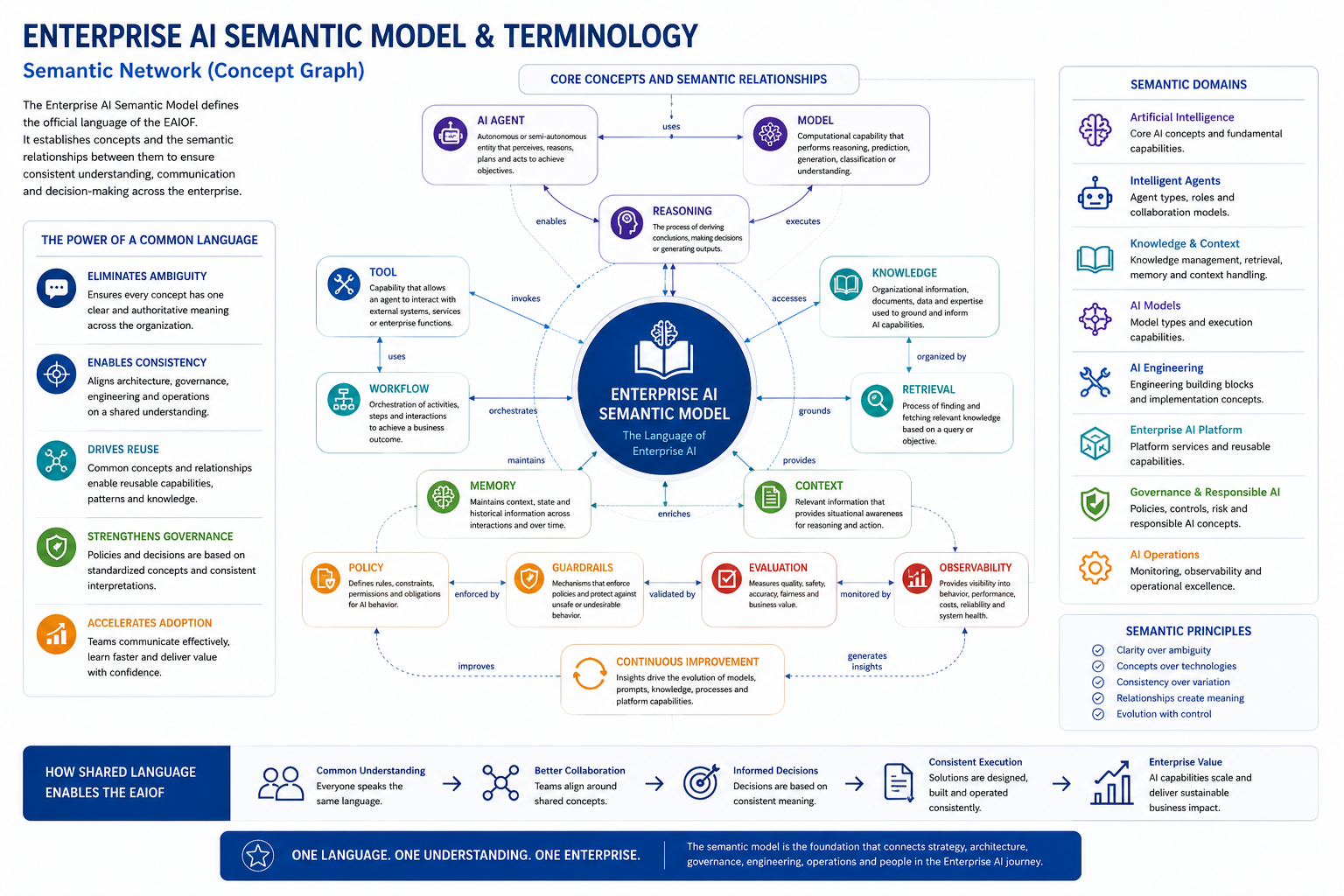
The Enterprise AI Operating Framework adopts a semantic model rather than a traditional glossary because Enterprise AI cannot be understood through isolated definitions alone. While a glossary provides individual descriptions for specific terms, a semantic model establishes the concepts that define a discipline and, more importantly, the relationships that exist between those concepts.
This distinction is fundamental.
Enterprise AI is not a collection of independent technologies or architectural components. It is an interconnected system of concepts that collectively describe how intelligent capabilities operate within the enterprise. Understanding each concept individually is necessary, but it is not sufficient. Meaning emerges from the relationships between concepts, just as enterprise architecture emerges from the relationships between business capabilities, applications, information, and technology rather than from any individual component in isolation.
For this reason, the Enterprise AI Semantic Model establishes both the meaning of Enterprise AI concepts and the semantic relationships that connect them into a coherent conceptual framework.
Consider the concept of an AI Agent.
An Agent cannot be fully understood as an isolated definition. Its behavior and architectural role depend upon several other concepts within the Enterprise AI ecosystem.
An Agent reasons by using one or more Models.
It extends its capabilities by invoking Tools that allow it to interact with enterprise systems and external services.
It performs informed reasoning by accessing organizational Knowledge, which provides the business context required for enterprise-specific decisions.
That knowledge is made available through Retrieval capabilities, which identify the information most relevant to the Agent's objective.
Retrieval mechanisms rely upon Embeddings that represent enterprise knowledge in a form suitable for semantic search and similarity matching.
Those embeddings are managed within the Vector Platform, which enables efficient retrieval across large volumes of organizational knowledge.
Agents frequently participate in broader Workflows, collaborating with people, applications, and other intelligent systems to accomplish business objectives.
These workflows operate according to enterprise Policies, which define the organizational rules, responsibilities, and decision boundaries that govern intelligent behavior.
Policies are implemented through Guardrails, ensuring that intelligent systems operate within approved business, security, ethical, regulatory, and operational constraints.
The execution of these capabilities generates Observability, providing visibility into system behavior, performance, quality, costs, reliability, and operational outcomes.
Observability, in turn, provides the evidence required for Evaluation, enabling the organization to measure the effectiveness, quality, trustworthiness, and business impact of Enterprise AI capabilities.
The results of evaluation drive Continuous Improvement, allowing models, prompts, knowledge, engineering practices, governance mechanisms, and platform capabilities to evolve based on objective evidence and operational experience.
This example illustrates an essential characteristic of Enterprise AI.
No concept exists independently.
Every concept derives part of its meaning from its relationship with other concepts within the enterprise ecosystem.
Models support Agents.
Agents consume Knowledge.
Knowledge is accessed through Retrieval.
Retrieval depends upon semantic representations.
Policies constrain intelligent behavior.
Guardrails operationalize governance.
Observability provides operational evidence.
Evaluation transforms evidence into organizational learning.
Continuous Improvement strengthens every capability across the Enterprise AI ecosystem.
Together, these relationships form a coherent conceptual network rather than a collection of independent definitions.
The Enterprise AI Semantic Model captures this network explicitly.
It establishes the concepts that define Enterprise AI.
It describes the semantic relationships that connect those concepts.
It clarifies how individual capabilities interact throughout the enterprise.
It provides a shared conceptual structure upon which architecture, governance, engineering, operations, platform capabilities, and organizational knowledge are consistently built.
This semantic structure serves as the conceptual map of the Enterprise AI Operating Framework.
Just as an architectural blueprint enables engineers to understand how structural components work together to create a complete building, the semantic model enables architects, engineers, governance teams, business stakeholders, and executive leadership to understand how Enterprise AI concepts interact to create a coherent organizational capability.
Every subsequent domain of the Enterprise AI Operating Framework relies upon this conceptual map.
Architectural models describe relationships already established within the semantic model.
Governance policies regulate concepts that have been semantically defined.
Platform capabilities implement relationships described by the model.
Engineering practices operationalize these concepts through software and infrastructure.
Operational processes monitor and continuously improve the behavior of the ecosystem as a whole.
For this reason, the Enterprise AI Semantic Model should not be viewed as documentation or a glossary of technical terminology.
It is the conceptual architecture of Enterprise AI.
It defines not only what the enterprise understands, but also how that understanding is organized into a coherent system of interconnected concepts. By providing this shared conceptual structure, the semantic model enables every subsequent component of the Enterprise AI Operating Framework to describe, design, govern, engineer, operate, and continuously evolve Artificial Intelligence with semantic consistency across the entire organization.
A Controlled Enterprise Vocabulary
A shared semantic model establishes the conceptual foundation of Enterprise AI. To ensure that this foundation is applied consistently throughout the organization, the Enterprise AI Operating Framework defines an official controlled enterprise vocabulary.
A controlled vocabulary is more than a standardized list of approved terms. It is a governance mechanism that ensures every concept defined within the Enterprise AI Semantic Model is described using consistent terminology across the entire organization. By establishing a single authoritative vocabulary, the framework eliminates ambiguity, reduces semantic variation, and enables Enterprise AI to be discussed, designed, governed, and implemented using a common language.
This distinction is particularly important in large enterprises, where multiple business units, technology teams, and governance functions collaborate on Artificial Intelligence initiatives. Without a controlled vocabulary, different teams naturally introduce alternative names for the same concept or use the same term to describe different capabilities. Over time, this inconsistency spreads across documentation, architecture, engineering standards, governance policies, training materials, and implementation guidance, making communication increasingly difficult and reducing the organization's ability to reuse knowledge effectively.
The Enterprise AI Operating Framework addresses this challenge by establishing a controlled vocabulary as the official language of Enterprise AI within the organization.
Every concept defined by the EAIOF is associated with a preferred enterprise term. Where alternative names, vendor-specific terminology, industry expressions, or commonly used synonyms exist, the framework identifies them while clearly defining the authoritative term that should be used in official enterprise communication. This approach preserves compatibility with external terminology while maintaining internal consistency.
The controlled vocabulary applies across the entire Enterprise AI lifecycle.
Enterprise strategies describe capabilities using standardized terminology.
Architectural documentation references common enterprise concepts.
Engineering standards define implementation guidance using consistent language.
Governance policies regulate capabilities that are semantically defined and universally understood.
Platform documentation describes reusable services using the same conceptual model.
Operational procedures, training materials, reference implementations, and organizational knowledge all reinforce the same enterprise vocabulary.
This consistency enables more effective collaboration across organizational boundaries.
Business stakeholders communicate requirements using terminology that architects and engineers interpret consistently.
Enterprise architects develop reference models using concepts that governance teams can evaluate objectively.
Solution architects and engineering teams implement capabilities that align with the organization's semantic model.
AI engineers, software engineers, and data specialists collaborate using a shared conceptual language rather than project-specific terminology.
Security, risk, and compliance teams evaluate Enterprise AI solutions according to standardized definitions rather than individual interpretations.
Operations teams monitor and support capabilities whose meaning is consistently understood throughout the enterprise.
Executive leadership discusses Enterprise AI strategy using the same language that guides architecture, governance, engineering, and operations.
The controlled vocabulary therefore becomes much more than a documentation standard.
It becomes one of the organization's most valuable knowledge assets.
It preserves semantic consistency across projects.
It enables architectural consistency across business domains.
It improves governance by ensuring that policies and standards refer to clearly defined concepts.
It accelerates engineering by reducing misunderstandings during design and implementation.
It strengthens organizational learning by enabling knowledge to be shared without semantic ambiguity.
Most importantly, it allows Enterprise AI to scale without losing conceptual coherence.
As the Enterprise AI Operating Framework continues to evolve, new concepts, capabilities, and technologies will inevitably emerge. The controlled vocabulary provides the governance mechanism through which these additions are evaluated, defined, and incorporated into the enterprise language without compromising the consistency of the existing semantic model. In this way, the vocabulary evolves together with the framework while preserving a single, authoritative language for the organization.
For this reason, the controlled enterprise vocabulary should not be viewed as a glossary maintained for documentation purposes. It is a strategic organizational capability that enables every stakeholder to communicate, design, govern, engineer, operate, and continuously evolve Enterprise AI using a common language. By institutionalizing semantic consistency across the enterprise, the controlled vocabulary transforms language itself into an enterprise asset that supports the long-term success of the Enterprise AI Operating Framework.
Technology-Neutral Terminology
One of the fundamental design principles of the Enterprise AI Operating Framework is technology neutrality. The framework is intentionally designed to remain independent of specific vendors, products, implementation frameworks, and technology ecosystems, ensuring that its conceptual foundations remain stable despite the continuous evolution of Artificial Intelligence.
This principle begins with language.
The terminology defined by the Enterprise AI Semantic Model is based on enduring enterprise concepts rather than on the technologies currently used to implement them. Definitions describe what a concept is and the role it plays within the Enterprise AI ecosystem, not how a particular product or framework implements it.
This distinction is essential because technologies evolve continuously, whereas enterprise concepts evolve much more gradually.
Throughout the history of enterprise technology, products have been introduced, matured, and eventually replaced by new generations of solutions. Programming languages have evolved. Databases have changed. Integration platforms have transitioned from Enterprise Service Buses to APIs and event-driven architectures. Cloud platforms have transformed infrastructure. Artificial Intelligence is following the same pattern, with foundation models, orchestration frameworks, vector platforms, and agent runtimes advancing at an unprecedented pace.
If the semantic model of the Enterprise AI Operating Framework were defined in terms of today's technologies, it would become obsolete each time the technology landscape evolved.
The EAIOF deliberately avoids this dependency.
Enterprise concepts are defined independently of their implementations.
An AI Agent is not defined by a particular orchestration framework. Whether an organization implements agents using LangGraph, Semantic Kernel, CrewAI, custom runtimes, or future technologies, the underlying concept of an Agent remains unchanged.
A Tool is not defined by a specific interoperability protocol. It represents a capability that enables an intelligent system to interact with external services, enterprise applications, or operational functions, regardless of whether that interaction is implemented through the Model Context Protocol (MCP), REST APIs, event-driven mechanisms, direct integrations, or technologies that may emerge in the future.
A Vector Platform is not defined by a particular database product. It represents the enterprise capability responsible for storing, indexing, and retrieving semantic representations of organizational knowledge, independent of whether that capability is implemented using pgvector, dedicated vector databases, cloud-native services, or future storage technologies.
Similarly, a Model is not defined by GPT, Claude, Gemini, Llama, Mistral, or any other specific implementation. It represents the execution capability through which intelligent reasoning, prediction, generation, classification, or decision support is performed. Individual models may evolve continuously, but the enterprise concept of a Model remains stable.
This separation between concepts and implementations provides significant strategic advantages.
Enterprise knowledge remains stable even as technologies evolve.
Architectural guidance remains relevant despite changes in vendors or platforms.
Governance policies continue to apply because they regulate enterprise capabilities rather than individual products.
Engineering standards remain consistent while allowing implementation technologies to evolve.
Training materials continue to teach enduring concepts rather than transient technical details.
Organizational knowledge becomes reusable across multiple generations of technology.
This approach also enables the Enterprise AI Operating Framework to accommodate innovation without requiring its conceptual foundations to be redesigned. New technologies can be incorporated by mapping them to existing enterprise concepts rather than introducing entirely new semantic structures. As the Artificial Intelligence ecosystem evolves, the framework expands through refinement rather than reinvention.
Technology neutrality should therefore not be interpreted as an avoidance of technology. On the contrary, the EAIOF fully embraces technological innovation. What it deliberately avoids is allowing the organization's conceptual understanding of Enterprise AI to become dependent upon any specific implementation.
The framework recognizes that technologies are implementation choices.
Enterprise concepts are organizational knowledge.
Technologies enable capabilities.
Concepts define capabilities.
Technologies evolve according to market innovation.
Concepts evolve according to organizational understanding.
This distinction lies at the heart of the Enterprise AI Operating Framework.
By separating enduring semantic concepts from continuously evolving implementation technologies, the EAIOF establishes a stable conceptual foundation capable of supporting successive generations of Artificial Intelligence without sacrificing architectural consistency, governance maturity, or organizational coherence. In doing so, it ensures that the language of Enterprise AI remains relevant for many years, regardless of how rapidly the technology landscape continues to evolve.
Terminology as an Architectural Contract
Within the Enterprise AI Operating Framework, terminology serves a purpose that extends far beyond communication. Every definition established by the Enterprise AI Semantic Model represents a formal architectural commitment that provides stability, consistency, and traceability across the entire framework.
For this reason, semantic definitions should be regarded as architectural contracts.
An architectural contract establishes a common understanding that every stakeholder can rely upon when designing, governing, implementing, operating, or evolving Enterprise AI capabilities. It ensures that concepts maintain a single authoritative meaning throughout the enterprise, allowing architectural decisions to remain consistent regardless of organizational boundaries, implementation technologies, or individual project interpretations.
This distinction is fundamental.
When an architect references an AI Agent, every stakeholder should understand exactly the same architectural concept.
When governance policies regulate Autonomous Decision-Making, they should rely upon the same semantic definition used by architects, engineers, security specialists, auditors, and business stakeholders.
When engineering teams implement Tools, Knowledge, Memory, or Workflows, they should be implementing the concepts defined by the Enterprise AI Semantic Model rather than project-specific interpretations.
Semantic consistency therefore becomes a prerequisite for architectural consistency.
Because the Enterprise AI Semantic Model establishes the official language of the Enterprise AI Operating Framework, every domain within the framework depends upon its definitions.
Architectural principles are expressed using standardized concepts.
Reference architectures describe capabilities according to the semantic model.
Platform specifications define reusable services using authoritative terminology.
Governance policies regulate concepts that have been formally defined.
Engineering standards reference common enterprise definitions.
Lifecycle processes describe activities using consistent language.
Operational procedures monitor and support capabilities whose meaning is universally understood.
Training materials educate the organization using the same conceptual foundation.
Reference implementations demonstrate architectures that are consistent with the enterprise semantic model.
This shared semantic foundation enables every artifact within the Enterprise AI Operating Framework to reinforce the same architectural understanding.
The implications of this approach extend beyond documentation.
A change to a semantic definition is not merely an editorial revision.
It may alter the interpretation of architectural principles.
It may affect governance policies and compliance requirements.
It may influence engineering standards and implementation guidance.
It may require updates to reference architectures, platform capabilities, operational procedures, lifecycle processes, training materials, and enterprise documentation.
It may even redefine the organizational understanding of an Enterprise AI capability.
For this reason, changes to the Enterprise AI Semantic Model should be managed with the same level of discipline applied to any other enterprise architectural asset.
Semantic definitions should be versioned.
Their evolution should be governed.
The rationale for change should be documented.
The impact on dependent artifacts should be assessed.
Affected domains should be reviewed for semantic consistency before changes are adopted across the enterprise.
This governance approach preserves the integrity of the Enterprise AI Operating Framework as it evolves.
As new concepts emerge, existing definitions mature, and Enterprise AI continues to develop, the semantic model can evolve without compromising architectural coherence. Every change becomes an intentional architectural decision rather than an uncontrolled modification of language.
Ultimately, the Enterprise AI Semantic Model establishes more than a common vocabulary.
It establishes a common architectural understanding.
Every definition becomes a stable reference upon which strategy, architecture, governance, engineering, operations, platform capabilities, and organizational knowledge are constructed.
For this reason, the terminology defined within this domain should be treated as an architectural contract shared by the entire enterprise. It provides the semantic stability that enables the Enterprise AI Operating Framework to evolve confidently while preserving consistency across every project, every capability, and every organizational function that contributes to Enterprise AI.
Standard Structure for Every Concept
Consistency is one of the fundamental objectives of the Enterprise AI Semantic Model. Achieving semantic consistency requires more than agreeing on the terminology used throughout the organization; it also requires every concept to be documented according to a common specification. Without a standardized structure, definitions naturally evolve with different levels of detail, inconsistent formats, and varying degrees of precision, making the semantic model increasingly difficult to govern and maintain.
For this reason, the Enterprise AI Operating Framework establishes a standard specification for every concept defined within the Enterprise AI Semantic Model.
This specification ensures that concepts are documented consistently regardless of their complexity or business domain. It also enables concepts to be compared, reviewed, versioned, governed, and evolved using a common documentation model that remains stable throughout the lifetime of the framework.
Every concept should therefore be described using the following structure.
1. Concept Name
The official enterprise name of the concept.
This is the authoritative term that should be used throughout the Enterprise AI Operating Framework. Alternative names, abbreviations, or vendor-specific terminology should not replace the official enterprise name.
2. Definition
A concise, precise, and technology-neutral definition.
The definition should explain what the concept is without describing implementation technologies, products, or vendor-specific approaches. Every definition should be sufficiently clear to eliminate ambiguity while remaining applicable as technologies evolve.
3. Purpose
The organizational purpose of the concept.
This section explains why the concept exists within the Enterprise AI ecosystem and the value it provides to the organization.
4. Responsibilities
The responsibilities associated with the concept.
This section defines the capabilities, behaviors, or functions that belong to the concept and clarifies its role within the Enterprise AI Operating Framework.
5. Characteristics
The defining characteristics of the concept.
These attributes distinguish the concept from related concepts and describe the properties that remain true regardless of implementation technology.
6. Relationships
The semantic relationships between the concept and other concepts within the Enterprise AI Semantic Model.
This section explains how the concept interacts with, depends upon, or contributes to other Enterprise AI capabilities, reinforcing the interconnected nature of the semantic model.
7. Examples
Representative examples that illustrate the concept in practical contexts.
Examples should clarify the meaning of the concept without becoming prescriptive implementation guidance. Where appropriate, examples may reference common industry practices, provided they do not become technology-specific definitions.
8. What It Is Not
Common misconceptions and concepts that are frequently confused with the current definition.
This section is particularly valuable because many Enterprise AI concepts are used inconsistently across the industry. Explicitly clarifying what a concept is not helps eliminate ambiguity and improves semantic precision throughout the organization.
9. Synonyms
Alternative terminology associated with the concept.
This section should identify:
- Accepted synonyms that may appear in industry literature or external documentation.
- Deprecated terms that should no longer be used within the organization.
- Ambiguous or discouraged expressions that should be avoided because they introduce semantic inconsistency.
The official enterprise term always takes precedence.
10. References
Cross-references to related Enterprise AI concepts and framework artifacts.
These references may include related semantic concepts, architectural models, capability definitions, governance principles, engineering patterns, lifecycle processes, reference implementations, or other domains of the Enterprise AI Operating Framework that expand upon the concept.
Optional Governance Metadata
As the Enterprise AI Semantic Model matures, organizations may choose to enrich each concept with governance metadata that supports lifecycle management and semantic governance.
Typical metadata includes:
- Version — The current approved version of the concept definition.
- Status — For example: Draft, Proposed, Approved, Deprecated, or Retired.
- Owner — The organizational role responsible for maintaining the definition.
- Last Updated — The most recent approved revision.
- Change History — A summary of significant semantic changes over time.
Although this metadata does not form part of the conceptual definition itself, it enables the semantic model to be governed as a living enterprise asset that evolves in a controlled and traceable manner.
By documenting every concept according to this standardized structure, the Enterprise AI Operating Framework establishes a consistent semantic specification that supports architectural precision, governance discipline, engineering consistency, and organizational learning. Every concept becomes easier to understand, easier to compare, easier to govern, and easier to evolve as Enterprise AI capabilities continue to mature.
This standardized specification also reinforces one of the central principles of the Enterprise AI Semantic Model: concepts should be treated as managed enterprise assets rather than isolated definitions. Consistency in the structure of those definitions is therefore as important as consistency in the terminology itself, ensuring that the semantic model remains coherent, maintainable, and authoritative throughout the continuous evolution of the Enterprise AI Operating Framework.
Categories of Enterprise AI Concepts
As the Enterprise AI Operating Framework evolves, the Enterprise AI Semantic Model will continuously expand to incorporate new concepts, capabilities, architectural patterns, governance mechanisms, engineering practices, and operational models. Over time, the semantic model is expected to contain a substantial number of interconnected concepts that collectively describe the Enterprise AI ecosystem.
Managing such a knowledge base requires more than defining individual concepts.
It requires organizing those concepts according to a coherent conceptual structure.
For this reason, the Enterprise AI Semantic Model is organized into a collection of Semantic Domains.
A Semantic Domain groups concepts that belong to the same area of knowledge and collectively describe a specific aspect of Enterprise AI. This organization improves navigation, facilitates governance, simplifies maintenance, and enables the semantic model to evolve without losing conceptual coherence.
The objective of these domains is not to isolate concepts from one another. On the contrary, Enterprise AI concepts remain highly interconnected. The domains simply provide a logical structure that helps organize related concepts while preserving the semantic relationships that exist across the entire model.
This organization also supports the long-term evolution of the framework.
New concepts can be incorporated into existing domains without disrupting the overall semantic structure.
New domains can be introduced as Enterprise AI evolves.
Existing concepts can mature while preserving their relationships with the rest of the semantic model.
In this way, the Enterprise AI Semantic Model grows organically while maintaining a consistent and navigable knowledge structure.
Although the semantic model will continue to evolve, the Enterprise AI Operating Framework initially organizes its concepts into the following Semantic Domains.
Artificial Intelligence
This domain defines the fundamental concepts that describe Artificial Intelligence as a discipline. It includes concepts related to intelligent reasoning, learning, inference, planning, evaluation, and the different categories of AI that collectively form the conceptual foundation of Enterprise AI.
Representative concepts include:
- Artificial Intelligence
- Machine Learning
- Generative AI
- Agentic AI
- Reasoning
- Inference
- Planning
- Reflection
- Evaluation
Enterprise Architecture
This domain defines the enterprise-level concepts through which Artificial Intelligence is established as an organizational capability. It describes the strategic, architectural, and organizational structures that enable Enterprise AI to operate consistently across the enterprise.
Representative concepts include:
- Enterprise AI
- Enterprise AI Platform
- Enterprise AI Capability
- Enterprise AI Service
- Enterprise AI Operating Framework
- Business Capability
- Reference Architecture
- Operating Model
Intelligent Agents
This domain describes the concepts associated with autonomous and collaborative intelligent systems. It defines different types of agents, their responsibilities, collaboration models, and the architectural structures that support agent-based systems.
Representative concepts include:
- Assistant
- Copilot
- AI Agent
- Task Agent
- Planner Agent
- Supervisor Agent
- Coordinator Agent
- Executor Agent
- Evaluator Agent
- Multi-Agent System
- Swarm
- Digital Worker
AI Models
This domain defines the concepts associated with the models that provide intelligent execution capabilities. It includes different categories of models together with their respective roles within Enterprise AI architectures.
Representative concepts include:
- Foundation Model
- Large Language Model
- Embedding Model
- Vision Model
- Speech Model
- Reasoning Model
- Re-ranking Model
Knowledge & Context
This domain defines the concepts that enable Artificial Intelligence to access, interpret, manage, and utilize enterprise knowledge. It encompasses semantic retrieval, contextual information, memory, and knowledge management capabilities.
Representative concepts include:
- Knowledge Base
- Document
- Chunk
- Embedding
- Metadata
- Retrieval
- Grounding
- Retrieval-Augmented Generation (RAG)
- Semantic Search
- Hybrid Search
- Memory
- Context
Enterprise AI Platform
This domain describes the reusable platform capabilities that support Enterprise AI development and operations across the organization.
Representative concepts include:
- AI Gateway
- Prompt Management
- Agent Registry
- Model Registry
- Tool Registry
- Workflow Engine
- Knowledge Platform
- Memory Platform
- Guardrails
- Observability
- Evaluation
- Policy Engine
- Marketplace
AI Engineering
This domain defines the engineering concepts used to design, implement, integrate, and operate Enterprise AI solutions.
Representative concepts include:
- Prompt
- Prompt Template
- Workflow
- Skill
- Tool
- Action
- Function Calling
- MCP Server
- API
- Context Window
- Session
- Conversation
Governance & Responsible AI
This domain establishes the concepts associated with governance, organizational control, compliance, security, accountability, and responsible use of Artificial Intelligence.
Representative concepts include:
- Policy
- Compliance
- Audit
- Responsible AI
- Human-in-the-Loop
- Approval
- Risk
- Security
- Identity
- Least Privilege
AI Operations
This domain defines the operational concepts required to deploy, monitor, support, evaluate, and continuously improve Enterprise AI capabilities operating in production environments.
Representative concepts include:
- Monitoring
- Tracing
- Metrics
- Benchmark
- Latency
- Availability
- Incident
- Rollback
- Version
- Deployment
These Semantic Domains provide the primary organizational structure of the Enterprise AI Semantic Model. They should not be interpreted as isolated knowledge areas, but as complementary perspectives of a single conceptual ecosystem. Concepts defined within one domain frequently relate to concepts defined in others, forming a rich semantic network that reflects the interconnected nature of Enterprise AI.
As the Enterprise AI Operating Framework continues to mature, additional domains and concepts will naturally emerge. The semantic structure has therefore been intentionally designed to be extensible, allowing the Enterprise AI Semantic Model to evolve alongside the discipline of Artificial Intelligence while preserving conceptual consistency, semantic precision, and architectural coherence across the entire framework.
A Living Enterprise Vocabulary
The language of Enterprise AI is not static.
Artificial Intelligence continues to evolve at an unprecedented pace. New architectural paradigms emerge, new engineering practices become established, new platform capabilities are introduced, and new forms of intelligent systems continuously reshape the discipline. As Enterprise AI matures, the vocabulary used to describe it inevitably evolves as well.
This evolution presents an important organizational challenge.
A semantic model that never changes will gradually lose relevance as the discipline advances.
Conversely, a semantic model that changes without governance quickly loses consistency, creating ambiguity, reducing architectural precision, and weakening the shared language upon which the enterprise depends.
The objective of the Enterprise AI Operating Framework is therefore not to preserve terminology unchanged.
Its objective is to preserve semantic consistency while allowing the enterprise language to evolve in a controlled and traceable manner.
For this reason, the Enterprise AI Semantic Model is intentionally designed as a living enterprise knowledge asset.
Like every strategic enterprise asset, the semantic model has its own lifecycle.
New concepts are introduced as the organization adopts new Enterprise AI capabilities.
Existing concepts evolve as organizational understanding matures and industry practices become better established.
Relationships between concepts may be refined to reflect advances in architecture, governance, engineering, and operational models.
Obsolete concepts may eventually be deprecated as the discipline evolves, while remaining documented to preserve historical continuity and ensure that legacy documentation, architectural decisions, and reference implementations remain understandable.
This continuous evolution should never occur informally.
Every change to the Enterprise AI Semantic Model represents a change to the conceptual language of the organization and therefore has the potential to influence architecture, governance, engineering standards, operational procedures, platform capabilities, training materials, and organizational knowledge.
For this reason, semantic evolution should be governed with the same level of discipline applied to any other enterprise architectural asset.
New concepts should be proposed through a formal governance process.
Definitions should be reviewed for semantic clarity, conceptual consistency, and architectural alignment before approval.
Changes to existing concepts should be versioned, documented, and evaluated for their impact on dependent artifacts throughout the Enterprise AI Operating Framework.
Deprecated terminology should remain part of the historical record, clearly identified as superseded, ensuring that previous versions of the framework and earlier architectural decisions remain interpretable over time.
This governance process ensures that the enterprise language evolves deliberately rather than reactively.
At the same time, it enables the Enterprise AI Operating Framework to incorporate innovation without compromising its conceptual integrity.
Emerging technologies can be represented through new or refined concepts.
Advances in Enterprise AI can enrich the semantic model.
New architectural patterns can be described using the existing conceptual structure.
The vocabulary grows together with the framework while preserving the consistency required for enterprise-wide communication.
This balance between stability and evolution is one of the defining characteristics of the Enterprise AI Operating Framework.
The framework does not seek to freeze the language of Artificial Intelligence at a particular moment in time.
Instead, it establishes a governance model that allows the language itself to mature alongside the discipline it describes.
As Enterprise AI continues to evolve, the Enterprise AI Semantic Model evolves with it, preserving the continuity of organizational knowledge while continuously expanding the enterprise's conceptual understanding.
For this reason, the Enterprise AI Semantic Model should not be regarded as a glossary that is periodically updated.
It should be understood as a living enterprise knowledge asset whose purpose is to preserve the semantic integrity of the Enterprise AI Operating Framework throughout its continuous evolution.
By governing the evolution of its language with the same discipline applied to architecture, engineering, and governance, the EAIOF ensures that its conceptual foundations remain stable, authoritative, and relevant, enabling the organization to embrace innovation without sacrificing the clarity, consistency, and shared understanding upon which successful Enterprise AI depends.
The Semantic Model as the Language of Enterprise AI
The Enterprise AI Semantic Model provides far more than a collection of definitions. It establishes the conceptual language through which the entire Enterprise AI Operating Framework is understood, communicated, governed, engineered, implemented, and continuously evolved.
Every domain of the EAIOF relies upon this shared semantic foundation.
Strategies describe Enterprise AI using concepts whose meaning has been formally established.
Architectures define enterprise capabilities according to standardized semantic definitions.
Governance policies regulate concepts that are consistently understood across the organization.
Engineering practices implement capabilities whose responsibilities and relationships have been precisely defined.
Operational models monitor and support enterprise capabilities using a common conceptual framework.
Training materials educate the workforce through a shared enterprise language.
Reference implementations demonstrate architectures built upon the same semantic foundation.
This common language enables every stakeholder—regardless of organizational role or technical specialization—to reason about Enterprise AI using the same concepts and the same understanding.
The value of the semantic model therefore extends well beyond communication.
It provides the conceptual consistency required for enterprise architecture.
It enables governance to regulate clearly defined capabilities rather than ambiguous terminology.
It allows engineering standards to reference stable concepts instead of project-specific interpretations.
It ensures that operational procedures describe capabilities that are universally understood.
It transforms organizational knowledge into a reusable enterprise asset by preserving a single authoritative interpretation of Enterprise AI concepts.
Every subsequent domain of the Enterprise AI Operating Framework builds upon this semantic foundation.
The Enterprise AI Taxonomy organizes these concepts into a structured knowledge hierarchy.
The Enterprise AI Principles establish how these concepts should guide architectural and organizational decision-making.
The Enterprise AI Reference Models describe how the concepts interact to form a coherent Enterprise AI ecosystem.
The Enterprise AI Patterns demonstrate how these concepts are realized through reusable architectural and engineering solutions.
The Enterprise AI Platform Capabilities operationalize these concepts by providing the technical services that enable Enterprise AI across the organization.
Governance, Engineering, Operations, Adoption, and every other domain of the EAIOF continue this progression, each expanding upon the conceptual language established by the Enterprise AI Semantic Model.
This dependency is intentional.
Enterprise Architecture depends upon a common conceptual language.
Governance depends upon common conceptual definitions.
Engineering depends upon common conceptual understanding.
Organizational learning depends upon common conceptual knowledge.
Without semantic consistency, architectural consistency cannot be achieved.
Without architectural consistency, enterprise reuse becomes difficult.
Without reuse, Enterprise AI cannot scale effectively across the organization.
For this reason, the Enterprise AI Semantic Model should not be viewed simply as a glossary or a documentation artifact.
It is the conceptual infrastructure of the Enterprise AI Operating Framework.
It defines the language through which every capability is described.
It provides the semantic precision upon which every architectural decision depends.
It preserves the consistency required for governance, engineering, operations, and organizational learning.
It enables the framework to evolve while maintaining a stable conceptual foundation.
Ultimately, the Enterprise AI Semantic Model transforms language into an enterprise capability.
By establishing a single, authoritative conceptual framework for Artificial Intelligence, it enables the entire organization to think, communicate, design, govern, engineer, and operate Enterprise AI with clarity, consistency, and shared understanding.
For this reason, the Enterprise AI Semantic Model should be regarded as one of the most strategic assets of the Enterprise AI Operating Framework. It is not simply the language of Enterprise AI—it is the conceptual foundation that allows the entire framework to function as a coherent, integrated, and continuously evolving enterprise capability.