Introduction
Every mature architectural discipline is founded on a set of principles that provide consistent direction for decision-making across the enterprise. Rather than prescribing specific technologies or implementation approaches, these principles establish enduring criteria that guide architectural evolution over time. They enable organizations to make coherent decisions despite changes in business priorities, organizational structures, technology landscapes, and market conditions.
This characteristic is evident across well-established disciplines. Enterprise Architecture defines principles that guide the evolution of the enterprise landscape. Software Engineering relies on engineering principles to promote maintainability, quality, and long-term sustainability. Cybersecurity establishes security principles that shape the protection of information assets, while Cloud Architecture defines design principles that support scalability, resilience, and operational efficiency. Although these disciplines evolve continuously, their underlying principles remain comparatively stable because they express fundamental architectural intentions rather than implementation choices.
Artificial Intelligence introduces a similar need for architectural discipline. However, the pace at which AI technologies evolve often encourages organizations to make decisions driven by the capabilities of the latest models, frameworks, or platforms instead of by long-term architectural objectives. New foundation models, orchestration techniques, development frameworks, and deployment approaches emerge at a rapid pace, creating an environment in which technology adoption can easily outpace architectural governance.
When architectural decisions become tightly coupled to the characteristics of specific technologies, enterprise AI environments tend to become fragmented. Different teams adopt different patterns, governance practices become inconsistent, solution interoperability declines, and the overall architecture becomes increasingly difficult to govern and evolve. Over time, this leads to unnecessary complexity, duplicated capabilities, increased operational risk, and reduced organizational agility.
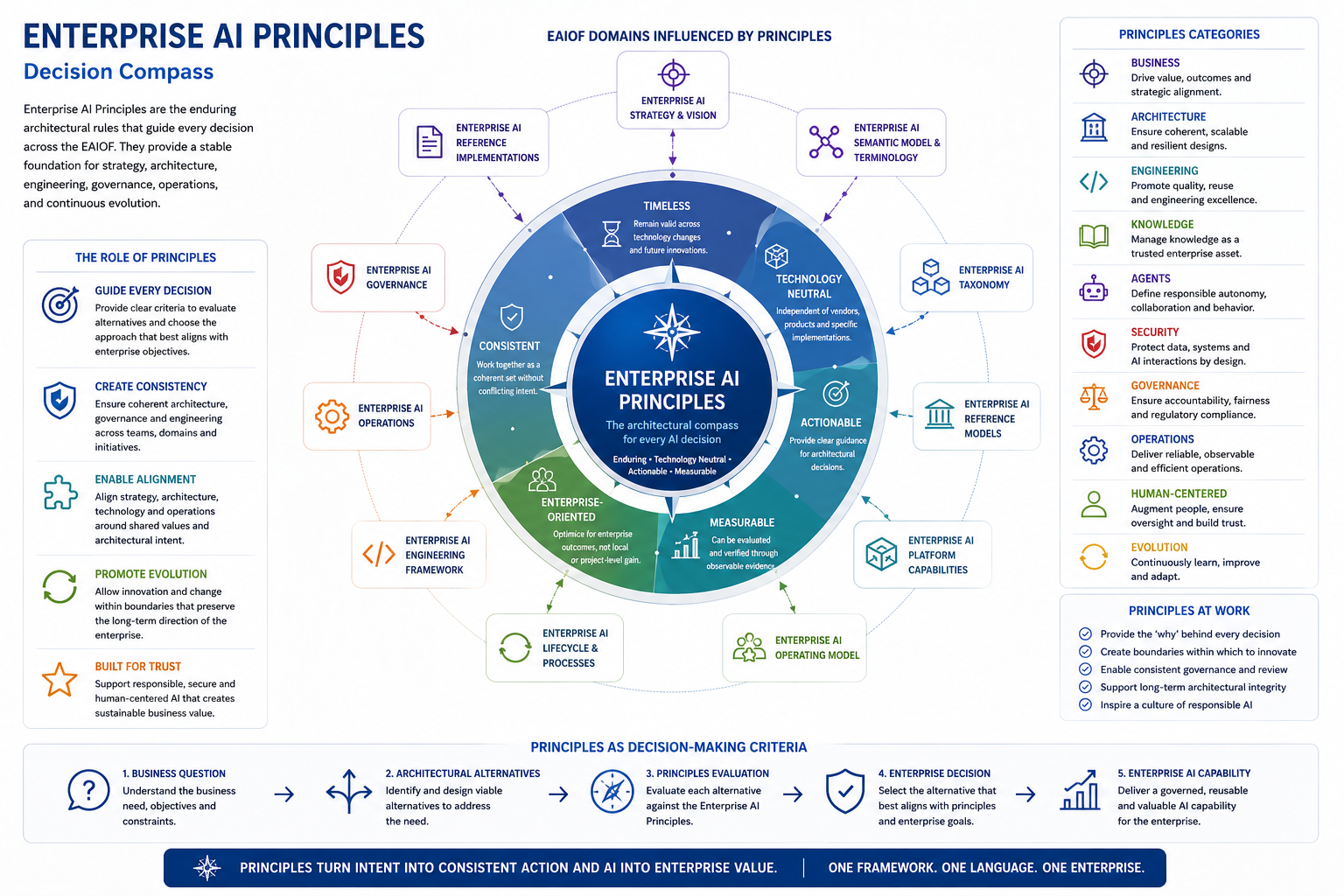
The Enterprise AI Operating Framework (EAIOF) addresses this challenge by defining a stable and technology-independent set of Enterprise AI Principles. These principles express the fundamental architectural beliefs upon which the framework is built and establish the decision-making foundation for every domain of the EAIOF. Rather than prescribing how individual technologies should be implemented, they define the characteristics that enterprise AI capabilities should exhibit regardless of future technological evolution.
Within the EAIOF, the Enterprise AI Principles provide a common architectural reference for the design, engineering, governance, operation, and continuous evolution of AI capabilities. They influence architectural decisions at every level of the organization, ensuring that individual initiatives contribute to a coherent enterprise-wide AI ecosystem rather than evolving as isolated implementations.
Consequently, every AI initiative developed under the EAIOF is expected to derive its architectural decisions from these principles. Enterprise AI capabilities should be designed in alignment with them, governance policies should reinforce them, engineering practices should operationalize them, and architecture reviews should evaluate their consistent application. In this way, the principles become a permanent decision framework that promotes consistency, sustainability, and architectural integrity across the entire AI landscape.
As one of the foundational domains of the EAIOF, the Enterprise AI Principles establish the architectural values that underpin the remainder of the framework. The domains presented throughout the EAIOF—including architecture, governance, engineering, platform capabilities, operating model, and organizational processes—should therefore be interpreted and applied through the perspective established by these principles, ensuring that the framework evolves as a coherent and unified discipline for enterprise-scale Artificial Intelligence.
What Is an Enterprise AI Principle?
Within the Enterprise AI Operating Framework (EAIOF), an Enterprise AI Principle is a fundamental architectural rule that guides decision-making across the organization. It represents a long-term statement of architectural intent that defines how Artificial Intelligence capabilities should be conceived, designed, governed, implemented, operated, and evolved. Unlike implementation guidance, which may change as technologies mature, principles establish a stable foundation that remains applicable regardless of changes in platforms, tools, methodologies, or organizational structures.
It is important to distinguish principles from other forms of architectural guidance. A principle is not a recommendation that may be applied selectively according to individual preferences, nor is it a guideline that provides optional direction for specific situations. Likewise, it should not be confused with a best practice. Best practices typically emerge from accumulated implementation experience and may evolve as technologies, market conditions, and industry standards change. Principles, by contrast, exist at a higher level of abstraction. They express the enduring architectural values that should consistently influence enterprise decisions over time.
This distinction is particularly important in the context of Artificial Intelligence. The AI ecosystem evolves at an exceptional pace, with continuous advances in models, orchestration approaches, development frameworks, infrastructure capabilities, and deployment patterns. While these innovations expand the range of available implementation options, they do not alter the architectural objectives that an enterprise seeks to achieve. Consequently, architectural principles provide continuity amid technological change, ensuring that short-term implementation decisions remain aligned with long-term organizational strategy.
Within the EAIOF, Enterprise AI Principles function as permanent decision-making criteria. Whenever architects, engineers, governance teams, or business stakeholders must choose between alternative designs, technologies, operating models, or implementation strategies, those alternatives should be evaluated against the principles established by the framework. Rather than determining a single technical solution, the principles provide a consistent basis for assessing whether a proposed approach supports the architectural direction defined by the organization.
This decision-making role extends across the entire AI lifecycle. Enterprise AI Principles influence strategic planning, solution architecture, platform design, governance policies, engineering practices, operational procedures, and continuous improvement initiatives. By serving as a common reference for these activities, they promote consistency across projects, reduce architectural fragmentation, and enable independent teams to make autonomous decisions while remaining aligned with the enterprise's overall AI strategy.
Ultimately, an Enterprise AI Principle is not intended to prescribe implementation details, but to establish the architectural boundaries within which implementation decisions should be made. As technologies continue to evolve, these principles provide the stability necessary for organizations to build AI capabilities that remain coherent, governable, and sustainable over the long term, ensuring that the evolution of individual solutions contributes to the evolution of a unified Enterprise AI architecture.
Principles as Architectural Governance
Within the Enterprise AI Operating Framework (EAIOF), Enterprise AI Principles represent the highest level of architectural governance. They establish the fundamental rules that shape every subsequent architectural, organizational, and technical decision within the framework. Rather than addressing individual implementation concerns, the principles define the architectural direction that all other domains of the EAIOF are expected to follow.
This governance role places principles at the foundation of the framework's decision hierarchy. Every architectural artifact, governance mechanism, operational process, and engineering practice should ultimately be traceable to one or more Enterprise AI Principles. In this way, the principles provide a common reference that ensures consistency across initiatives, regardless of the teams involved, the technologies adopted, or the specific business domains in which AI capabilities are implemented.
Because they operate at the highest level of abstraction, Enterprise AI Principles influence a broad range of organizational and architectural concerns. They guide the definition of enterprise AI strategy by establishing the characteristics that AI initiatives should exhibit over time. They shape the Enterprise AI Reference Architecture by defining the architectural qualities that reference models and architectural patterns must support. They also influence the capabilities provided by the Enterprise AI Platform, ensuring that shared services are developed in alignment with the long-term objectives of the organization.
The influence of the principles extends equally to engineering and operational disciplines. Engineering standards, lifecycle processes, operating models, governance policies, security controls, operational procedures, and reference implementations should all be designed to reinforce the architectural intent expressed by the principles. Although these artifacts exist at different levels of abstraction and serve different purposes, they collectively operationalize the same architectural foundation established by the EAIOF.
This hierarchical relationship is essential for maintaining architectural coherence as the organization evolves. Individual implementation decisions may change in response to new technologies, emerging business requirements, or operational experience. However, because those decisions are constrained by a stable set of Enterprise AI Principles, the overall architecture remains consistent and aligned with the enterprise's long-term objectives.
By positioning Enterprise AI Principles as the foundation of architectural governance, the EAIOF ensures that governance is not limited to compliance activities or design reviews. Instead, governance becomes an architectural discipline that continuously aligns strategy, architecture, engineering, operations, and organizational practices around a shared set of enduring principles. This approach enables organizations to evolve their AI capabilities while preserving consistency, reducing fragmentation, and maintaining a sustainable enterprise architecture over time.
Characteristics of Effective Principles
Not every architectural statement qualifies as an effective principle. To fulfill their role within the Enterprise AI Operating Framework (EAIOF), Enterprise AI Principles must possess characteristics that enable them to provide meaningful and enduring guidance across the organization. Principles that are overly specific, dependent on current technologies, or limited to individual projects quickly lose their relevance and fail to provide the stable foundation required for enterprise-scale architectural governance.
An effective Enterprise AI Principle should first be timeless. Its validity should extend well beyond the lifecycle of any particular technology, implementation approach, or organizational initiative. While AI technologies continue to evolve at a rapid pace, the architectural intent expressed by a principle should remain applicable for many years, providing continuity as the enterprise adapts to changing business and technological environments.
Enterprise AI Principles should also be technology neutral. They should define the architectural qualities that an organization seeks to achieve without prescribing specific products, vendors, platforms, programming languages, or implementation frameworks. This technology independence allows the principles to remain relevant as the technology landscape evolves and enables organizations to adopt new capabilities without requiring fundamental changes to their architectural foundation.
A principle must also be actionable. Its purpose is not merely to describe desirable characteristics, but to influence real architectural decisions. When multiple implementation alternatives exist, the principle should provide clear direction for evaluating those alternatives and selecting the approach that best aligns with the enterprise's architectural objectives. A principle that cannot meaningfully influence decision-making offers limited value as a governance instrument.
Whenever practical, Enterprise AI Principles should be measurable. Although some architectural concepts are inherently qualitative, organizations should seek to define observable evidence that demonstrates whether a principle has been applied consistently. This enables architecture reviews, governance assessments, and continuous improvement activities to evaluate compliance based on objective criteria rather than subjective interpretation.
Effective principles must also be enterprise-oriented. Their primary objective is to maximize long-term value for the organization as a whole rather than optimize individual projects, departments, or short-term initiatives. Decisions that appear beneficial from a local perspective may introduce fragmentation, duplication, or governance challenges at the enterprise level. Enterprise AI Principles therefore encourage architectural decisions that strengthen the overall AI ecosystem, even when they require local trade-offs.
Finally, the complete set of Enterprise AI Principles should be internally consistent. Principles should complement and reinforce one another rather than introduce conflicting architectural objectives. Because they collectively define the architectural philosophy of the EAIOF, they must operate as an integrated system of governance. Consistency among principles enables architects, engineers, and governance teams to apply them coherently across diverse initiatives without creating ambiguity or competing priorities.
Together, these characteristics ensure that Enterprise AI Principles serve as reliable and durable instruments of architectural governance. They enable the principles to guide strategic planning, architecture, engineering, governance, and operational decision-making in a consistent manner, while preserving the flexibility necessary for organizations to adopt new technologies and continuously evolve their Enterprise AI capabilities.
Standard Structure for Every Principle
To ensure consistency across the Enterprise AI Operating Framework (EAIOF), every Enterprise AI Principle should be documented using a common structure. A standardized format improves readability, facilitates governance, and enables principles to be interpreted and applied consistently by architects, engineers, governance teams, and business stakeholders. It also reinforces the role of the principles as formal architectural assets rather than informal guidance.
The use of a common structure is particularly important in large organizations, where principles are referenced by multiple disciplines throughout the AI lifecycle. When every principle follows the same documentation model, architecture reviews become more consistent, governance activities become more objective, and the rationale behind architectural decisions becomes easier to understand and communicate. Furthermore, a standardized representation simplifies the evolution of the framework by ensuring that new principles can be introduced without changing the overall governance model.
Within the EAIOF, each Enterprise AI Principle should include the following sections.
Principle Name
The principle should begin with a concise and descriptive name that clearly identifies its architectural intent. The name should be sufficiently precise to distinguish the principle from others while remaining stable over time. Consistent naming also facilitates cross-referencing throughout the framework and supports its adoption as a common architectural vocabulary.
Statement
The statement is the authoritative expression of the principle. It should clearly define the architectural rule that the organization expects to be followed, using language that is precise, unambiguous, and independent of specific technologies or implementation approaches. This statement serves as the primary reference during architectural decision-making and governance activities.
Rationale
The rationale explains why the principle exists. It describes the organizational or architectural problem that the principle addresses, the reasoning behind its adoption, and the value it creates for the enterprise. By documenting the underlying motivation, the rationale helps stakeholders understand not only what the principle requires, but also why adherence to it is important. This shared understanding promotes more informed architectural decisions and reduces the risk of treating principles as arbitrary constraints.
Implications
Every principle has practical consequences for the way Enterprise AI capabilities are designed, implemented, governed, and operated. The implications section identifies these consequences by describing how the principle influences architectural decisions, engineering practices, operational processes, and governance activities. Rather than prescribing detailed implementation guidance, this section clarifies the organizational responsibilities and architectural considerations that naturally arise from adopting the principle.
Examples
Representative examples may be included to illustrate how the principle can be applied in practice. These examples should remain concise, technology-neutral whenever possible, and focused on clarifying the architectural intent rather than demonstrating specific implementations. Their purpose is to improve understanding without constraining future design choices.
Anti-Patterns
Documenting common violations is an effective way to reinforce the correct interpretation of a principle. This section describes implementation approaches, architectural decisions, or governance practices that conflict with the principle and explains why they should be avoided. By highlighting typical mistakes and architectural anti-patterns, the framework helps organizations recognize situations that may compromise the long-term integrity of their Enterprise AI architecture.
Related Principles
Enterprise AI Principles should not be interpreted in isolation. Many architectural decisions involve multiple principles that complement and reinforce one another. This section identifies those relationships, enabling readers to understand how individual principles contribute to a broader architectural philosophy. Cross-referencing also emphasizes that the principles collectively form an integrated system of governance rather than a collection of independent rules.
By adopting this standardized structure, the EAIOF establishes a consistent method for documenting and maintaining its architectural principles. Each principle becomes a complete governance artifact that not only defines an architectural rule but also explains its purpose, clarifies its organizational impact, illustrates its application, and positions it within the broader system of Enterprise AI governance defined by the framework.
Categories of Enterprise AI Principles
Enterprise AI Principles address a broad range of architectural, organizational, engineering, and operational concerns. A single set of undifferentiated principles would be difficult to govern and would provide limited support for the diverse decisions that arise throughout the lifecycle of Enterprise AI capabilities. For this reason, the Enterprise AI Operating Framework (EAIOF) organizes its principles into a number of complementary categories, each focusing on a distinct aspect of enterprise-wide AI adoption.
These categories do not represent isolated domains of governance. On the contrary, they form an integrated system in which principles from different categories collectively influence architectural decisions. A single initiative may simultaneously apply business, architectural, engineering, security, governance, and operational principles, ensuring that decisions remain balanced across multiple organizational perspectives.
The categorization of principles also improves the usability of the framework. It enables architects, engineers, governance teams, and business leaders to identify the principles that are most relevant to a particular decision while maintaining visibility of the broader architectural context. More importantly, it reinforces the idea that successful Enterprise AI adoption requires coordinated governance across the entire organization rather than optimization within individual disciplines.
The EAIOF groups Enterprise AI Principles into the following categories.
Business Principles
Business Principles ensure that Artificial Intelligence remains aligned with the strategic objectives of the organization. They establish that AI initiatives exist to create measurable business value rather than to promote the adoption of technology for its own sake. These principles influence investment decisions, portfolio management, business prioritization, and value realization by ensuring that Enterprise AI capabilities are continuously evaluated according to the outcomes they generate for the organization.
Representative principles within this category include Business Value First, Outcome Before Technology, Business Capability Driven, Customer-Centric AI, Enterprise Reuse Before Project Optimization, Continuous Value Measurement, and Business Accountability.
Architectural Principles
Architectural Principles define the structural characteristics that should govern the Enterprise AI ecosystem. They guide the design of enterprise architectures that are modular, interoperable, scalable, resilient, and capable of evolving over time. These principles provide the architectural foundation upon which Enterprise AI platforms, services, and solutions are constructed, ensuring that local implementation decisions contribute to a coherent enterprise-wide architecture.
Representative principles include AI as an Enterprise Capability, Platform First, Service-Oriented AI, Model Agnostic, Provider Agnostic, API First, Composable Architecture, Loose Coupling, Separation of Concerns, Scalability by Design, and Evolutionary Architecture.
Engineering Principles
Engineering Principles establish how Enterprise AI solutions should be implemented throughout the software development lifecycle. They promote engineering practices that improve quality, maintainability, repeatability, and operational readiness while encouraging automation and continuous validation. These principles translate architectural intent into engineering discipline without prescribing specific technologies or development methodologies.
Representative principles include Prompt as Code, Knowledge as Product, Configuration over Customization, Reuse Before Build, Test Before Release, Automation by Default, Documentation as Code, and Continuous Evaluation.
Knowledge Principles
Knowledge is one of the most valuable assets within an Enterprise AI ecosystem. Knowledge Principles govern the way organizational knowledge is created, managed, maintained, and consumed by AI capabilities. Their objective is to ensure that AI systems rely on trusted, well-governed, and traceable sources of information, thereby improving reliability, explainability, and long-term sustainability.
Representative principles include Knowledge Before Generation, Trusted Knowledge Sources, Knowledge Ownership, Knowledge Lifecycle Management, Metadata First, Quality over Quantity, and Knowledge Traceability.
Agent Principles
As autonomous and semi-autonomous AI agents become increasingly common within enterprise environments, organizations require architectural guidance for their design and behavior. Agent Principles establish the responsibilities, autonomy boundaries, collaboration mechanisms, and decision-making expectations that enable agents to operate safely and effectively within enterprise governance structures.
Representative principles include Purpose-Driven Agents, Least Responsibility, Tool Before Hallucination, Explicit Reasoning, Delegation over Monoliths, Controlled Autonomy, Collaborative Intelligence, and Human Oversight by Default.
Security Principles
Enterprise AI introduces new security considerations that extend beyond traditional information systems. Security Principles ensure that AI capabilities are designed, deployed, and operated according to security requirements that protect enterprise assets, sensitive information, AI interactions, and external integrations. These principles promote security as an inherent architectural characteristic rather than as an activity performed after implementation.
Representative principles include Security by Design, Identity First, Least Privilege, Zero Trust for AI, Protected Prompts, Protected Knowledge, Secure Tool Invocation, and Data Minimization.
Governance Principles
Governance Principles establish the mechanisms through which Enterprise AI is directed, controlled, monitored, and continuously improved. They define how policies, accountability, compliance, risk management, and responsible AI practices should be embedded throughout the AI lifecycle. These principles ensure that governance becomes an integral component of Enterprise AI rather than an external oversight function.
Representative principles include Governance by Design, Policy-Driven Decisions, Responsible AI, Explainability, Accountability, Auditability, Risk-Based Governance, and Compliance by Default.
Operational Principles
Operational Principles guide the deployment and management of Enterprise AI capabilities in production environments. They emphasize operational resilience, observability, continuous monitoring, performance management, cost awareness, and incident preparedness. Their objective is to ensure that AI systems remain reliable, measurable, and continuously improvable throughout their operational lifecycle.
Representative principles include Observability by Design, Evaluation Before Deployment, Continuous Monitoring, Continuous Improvement, Cost Transparency, Operational Resilience, Performance Awareness, and Incident Readiness.
Human-Centered Principles
The EAIOF recognizes that Enterprise AI is intended to augment human capabilities rather than replace organizational responsibility. Human-Centered Principles establish that people remain responsible for defining objectives, exercising judgment, and maintaining accountability for enterprise decisions. These principles promote transparency, user trust, meaningful human oversight, and continuous collaboration between people and AI capabilities.
Representative principles include Human-Centered AI, Human Approval for Critical Decisions, Transparency, User Trust, Augmentation over Replacement, Human Accountability, and Continuous Feedback.
Evolution Principles
Artificial Intelligence is characterized by continuous technological, organizational, and regulatory change. Evolution Principles enable organizations to embrace innovation while maintaining architectural stability and governance consistency. Rather than encouraging constant architectural redesign, these principles support controlled adaptation, organizational learning, and technology independence, ensuring that Enterprise AI capabilities remain sustainable over the long term.
Representative principles include Evolution over Perfection, Experimentation with Governance, Learning Organization, Continuous Adaptation, Innovation with Control, Future Compatibility, and Technology Independence.
Collectively, these categories provide a comprehensive governance model for Enterprise AI. Each category addresses a specific dimension of enterprise AI adoption, yet none should be interpreted in isolation. The principles they contain are intentionally designed to reinforce one another, creating an integrated architectural foundation that guides strategy, architecture, engineering, governance, operations, and organizational evolution. The chapters that follow introduce the individual Enterprise AI Principles defined by the EAIOF, each documented using the standard structure established in this domain and collectively forming the architectural philosophy that underpins the entire framework.
Principles as Decision-Making Criteria
One of the primary purposes of the Enterprise AI Principles is to provide a consistent basis for architectural decision-making throughout the lifecycle of Enterprise AI solutions. Every significant architectural decision—whether strategic, organizational, or technical—requires the evaluation of alternative approaches. The role of the principles is not to eliminate these alternatives, but to provide objective criteria for assessing which option best supports the long-term architectural direction of the enterprise.
In many organizations, architectural discussions are dominated by comparisons between technologies, products, or vendors. While these considerations are often important, they should not represent the starting point of the decision-making process. Technologies are implementation choices that evolve continuously, whereas architectural principles define the enduring characteristics that an Enterprise AI ecosystem is expected to exhibit over time. As a result, selecting a technology without first considering the architectural principles may lead to decisions that are locally effective but inconsistent with the broader enterprise architecture.
The EAIOF therefore encourages a different perspective. Rather than asking which technology, framework, or implementation approach appears to be superior in isolation, architects and engineering teams should evaluate how well each alternative aligns with the Enterprise AI Principles. The preferred solution is not necessarily the one that offers the greatest number of features or the newest capabilities, but the one that most effectively supports the architectural objectives established by the framework.
This principle-driven approach transforms architectural decision-making from an exercise in technology selection into a process of architectural alignment. Enterprise AI Principles become the common evaluation framework through which competing alternatives are assessed, enabling decisions to remain consistent across projects, business units, and implementation teams. Because all initiatives apply the same architectural criteria, independently developed solutions are more likely to converge toward a coherent enterprise architecture rather than evolve into isolated implementations.
Applying principles as decision-making criteria also improves architectural governance. Design reviews, architecture boards, and governance committees can evaluate proposals against a shared and well-defined set of principles instead of relying primarily on subjective preferences or familiarity with particular technologies. This increases transparency in architectural decisions, promotes consistency across the organization, and provides a clear rationale for accepting or rejecting specific design alternatives.
It is important to recognize that Enterprise AI Principles do not prescribe a single implementation for every situation. Different technologies or architectural patterns may satisfy the same principle depending on the business context, organizational constraints, and operational requirements. The objective is therefore not to standardize every technical decision, but to ensure that all decisions contribute to the same architectural vision and support the long-term evolution of the Enterprise AI ecosystem.
By positioning Enterprise AI Principles as the primary decision-making criteria, the EAIOF establishes an architecture-first approach to Enterprise AI adoption. Technologies become instruments for realizing architectural intent rather than drivers of architectural direction, enabling organizations to evolve their AI capabilities with greater consistency, resilience, and long-term sustainability.
Principles as Organizational Culture
Although Enterprise AI Principles are documented as architectural artifacts, their influence extends far beyond the architecture function. Within the Enterprise AI Operating Framework (EAIOF), they are intended to shape not only the design of Enterprise AI capabilities but also the way the organization collectively thinks about, develops, governs, and evolves Artificial Intelligence. Over time, the principles become part of the organization's shared operating philosophy, influencing decisions at every level of the enterprise.
This broader influence reflects the nature of architectural principles themselves. They are not merely technical constraints applied during solution design, but expressions of the organizational values that govern how AI should be adopted responsibly and sustainably. When applied consistently, the principles establish a common understanding that transcends individual projects, organizational units, and professional disciplines, creating a shared language for discussing Enterprise AI decisions.
For engineering teams, the principles provide a consistent foundation for implementation decisions, encouraging approaches that reinforce architectural coherence rather than optimizing only for local requirements. For governance functions, they establish objective criteria for evaluating compliance, managing risk, and ensuring that AI initiatives remain aligned with organizational policies and strategic objectives. Platform teams rely on the principles to guide the evolution of shared capabilities, while business leaders use them to frame expectations regarding the role of Artificial Intelligence in achieving business outcomes.
This shared understanding is particularly valuable in organizations where Enterprise AI adoption involves multiple business units, diverse technology teams, and a wide range of stakeholders. Without a common set of principles, different groups may develop their own assumptions about how AI should be designed, governed, or operated, resulting in inconsistent practices and fragmented architectures. Enterprise AI Principles help prevent this divergence by providing a stable and enterprise-wide reference that aligns decisions across organizational boundaries.
The cultural influence of the principles also supports organizational maturity. As the principles become embedded in governance processes, engineering standards, architecture reviews, operational practices, and day-to-day decision-making, they gradually shift from being documented statements to becoming accepted organizational norms. New initiatives naturally adopt them, experienced practitioners reinforce them through their work, and governance mechanisms institutionalize them as part of the organization's standard operating model for Enterprise AI.
In many respects, this cultural impact represents one of the most significant outcomes of the Enterprise AI Principles. While they undoubtedly provide architectural guidance, their greatest value lies in establishing a consistent way of thinking about Enterprise AI across the enterprise. By fostering a shared architectural mindset, the principles enable organizations to evolve their AI capabilities with greater consistency, collaboration, and long-term resilience, ensuring that Enterprise AI becomes an integrated organizational capability rather than a collection of independent technological initiatives.
Principles as the Foundation of Every Future Decision
The Enterprise AI Principles establish the architectural foundation upon which the entire Enterprise AI Operating Framework (EAIOF) is constructed. Every subsequent domain within the framework derives its direction from these principles, ensuring that the EAIOF functions as a coherent and integrated system rather than as a collection of independent disciplines. In this sense, the principles represent the highest level of architectural intent, from which all other models, capabilities, processes, and governance mechanisms originate.
This relationship is reflected throughout the framework. The Enterprise AI Reference Models express the architectural concepts established by the principles and translate them into reusable representations of enterprise AI capabilities. The Enterprise AI Platform implements these principles through shared capabilities that provide a consistent technological foundation for AI solutions. The Governance Framework reinforces the principles by defining the policies, controls, and oversight mechanisms necessary to ensure their continued application across the organization.
Similarly, the Enterprise AI Operating Model transforms the principles into organizational responsibilities, decision-making structures, and operational practices that support enterprise-wide AI adoption. Lifecycle processes apply the principles throughout the planning, design, development, deployment, operation, and continuous evolution of AI capabilities, ensuring that architectural intent is preserved from strategy through production. The Enterprise AI Engineering Framework further operationalizes the principles by defining engineering standards, practices, and methodologies that enable development teams to implement solutions in a consistent and governed manner. Finally, the Reference Implementations demonstrate how the principles can be realized in practice, providing concrete examples that illustrate their application without constraining future technological choices.
This traceability is fundamental to the integrity of the EAIOF. Architectural decisions should not emerge independently within individual domains, nor should governance mechanisms, engineering practices, or operational procedures evolve in isolation. Instead, each of these elements should be demonstrably aligned with the Enterprise AI Principles, creating a clear line of reasoning that connects day-to-day implementation decisions with the enduring architectural philosophy of the organization.
Establishing this chain of alignment also strengthens governance and simplifies the evolution of the framework itself. As business priorities, regulatory requirements, and AI technologies continue to change, individual components of the EAIOF may be refined, extended, or replaced. However, because those components are anchored in a stable set of Enterprise AI Principles, the framework can evolve without compromising its architectural consistency or organizational coherence.
For this reason, the Enterprise AI Principles should not be viewed merely as architectural recommendations or high-level statements of intent. They constitute the fundamental decision-making framework for Enterprise AI adoption. Every significant architectural decision, governance decision, engineering decision, operational decision, and future enhancement of the EAIOF should ultimately be justifiable through the principles established in this domain. In doing so, the framework ensures that Enterprise AI evolves through disciplined architectural governance, preserving consistency, sustainability, and strategic alignment across the enterprise over the long term.