Introduction
As Artificial Intelligence becomes an integral part of enterprise operations, organizations are incorporating intelligent capabilities into an increasingly broad range of business processes, products, and services. AI agents, reasoning systems, knowledge platforms, Retrieval-Augmented Generation (RAG), autonomous workflows, intelligent decision support, and multimodal interactions are no longer isolated innovations; they are becoming core architectural capabilities that must coexist within a unified enterprise ecosystem.
While this evolution significantly expands the opportunities for business transformation, it also increases architectural complexity. Enterprise AI solutions are no longer composed of a single model or application, but of multiple interconnected capabilities, each with distinct responsibilities, dependencies, governance requirements, and operational characteristics. As organizations adopt AI at scale, understanding how these capabilities relate to one another becomes as important as understanding the technologies used to implement them.
Addressing this complexity requires more than selecting appropriate platforms, models, or engineering frameworks. It requires a shared conceptual understanding of the Enterprise AI ecosystem—a common architectural language that enables business stakeholders, architects, engineers, governance teams, and operations professionals to reason about AI consistently across the organization. This is the role fulfilled by the Enterprise AI Reference Models.
A Reference Model provides a technology-independent representation of a domain. Rather than prescribing how a solution should be implemented, it identifies the fundamental concepts that define the domain, the capabilities those concepts represent, and the relationships that exist among them. In doing so, it establishes a stable conceptual framework that remains valid regardless of implementation technologies, organizational structures, vendors, or deployment models.
This distinction is essential within the EAIOF because different architectural artifacts serve different purposes. A Reference Model defines what constitutes the Enterprise AI ecosystem by describing its conceptual structure. A Reference Architecture builds upon that conceptual foundation by defining how those concepts should be organized into an enterprise architecture. A Solution Architecture, in turn, describes how a specific solution realizes that architecture within the context of a particular business initiative. Maintaining this separation enables organizations to evolve their technologies without continually redefining the underlying architectural concepts.
For this reason, the Enterprise AI Operating Framework introduces Reference Models before addressing architectural designs or implementation guidance. Sustainable enterprise architectures are built upon stable conceptual foundations rather than on the characteristics of contemporary technologies. Models, orchestration frameworks, infrastructure platforms, and engineering practices will continue to evolve, but the fundamental concepts that describe Enterprise AI as an enterprise capability should remain comparatively stable. Establishing these concepts first provides the continuity necessary for the framework to evolve without losing architectural coherence.
The Enterprise AI Reference Models collectively describe the Enterprise AI ecosystem from multiple complementary perspectives. Rather than representing a single architectural view, they capture the essential concepts required to understand Enterprise AI at the enterprise level, including capabilities, architectural building blocks, organizational responsibilities, governance dimensions, operational concerns, knowledge structures, and the relationships that connect them. Together, these models form a comprehensive conceptual representation of the enterprise AI landscape.
These models serve several important purposes throughout the organization. They provide architects with a common conceptual foundation for designing Enterprise AI solutions and ensure that architectural decisions are based on a consistent understanding of enterprise capabilities. They help engineering teams understand the responsibilities of the components they are expected to implement, independent of specific technologies or platforms. They support governance activities by identifying the architectural elements that require ownership, accountability, policy enforcement, and oversight. They also establish a shared vocabulary that enables executives, business stakeholders, architects, engineers, and operations teams to discuss Enterprise AI using the same conceptual framework.
Within the broader EAIOF, the Enterprise AI Reference Models occupy a pivotal position between architectural principles and implementation practices. The Enterprise AI Principles establish the enduring decision criteria that guide architectural thinking. The Reference Models translate those principles into a coherent conceptual representation of the Enterprise AI ecosystem. Subsequent domains—including Reference Architectures, Platform Capabilities, Governance, Operating Model, Lifecycle Processes, and Engineering Frameworks—build upon these conceptual models to define how Enterprise AI capabilities should be organized, governed, implemented, and operated throughout the organization.
This relationship makes the Reference Models the conceptual bridge between architectural intent and practical realization. They transform the principles established by the Enterprise AI Body of Knowledge into a structured representation of the enterprise AI landscape, providing a common foundation from which architectural designs, governance mechanisms, engineering standards, and operational processes can be developed consistently.
Accordingly, the Enterprise AI Reference Models should not be regarded merely as conceptual diagrams or documentation artifacts. They represent the conceptual blueprint of Enterprise AI within the EAIOF, defining the fundamental structure of the enterprise AI ecosystem and establishing the mental models required for consistent architectural reasoning. By providing this stable conceptual foundation, they enable organizations to design, govern, engineer, operate, and continuously evolve Enterprise AI capabilities while remaining independent of the inevitable evolution of technologies, platforms, and implementation approaches.
Ultimately, every Enterprise AI architecture developed within the EAIOF derives its conceptual structure from these Reference Models. They provide the common architectural language that enables the organization to build AI capabilities that are consistent, interoperable, governable, and aligned with the long-term architectural vision of the Enterprise AI Operating Framework, regardless of how Artificial Intelligence technologies continue to evolve.
What Is a Reference Model?
A Reference Model is an abstract, technology-independent representation of a domain that defines its fundamental concepts, the capabilities those concepts represent, and the relationships that exist between them. Its purpose is not to describe how a particular solution should be implemented, but to establish a shared conceptual understanding that can be applied consistently across the enterprise. By providing this common foundation, a Reference Model enables different stakeholders to reason about a domain using the same architectural vocabulary, regardless of organizational structures, implementation technologies, or vendor-specific products.
Within the Enterprise AI Operating Framework (EAIOF), Reference Models provide the conceptual foundation upon which every subsequent architectural and engineering activity is built. They describe the essential structure of the Enterprise AI ecosystem without prescribing technologies, platforms, implementation patterns, or operational solutions. Their role is to define the conceptual landscape of Enterprise AI before architectural decisions are made, ensuring that the enterprise shares a consistent understanding of what must be represented, governed, and ultimately implemented.
From this perspective, a Reference Model addresses the domain at a conceptual level. It identifies the principal elements that compose the Enterprise AI ecosystem, defines the capabilities associated with those elements, explains the relationships that connect them, and establishes the responsibilities and boundaries that distinguish one area of the architecture from another. These conceptual boundaries are particularly important because they promote a clear separation of concerns, support governance, and provide a stable foundation for the evolution of enterprise architectures over time.
Rather than focusing on implementation details, Reference Models help answer a different class of questions—those that define the conceptual structure of the domain itself. They enable the organization to understand what fundamental capabilities constitute Enterprise AI, how those capabilities relate to one another, where architectural and organizational responsibilities reside, and how the various components of the Enterprise AI ecosystem collectively form a coherent enterprise capability. Establishing these concepts before implementation begins allows subsequent architectural decisions to be made within a well-defined conceptual framework instead of emerging independently across individual projects.
Understanding the scope of a Reference Model also requires understanding its limitations. A Reference Model does not prescribe implementation choices or technology decisions. It does not recommend cloud providers, programming languages, databases, orchestration frameworks, deployment topologies, engineering patterns, or operational procedures. These decisions are intentionally deferred to other domains of the EAIOF because they depend on organizational context, business requirements, and technological evolution rather than on the enduring conceptual structure of Enterprise AI.
This separation of concerns reflects the layered architecture of the Enterprise AI Operating Framework. The Reference Models establish the conceptual representation of the Enterprise AI ecosystem. Building upon this foundation, the Reference Architectures organize those concepts into reusable architectural structures suitable for enterprise adoption. The Enterprise AI Platform Capabilities define the shared technical services required to realize those architectures, while the Enterprise AI Engineering Framework specifies the engineering practices through which those capabilities are implemented. Finally, the operational domains define how Enterprise AI capabilities are deployed, monitored, governed, and continuously improved throughout their lifecycle.
This progression embodies one of the fundamental architectural principles of the EAIOF: concepts precede architecture, architecture precedes implementation, and implementation precedes operations. Maintaining these distinct levels of abstraction enables the framework to preserve conceptual stability while allowing implementation technologies, engineering practices, and operational models to evolve independently. As a result, the organization can continuously adopt new technologies without repeatedly redefining its architectural foundations.
Reference Models also play a critical role in establishing a common mental model across the enterprise. Business stakeholders use them to understand how Enterprise AI capabilities support organizational objectives and create business value. Enterprise Architects rely on them to develop consistent architectural structures, while Solution Architects use them as the conceptual basis for solution design. Engineering teams reference them to understand the capabilities their solutions are expected to realize, and governance functions use them to identify the architectural elements that require ownership, accountability, policy enforcement, and oversight. Because every stakeholder begins with the same conceptual foundation, communication becomes more precise, architectural decisions become more consistent, and enterprise capabilities become easier to govern, compare, reuse, and evolve.
For these reasons, Enterprise AI Reference Models should not be viewed merely as architectural diagrams or high-level illustrations. They represent the conceptual blueprint of the Enterprise AI ecosystem, defining its enduring structure independently of the technologies used to implement it. They establish the architectural vocabulary through which Enterprise AI is understood across the organization and provide the conceptual foundation upon which every subsequent architectural, engineering, governance, and operational decision within the EAIOF is based.
Ultimately, the value of a Reference Model lies in its ability to enable architectural reasoning before implementation begins. By separating conceptual understanding from technological realization, it allows organizations to develop Enterprise AI capabilities that remain coherent, governable, and strategically aligned despite the continuous evolution of Artificial Intelligence technologies. This conceptual stability is essential to ensuring that the Enterprise AI Operating Framework can evolve over time while preserving a consistent architectural vision across the enterprise.
Why Reference Models Matter
Enterprise AI introduces a level of architectural complexity that extends far beyond the selection of individual technologies. Modern Enterprise AI ecosystems combine intelligent agents, knowledge repositories, reasoning capabilities, orchestration services, governance mechanisms, platform services, and operational processes into solutions that must operate consistently across multiple business domains. As the number of these interconnected capabilities grows, maintaining architectural coherence becomes increasingly challenging. Successfully managing this complexity requires more than technical expertise; it requires a shared conceptual understanding of the Enterprise AI ecosystem before architectural and implementation decisions are made.
In practice, many organizations approach Enterprise AI from the opposite direction. Architecture often begins with the evaluation of technologies rather than with an understanding of the enterprise capabilities that those technologies are intended to support. One team may choose a particular Large Language Model as the starting point for a solution, while another begins with an orchestration framework, a vector database, an AI gateway, or an agent framework. Each decision may be technically sound when considered independently, yet the resulting architectures frequently reflect the characteristics of the selected technologies rather than the long-term architectural objectives of the enterprise.
This technology-first approach naturally leads to fragmentation. Individual projects establish their own architectural boundaries, define capabilities differently, adopt distinct governance mechanisms, and implement incompatible engineering practices. Capabilities that should exist once at the enterprise level are duplicated across solutions, reusable services become difficult to identify, and governance efforts become increasingly complex because each implementation introduces its own architectural interpretation. Over time, the organization accumulates a portfolio of independent AI applications rather than developing a cohesive Enterprise AI capability.
Reference Models address this challenge by reversing the architectural design process. Instead of beginning with implementation technologies, they begin with concepts. Before selecting platforms, models, frameworks, or engineering approaches, architects first establish the enterprise capabilities that are required, the responsibilities associated with those capabilities, the relationships between them, and the architectural boundaries that separate them. Only after this conceptual foundation has been defined do architectural and technological decisions become appropriate.
This distinction fundamentally changes the role of technology within Enterprise AI. Technologies are no longer treated as the architecture itself, but as mechanisms for implementing an architecture that has already been defined conceptually. As a result, the conceptual structure of the Enterprise AI ecosystem remains stable even as implementation technologies evolve. Organizations can adopt new models, replace orchestration platforms, introduce different infrastructure services, or modernize engineering practices without redefining the underlying architecture that governs their Enterprise AI capabilities.
The benefits of this approach extend across the entire organization. Architectural consistency improves because every initiative is derived from the same conceptual foundation. Communication becomes more effective because business stakeholders, architects, engineers, governance teams, and operations professionals share a common understanding of the Enterprise AI ecosystem. Enterprise capabilities become easier to compare, govern, and reuse because they are defined according to a consistent conceptual model rather than by the technologies chosen for individual projects.
Reference Models also strengthen architectural governance. Governance policies, ownership models, security controls, and compliance requirements can be associated with stable architectural concepts instead of with individual technologies. This enables governance mechanisms to remain relevant despite technological change and ensures that enterprise-wide policies are applied consistently across different AI initiatives. Similarly, engineering teams benefit from a common architectural foundation that promotes standardization, reuse, and alignment while preserving the flexibility to select implementation technologies that best satisfy specific solution requirements.
From an operational perspective, Reference Models improve the long-term sustainability of Enterprise AI. Because the conceptual architecture remains stable, organizations can evolve individual components of their technology landscape without disrupting the overall structure of the Enterprise AI ecosystem. This separation between conceptual design and technological realization reduces architectural debt, facilitates modernization initiatives, and enables organizational knowledge to accumulate over time rather than being tied to successive generations of technology.
Reference Models also establish a common architectural language for the enterprise. Business stakeholders can better understand how Enterprise AI capabilities contribute to strategic objectives and business outcomes. Enterprise Architects use the models to define coherent enterprise structures, while Solution Architects derive solution designs from a shared conceptual foundation. Engineering teams understand the capabilities their solutions are expected to realize, governance functions identify the architectural elements requiring oversight and accountability, and operations teams gain a consistent view of how Enterprise AI capabilities interact throughout their operational lifecycle. This shared understanding reduces ambiguity, improves collaboration across organizational boundaries, and enables more effective communication among diverse stakeholders.
Ultimately, the value of Reference Models lies in their ability to ensure that Enterprise AI architectures are driven by enduring organizational concepts rather than by transient implementation choices. They provide the conceptual discipline required to build Enterprise AI as an enterprise capability instead of as a collection of isolated technical solutions. In doing so, they enable organizations to evolve their AI ecosystems while preserving architectural consistency, promoting reuse, strengthening governance, and maintaining alignment with long-term business objectives.
For these reasons, the Enterprise AI Reference Models constitute one of the foundational architectural assets of the EAIOF. They provide the conceptual structure upon which every subsequent architectural, engineering, governance, and operational decision is based, ensuring that the evolution of Enterprise AI remains coherent, sustainable, and aligned with the architectural vision established by the framework.
Reference Models as Enterprise Mental Models
One of the most significant contributions of a Reference Model extends beyond its architectural purpose. While Reference Models define the conceptual structure of the Enterprise AI ecosystem, they also establish a shared mental model that enables the organization to develop a common understanding of Enterprise AI. This shared understanding is essential for coordinating decisions across business, architecture, engineering, governance, and operations, particularly as AI initiatives expand across multiple organizational domains.
A mental model represents the conceptual framework through which individuals interpret and reason about a complex system. Within any enterprise, different organizational functions naturally develop perspectives that reflect their responsibilities and objectives. Business leaders focus on strategic outcomes, value creation, and organizational transformation. Enterprise Architects concentrate on enterprise capabilities and long-term architectural evolution. Solution Architects design solutions that satisfy specific business needs while conforming to enterprise standards. Engineering teams focus on implementation, quality, and technical delivery. Governance functions prioritize accountability, risk management, compliance, and policy enforcement, while operations teams emphasize reliability, performance, resilience, and continuous service improvement.
Each of these perspectives is both necessary and legitimate. However, when they are built upon different conceptual interpretations of Enterprise AI, collaboration becomes increasingly difficult. Stakeholders may use the same terminology while referring to different concepts, architectural discussions require continual clarification, governance decisions become inconsistent, and individual projects develop their own interpretations of the Enterprise AI landscape. The resulting lack of conceptual alignment often leads to fragmented architectures, duplicated capabilities, and unnecessary organizational complexity.
The Enterprise AI Operating Framework (EAIOF) addresses this challenge by using Reference Models to establish a common conceptual representation of the Enterprise AI ecosystem. Rather than allowing each organizational function to develop its own mental model, the EAIOF provides a single conceptual framework that can be shared across the enterprise. Although stakeholders continue to approach Enterprise AI from different professional perspectives, they do so using the same architectural representation of the domain. This shared foundation enables diverse disciplines to communicate more effectively while preserving the unique responsibilities of each role.
The value of this common mental model becomes evident across the organization. Enterprise Architects use the Reference Models to understand how enterprise capabilities relate to one another and to ensure that architectural decisions contribute to a coherent enterprise architecture. Business Architects connect Enterprise AI capabilities to business capabilities, value streams, and organizational transformation initiatives. Solution Architects derive implementation architectures from a consistent conceptual foundation, while engineering teams gain a clear understanding of the responsibilities associated with the capabilities they are expected to implement. AI Engineers can position models, agents, knowledge services, reasoning capabilities, workflows, and platform components within the broader Enterprise AI ecosystem rather than viewing them as isolated technical assets. Governance teams use the models to identify ownership boundaries, accountability structures, and architectural elements requiring oversight, while business stakeholders and executive leadership gain a consistent view of Enterprise AI as an enterprise capability that supports strategic objectives rather than as a collection of disconnected technology initiatives.
This shared conceptual understanding also reinforces the relationships among the various domains of the EAIOF. The Enterprise AI Semantic Model establishes the common language through which Enterprise AI concepts are defined. The Enterprise AI Taxonomy organizes those concepts into a consistent classification structure. The Enterprise AI Principles define the architectural values and decision criteria that guide the framework. Building upon these foundations, the Reference Models transform terminology, classifications, and principles into a coherent conceptual representation of the Enterprise AI ecosystem. Subsequent domains—including Reference Architectures, Platform Capabilities, Governance, Operating Model, and Engineering Frameworks—can therefore be developed from a common architectural perspective rather than from independent interpretations of the domain.
Establishing a shared mental model produces significant organizational benefits. Communication between business and technology becomes more precise because stakeholders rely on the same conceptual vocabulary and architectural structure. Architectural reviews become more objective, as solutions can be evaluated against a common conceptual reference rather than against project-specific assumptions. Engineering teams implement capabilities that are consistently understood across initiatives, governance functions apply policies within clearly defined architectural boundaries, and enterprise capabilities become easier to compare, reuse, and evolve because they are described within a single conceptual framework. As the organization gains experience with Enterprise AI, this common understanding also enables organizational learning to accumulate, with each new initiative reinforcing the same architectural knowledge instead of introducing alternative conceptual models.
Ultimately, the Enterprise AI Reference Models transform Enterprise AI from a collection of individual interpretations into a shared organizational understanding. By establishing common mental models across business, architecture, engineering, governance, operations, and executive leadership, they create the conceptual alignment required for Enterprise AI to function as an integrated enterprise capability. This shared understanding strengthens decision-making, improves collaboration, reduces architectural ambiguity, and provides the intellectual foundation upon which the remainder of the Enterprise AI Operating Framework is built.
For these reasons, Reference Models should be regarded as considerably more than conceptual diagrams. They represent the shared architectural understanding that aligns the entire organization around a common vision of Enterprise AI, enabling consistent reasoning, coordinated governance, effective collaboration, and the sustainable evolution of Enterprise AI as a strategic enterprise capability.
Characteristics of Enterprise AI Reference Models
The value of a Reference Model depends not only on the concepts it describes, but also on the quality of the model itself. A Reference Model that is tightly coupled to specific technologies, difficult to understand, or inconsistent with other enterprise models cannot provide the stable architectural foundation required by the Enterprise AI Operating Framework.
For this reason, every Enterprise AI Reference Model should exhibit a common set of architectural characteristics. These characteristics establish the quality criteria that ensure the models remain useful, consistent, and relevant as Enterprise AI continues to evolve.
Together, they define the architectural properties expected of every Reference Model within the EAIOF.
Technology Neutral
Reference Models describe enterprise concepts, capabilities, responsibilities, and relationships rather than implementation technologies.
They should remain independent of vendors, products, cloud providers, programming languages, databases, orchestration frameworks, or engineering tools. Technologies may evolve over time, but the conceptual structure represented by the model should remain stable.
Business Oriented
Reference Models should describe Enterprise AI from the perspective of organizational capabilities before considering technical implementation.
Their primary purpose is to explain how Enterprise AI contributes to business value, organizational enablement, governance, and enterprise architecture. Technical implementation is addressed by subsequent architectural and engineering domains.
Reusable
Reference Models should be sufficiently generic to support multiple industries, business domains, and organizational contexts.
Although individual organizations may specialize or extend the models, their fundamental structure should remain applicable across a wide range of Enterprise AI initiatives.
Stable
Reference Models should evolve deliberately rather than reactively.
While Artificial Intelligence technologies continue to change rapidly, the conceptual structure represented by the models should remain stable over extended periods. Changes should occur only when the underlying understanding of Enterprise AI evolves, rather than in response to short-term technological innovation.
Composable
Individual Reference Models should be designed as complementary building blocks of a larger Enterprise AI architecture.
Each model represents a specific perspective of the Enterprise AI ecosystem, while maintaining explicit relationships with other Reference Models. This composability enables organizations to combine multiple models into increasingly comprehensive architectural views without sacrificing consistency.
Traceable
Every significant architectural artifact within the Enterprise AI Operating Framework should ultimately be traceable to one or more Reference Models.
Reference Architectures, Platform Capabilities, Governance Policies, Engineering Standards, Operational Procedures, and Solution Architectures should all derive from the conceptual structures established by the Reference Models. This traceability ensures that implementation decisions remain aligned with the enterprise's architectural foundations.
Consistent
All Reference Models should follow a common modeling philosophy, terminology, level of abstraction, and organizational structure.
They should reuse the concepts defined by the Enterprise AI Semantic Model, adopt the classifications established by the Enterprise AI Taxonomy, and remain aligned with the Enterprise AI Principles. This consistency enables the collection of Reference Models to function as a coherent architectural system rather than as a series of independent diagrams.
Understandable
Reference Models should communicate complex architectural concepts in a manner that is accessible to a broad range of stakeholders.
Although they provide architectural guidance, their purpose is not limited to enterprise architects. Business leaders, governance teams, solution architects, software engineers, AI engineers, operations teams, and executive leadership should all be able to understand the conceptual structure represented by the models and use it as a common basis for discussion and decision-making.
Collectively, these characteristics ensure that the Enterprise AI Reference Models fulfill their intended purpose within the Enterprise AI Operating Framework. They provide conceptual stability without limiting innovation, support architectural consistency without constraining implementation flexibility, and establish a common architectural foundation that can be understood and applied throughout the enterprise.
By adhering to these characteristics, the Enterprise AI Reference Models become durable architectural assets rather than transient design artifacts. They enable Enterprise AI to evolve continuously while preserving the conceptual integrity, organizational coherence, and long-term sustainability of the Enterprise AI Operating Framework.
Standard Structure for Every Reference Model
Consistency is one of the defining characteristics of a mature architectural framework. As the Enterprise AI Operating Framework expands, it will incorporate multiple Reference Models, each describing a different perspective of the Enterprise AI ecosystem. Although these models address different architectural concerns, they should all be documented according to a common specification that ensures consistency, comparability, and long-term maintainability.
Without a standardized structure, Reference Models naturally evolve with different levels of detail, inconsistent documentation styles, varying architectural viewpoints, and incompatible representations. This makes architectural governance more difficult, reduces reuse, and weakens the coherence of the overall framework.
For this reason, the Enterprise AI Operating Framework establishes a standard specification for every Enterprise AI Reference Model.
This specification ensures that all Reference Models are described using the same architectural structure, regardless of the business domain, organizational capability, or Enterprise AI perspective they represent. It also enables the models to be reviewed, governed, versioned, compared, and evolved according to a common architectural methodology.
Every Enterprise AI Reference Model should therefore include the following sections.
Model Name
The official name of the Reference Model.
The name should uniquely identify the architectural model within the Enterprise AI Operating Framework and remain consistent across documentation, governance artifacts, training materials, and reference implementations.
Purpose
The architectural purpose of the model.
This section explains why the model exists, the organizational problem it addresses, and the architectural value it provides within the Enterprise AI ecosystem.
Scope
The architectural boundary represented by the model.
The scope clearly identifies which enterprise capabilities, organizational functions, lifecycle phases, or architectural concerns are included within the model, as well as those that intentionally remain outside its boundaries.
Architectural Viewpoint
The primary architectural perspective represented by the model.
Each Reference Model should explicitly identify the viewpoint from which it describes Enterprise AI, such as business capabilities, enterprise services, intelligent agents, governance, platform capabilities, operational responsibilities, knowledge management, or another architectural dimension.
This viewpoint enables stakeholders to understand the purpose of the model within the broader Enterprise AI architecture.
Core Concepts
The primary concepts represented within the model.
These concepts should be defined according to the Enterprise AI Semantic Model and classified according to the Enterprise AI Taxonomy, ensuring conceptual consistency throughout the framework.
Relationships
The architectural relationships that connect the concepts represented by the model.
This section describes how concepts interact, their dependencies, information flows, responsibilities, collaboration mechanisms, and any other relationships required to understand the structure of the Enterprise AI ecosystem represented by the model.
Inputs
The information, capabilities, services, events, or resources entering the architectural boundary represented by the model.
This section clarifies the external dependencies required for the model to operate within the broader Enterprise AI ecosystem.
Outputs
The information, capabilities, services, decisions, events, or artifacts produced by the model.
Outputs define how the model contributes to other Enterprise AI capabilities and how it participates within the overall enterprise architecture.
Consumers
The organizational roles, architectural domains, enterprise capabilities, or other Reference Models that consume or depend upon the model.
Typical consumers may include enterprise architects, solution architects, engineering teams, governance bodies, operations teams, business stakeholders, and executive leadership.
Related Models
Cross-references to other Enterprise AI Reference Models that complement or extend the current model.
These relationships reinforce the interconnected nature of the Enterprise AI architectural landscape and enable stakeholders to navigate between related architectural viewpoints.
Assumptions
The architectural assumptions upon which the model is based.
This section documents the conditions presumed to be true when interpreting or applying the model, providing additional context for architects and governance bodies.
Constraints
The architectural limitations or boundaries that intentionally restrict the applicability of the model.
Clearly documenting constraints helps prevent inappropriate use of the model and preserves architectural consistency across the framework.
Governance Considerations
The governance responsibilities associated with the architectural elements represented by the model.
Where appropriate, this section identifies the policies, controls, accountability mechanisms, human oversight requirements, or compliance considerations relevant to the model.
Optional Governance Metadata
To support lifecycle management, each Reference Model may include governance metadata such as:
- Version
- Status (Draft, Proposed, Approved, Deprecated, Retired)
- Owner
- Last Updated
- Change History
Although this metadata is not part of the architectural model itself, it enables every Reference Model to be governed as a managed enterprise asset throughout its lifecycle.
By documenting every Reference Model according to this standardized structure, the Enterprise AI Operating Framework establishes a consistent architectural specification that improves governance, architectural review, traceability, reuse, and long-term maintainability. Each model becomes easier to understand, compare, evolve, and integrate with the broader collection of Enterprise AI Reference Models.
More importantly, this common specification reinforces one of the central principles of the EAIOF: Reference Models are strategic architectural assets rather than isolated diagrams. Their value lies not only in the concepts they represent, but also in the consistency with which they describe the Enterprise AI ecosystem. A standardized structure ensures that every Reference Model contributes to a coherent architectural knowledge base capable of supporting the continuous evolution of Enterprise AI across the enterprise.
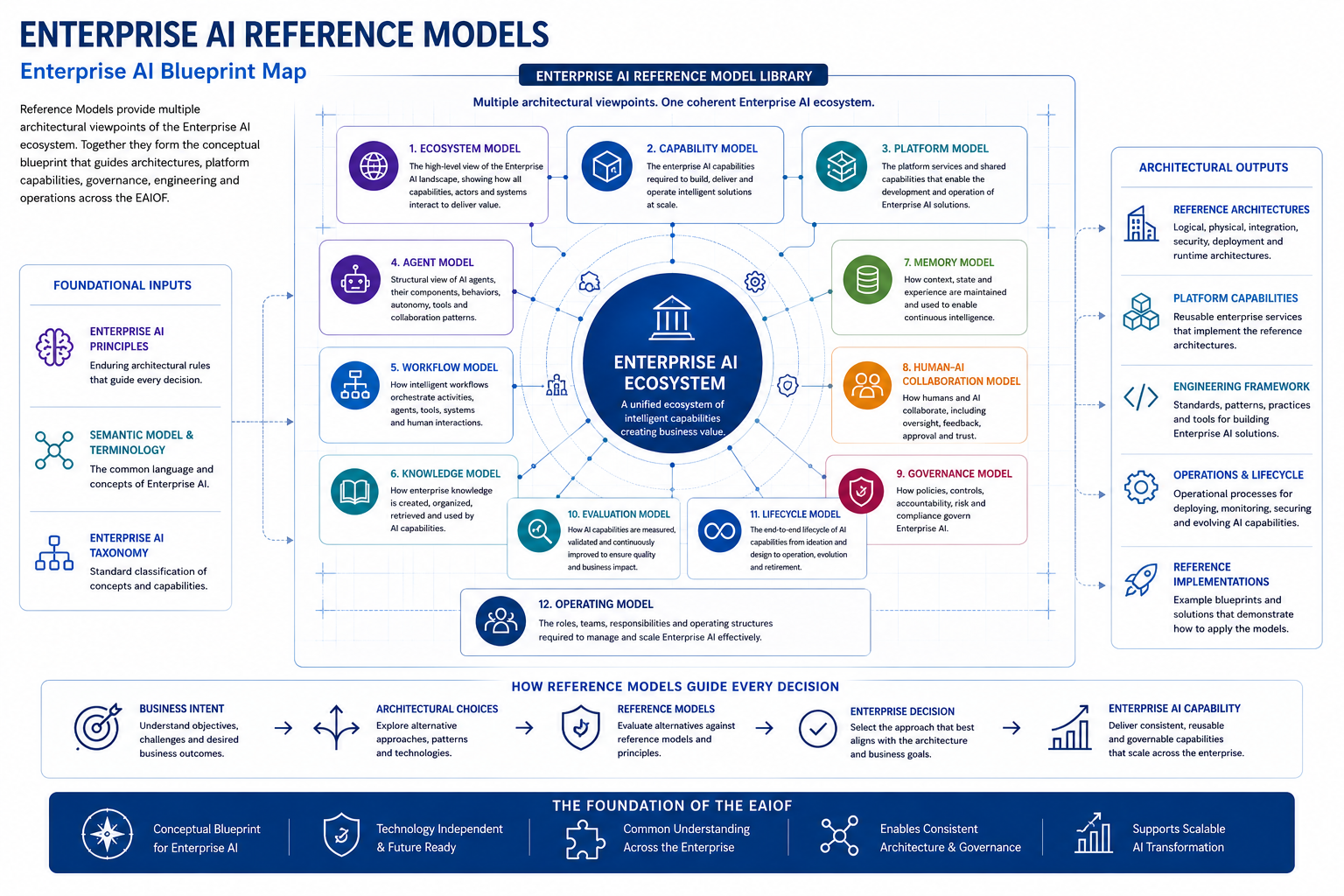
The Enterprise AI Reference Model Library
The Enterprise AI Operating Framework establishes a comprehensive library of Enterprise AI Reference Models. Rather than relying on a single architectural representation, the framework describes Enterprise AI through a collection of complementary conceptual models, each focusing on a particular architectural perspective of the Enterprise AI ecosystem.
This approach reflects the multidisciplinary nature of Enterprise AI.
Enterprise AI encompasses business capabilities, intelligent systems, enterprise services, organizational knowledge, governance mechanisms, engineering practices, operational responsibilities, platform capabilities, and organizational structures. No single model can adequately represent all of these dimensions while remaining understandable and useful.
For this reason, the Enterprise AI Reference Model Library is intentionally organized as a collection of specialized Reference Models.
Each model describes a specific architectural viewpoint.
Together, they provide a complete conceptual representation of Enterprise AI.
Although every Reference Model addresses a distinct architectural concern, they are not independent.
They share the same semantic definitions established by the Enterprise AI Semantic Model.
They organize concepts according to the Enterprise AI Taxonomy.
They embody the Enterprise AI Principles.
They describe complementary views of the same Enterprise AI ecosystem.
Collectively, they form a coherent architectural knowledge base that supports strategy, architecture, governance, engineering, operations, and organizational learning throughout the Enterprise AI Operating Framework.
The initial Enterprise AI Reference Model Library consists of the following Reference Models.
1. Enterprise AI Ecosystem Model
Provides the highest-level conceptual view of Enterprise AI across the organization.
This model establishes the overall Enterprise AI landscape by identifying the principal architectural domains and their relationships.
Representative concepts include:
- Business Domains
- Enterprise AI Platform
- Enterprise Applications
- Users and Business Roles
- AI Services
- AI Agents
- Enterprise Knowledge
- Governance
- Operations
- External Systems
The Enterprise AI Ecosystem Model serves as the conceptual entry point to the Reference Model Library and provides the enterprise-wide context upon which all other Reference Models are built.
2. Enterprise AI Capability Model
Defines the fundamental capabilities required to establish Enterprise AI as an organizational capability.
Representative capabilities include:
- Reasoning
- Knowledge Management
- Conversation
- Planning
- Retrieval
- Evaluation
- Observability
- Governance
- Security
- Automation
These capabilities represent reusable enterprise building blocks that are subsequently realized through Enterprise AI Platform capabilities, enterprise architectures, and solution implementations.
3. Enterprise AI Platform Model
Describes the conceptual structure of the Enterprise AI Platform.
Representative platform capabilities include:
- AI Gateway
- Prompt Management
- Agent Registry
- Model Registry
- Tool Registry
- Knowledge Platform
- Vector Platform
- Memory Platform
- Workflow Platform
- Policy Engine
- Guardrails
- Observability
- Evaluation
- Cost Management
- Developer Portal
The model explains how these capabilities collectively support Enterprise AI while remaining independent of implementation technologies.
4. Enterprise AI Agent Model
Defines the conceptual structure of an Enterprise AI Agent.
Representative concepts include:
- Goals
- Planning
- Reasoning
- Memory
- Knowledge
- Tools
- Policies
- Guardrails
- Evaluation
- Observability
- Human Interaction
The model establishes the fundamental architectural composition of Enterprise AI Agents and provides a common conceptual structure for agent-based systems.
5. Enterprise AI Workflow Model
Defines the conceptual organization of Enterprise AI workflows.
Representative concepts include:
- Events
- Tasks
- Agents
- Tools
- Approvals
- Business Rules
- Policies
- State
- Orchestration
- Completion
The model applies equally to deterministic workflows, adaptive workflows, human-in-the-loop processes, and complex multi-agent orchestration.
6. Enterprise Knowledge Model
Describes enterprise knowledge as a strategic organizational capability.
Representative concepts include:
- Knowledge Sources
- Documents
- Metadata
- Chunks
- Embeddings
- Retrieval
- Grounding
- Versioning
- Quality
- Ownership
- Knowledge Lifecycle
This model establishes the conceptual foundation for Enterprise Knowledge Platforms and organizational knowledge management.
7. Enterprise Memory Model
Defines the conceptual organization of memory within Enterprise AI.
Representative concepts include:
- Working Memory
- Session Memory
- Conversation Memory
- Long-Term Memory
- Semantic Memory
- Episodic Memory
- Shared Memory
- Organizational Memory
The model explains how memory supports reasoning continuity, contextual awareness, and intelligent behavior.
8. Human–AI Collaboration Model
Defines the conceptual relationships between humans and intelligent systems.
Representative concepts include:
- Human Interaction
- AI Agents
- Decision Support
- Approvals
- Feedback
- Escalation
- Learning
- Trust
- Transparency
The model reinforces one of the central principles of the Enterprise AI Operating Framework: Enterprise AI augments human capabilities rather than indiscriminately replacing human decision-making.
9. Enterprise AI Governance Model
Defines the conceptual governance ecosystem that surrounds Enterprise AI.
Representative concepts include:
- Policies
- Controls
- Risk
- Compliance
- Security
- Identity
- Approvals
- Audit
- Responsible AI
- Lifecycle Governance
The model establishes how governance capabilities interact to provide oversight, accountability, compliance, and organizational control throughout the Enterprise AI ecosystem.
10. Enterprise AI Evaluation Model
Defines evaluation as a first-class enterprise capability.
Representative concepts include:
- Benchmarks
- Golden Datasets
- Metrics
- Quality
- Accuracy
- Groundedness
- Faithfulness
- Performance
- Business Outcomes
- Continuous Evaluation
The model ensures that evaluation is treated as an integral architectural capability throughout the Enterprise AI lifecycle rather than as a post-implementation activity.
11. Enterprise AI Lifecycle Model
Defines the conceptual lifecycle through which Enterprise AI capabilities evolve.
Representative lifecycle phases include:
- Opportunity Identification
- Business Assessment
- Architecture
- Design
- Engineering
- Testing
- Evaluation
- Deployment
- Operations
- Continuous Improvement
- Retirement
This model provides the conceptual foundation for the Lifecycle & Processes domain of the Enterprise AI Operating Framework.
12. Enterprise AI Operating Model
Defines the conceptual organization required to operate Enterprise AI as an enterprise capability.
Representative organizational concepts include:
- Business Ownership
- Enterprise AI Platform Team
- Enterprise Architecture
- Engineering
- Operations
- Governance
- Security
- Knowledge Management
- Executive Sponsorship
Although organizational structures are defined in greater detail within the Operating Model domain of the EAIOF, this Reference Model establishes the conceptual relationships between the principal organizational functions responsible for Enterprise AI.
Together, these Reference Models form the Enterprise AI Reference Model Library.
Each model contributes a distinct architectural perspective.
Together, they describe the complete conceptual ecosystem of Enterprise AI.
As the Enterprise AI Operating Framework continues to evolve, additional Reference Models may be introduced to represent emerging architectural concerns or new organizational capabilities. The library has therefore been intentionally designed to be extensible, allowing new models to complement the existing collection without compromising conceptual consistency or architectural coherence.
The Enterprise AI Reference Model Library should therefore be regarded as a living architectural knowledge base. By providing multiple, interconnected views of the Enterprise AI ecosystem, it enables architects, engineers, governance bodies, business stakeholders, and executive leadership to develop a shared understanding of Enterprise AI while supporting the continuous evolution of the Enterprise AI Operating Framework.
Relationships Between Reference Models
The Enterprise AI Reference Models should never be interpreted as a collection of independent architectural descriptions. Although each model represents a specific architectural viewpoint, Enterprise AI itself is an integrated enterprise capability whose business, architectural, technological, operational, and governance dimensions are inherently interconnected.
For this reason, every Reference Model contributes to a broader conceptual architecture.
Each model describes a different perspective of the same Enterprise AI ecosystem.
Together, they establish a coherent architectural understanding that enables Enterprise AI to be viewed as a unified enterprise capability rather than as a collection of isolated technologies, independent projects, or disconnected organizational functions.
This multidimensional perspective is one of the defining characteristics of the Enterprise AI Operating Framework.
No single Reference Model attempts to describe the entire Enterprise AI ecosystem.
Instead, each model focuses on a specific architectural concern while remaining explicitly connected to the others through shared concepts, complementary responsibilities, and consistent architectural boundaries.
Collectively, these relationships provide a comprehensive understanding of Enterprise AI from multiple architectural viewpoints.
The Enterprise AI Ecosystem Model establishes the overall organizational context and identifies the principal architectural domains that compose the Enterprise AI landscape.
The Enterprise AI Capability Model defines the organizational capabilities required to deliver Enterprise AI as a strategic business capability.
The Enterprise AI Platform Model describes the reusable enterprise services and platform capabilities that realize those organizational capabilities.
The Enterprise AI Agent Model explains how intelligent agents perform reasoning, planning, decision-making, and autonomous execution within the enterprise.
The Enterprise AI Workflow Model describes how intelligent activities are coordinated across agents, services, tools, business processes, and human participants.
The Enterprise Knowledge Model explains how organizational knowledge is created, governed, retrieved, and applied to provide business context for intelligent systems.
The Enterprise Memory Model describes how contextual information is preserved across interactions, enabling continuity of reasoning and intelligent behavior over time.
The Human–AI Collaboration Model explains how humans and intelligent systems cooperate to achieve business outcomes through decision support, approvals, supervision, feedback, and shared responsibility.
The Enterprise AI Governance Model establishes the organizational controls, policies, accountability mechanisms, and compliance structures that govern every Enterprise AI capability.
The Enterprise AI Evaluation Model defines how Enterprise AI capabilities are measured, validated, benchmarked, and continuously improved to ensure that they produce reliable business outcomes.
The Enterprise AI Lifecycle Model explains how Enterprise AI capabilities evolve from initial opportunity identification through architecture, engineering, deployment, operations, continuous improvement, and eventual retirement.
The Enterprise AI Operating Model defines the organizational responsibilities, teams, governance structures, and operating relationships required to manage Enterprise AI as an enterprise capability.
Viewed independently, each Reference Model explains only one aspect of Enterprise AI.
Viewed collectively, they describe a complete conceptual architecture.
This integrated perspective enables Enterprise AI to be understood as a system of interconnected enterprise capabilities whose value emerges from the interaction of all architectural dimensions rather than from any individual component.
The relationships between Reference Models also establish end-to-end architectural traceability throughout the Enterprise AI Operating Framework.
Business objectives are realized through Enterprise AI capabilities.
Capabilities are enabled by platform services.
Platform services support intelligent agents.
Agents participate in workflows.
Workflows consume enterprise knowledge and memory.
Knowledge and intelligent behavior operate within governance boundaries.
Governance is reinforced through evaluation.
Evaluation informs continuous improvement throughout the Enterprise AI lifecycle.
The operating model provides the organizational structure required to sustain this entire ecosystem.
This traceability enables architects to understand how strategic objectives ultimately influence implementation decisions, while allowing engineering teams, governance bodies, and operational teams to relate their activities to the broader Enterprise AI architecture.
More importantly, it ensures that every architectural decision contributes to a coherent enterprise-wide model rather than optimizing individual components in isolation.
As the Enterprise AI Operating Framework continues to evolve, new Reference Models may be introduced to describe emerging architectural concerns. These models will not exist independently; they will extend the existing conceptual architecture by establishing new relationships with the models already defined within the Enterprise AI Reference Model Library. In this way, the framework grows incrementally while preserving architectural consistency, semantic integrity, and organizational coherence.
For this reason, the Enterprise AI Reference Models should be understood as an interconnected architectural system rather than as a collection of individual diagrams. Their relationships create the conceptual architecture of Enterprise AI, enabling every stakeholder to navigate the enterprise landscape from business strategy to organizational capabilities, platform services, intelligent systems, governance, operations, and continuous evolution through a single, coherent architectural framework.
Reference Models as the Blueprint for Future Architecture
The Enterprise AI Reference Models represent the point at which the Enterprise AI Operating Framework (EAIOF) transitions from conceptual knowledge to architectural design. The preceding domains of the framework establish the language, terminology, taxonomy, principles, and other conceptual foundations required to understand Enterprise AI as an enterprise capability. The Reference Models build upon those foundations by organizing them into a coherent architectural representation of the Enterprise AI ecosystem, creating the conceptual blueprint from which every subsequent architectural artifact is derived.
This role is fundamental to the architecture of the EAIOF. Reference Models do not prescribe technologies, products, implementation frameworks, deployment topologies, programming languages, cloud providers, databases, orchestration platforms, or engineering tools. Their purpose is to define the enduring conceptual structure of Enterprise AI independently of the technologies used to realize it. By operating at this level of abstraction, the Reference Models establish architectural foundations that remain applicable even as implementation approaches continue to evolve.
Maintaining this separation between conceptual architecture and technical implementation is one of the defining characteristics of the EAIOF. Artificial Intelligence is evolving rapidly, and organizations are continually presented with new models, platforms, engineering frameworks, infrastructure services, and operational capabilities. If the conceptual architecture of the enterprise were tied directly to these technologies, every significant technological change would require the organization to redesign its architectural foundations. By separating concepts from implementation, the EAIOF allows the technology landscape to evolve while preserving a stable architectural model that continues to guide enterprise-wide decision-making.
The Enterprise AI Reference Models therefore serve as the architectural blueprint upon which the remaining domains of the framework are constructed. They provide the conceptual structures that the Enterprise AI Reference Architectures transform into logical, physical, integration, security, deployment, and runtime architectures suitable for enterprise implementation. In turn, the Enterprise AI Platform realizes the capabilities represented by those architectures through reusable enterprise services that support AI across the organization. The Enterprise AI Engineering Framework translates these architectural capabilities into engineering standards, development practices, reusable patterns, and reference implementations, while the Governance Framework establishes the policies, responsibilities, accountability structures, and oversight mechanisms required to manage them. Finally, the operational domains ensure that these capabilities remain reliable, secure, observable, resilient, and continuously improved throughout their operational lifecycle.
This progression creates a continuous chain of architectural traceability across the entire EAIOF. Business objectives are translated into enterprise capabilities, those capabilities are represented conceptually through the Reference Models, and the Reference Architectures organize those concepts into implementable architectural structures. Platform capabilities provide the reusable technical foundation required to realize the architecture, engineering practices transform those capabilities into working solutions, and operational processes sustain them throughout their lifecycle. Each stage builds upon the previous one while remaining aligned with the same conceptual foundation established by the Reference Models.
This traceability is one of the principal strengths of the EAIOF because it ensures that architectural intent is preserved throughout the entire lifecycle of Enterprise AI. Decisions made during engineering, governance, operations, or platform evolution can always be related back to the conceptual structures defined by the Reference Models. This alignment strengthens architectural governance, improves consistency across initiatives, and provides a clear rationale for architectural decisions at every level of the enterprise.
The Reference Models also provide continuity as the framework evolves. Artificial Intelligence will continue to introduce new architectural capabilities, intelligent systems, governance requirements, engineering practices, and operational models. Because the conceptual blueprint remains stable, these innovations can be incorporated into the Enterprise AI ecosystem without requiring the underlying architecture to be redefined. New technologies become extensions of an established conceptual structure rather than catalysts for architectural fragmentation, allowing organizations to innovate while preserving long-term architectural coherence.
For these reasons, the Enterprise AI Reference Models should be regarded as one of the most strategic architectural assets within the EAIOF. They provide the conceptual bridge between knowledge and architecture, transforming the concepts established by the Enterprise AI Body of Knowledge into the structural foundation upon which enterprise architectures are designed. They enable architects, engineers, governance teams, and operations professionals to work from the same architectural blueprint, ensuring that Enterprise AI capabilities are developed within a consistent and technology-independent conceptual framework.
Ultimately, the Enterprise AI Reference Models provide the conceptual architecture that enables the EAIOF to progress from understanding Enterprise AI to designing and implementing it. By serving as the architectural blueprint for every subsequent domain, they ensure that future architectures, platform capabilities, engineering practices, governance models, and operational processes remain grounded in a coherent, enterprise-wide understanding of Artificial Intelligence. In doing so, they enable the framework to evolve continuously while preserving the architectural consistency, strategic alignment, and organizational coherence required for sustainable Enterprise AI adoption.