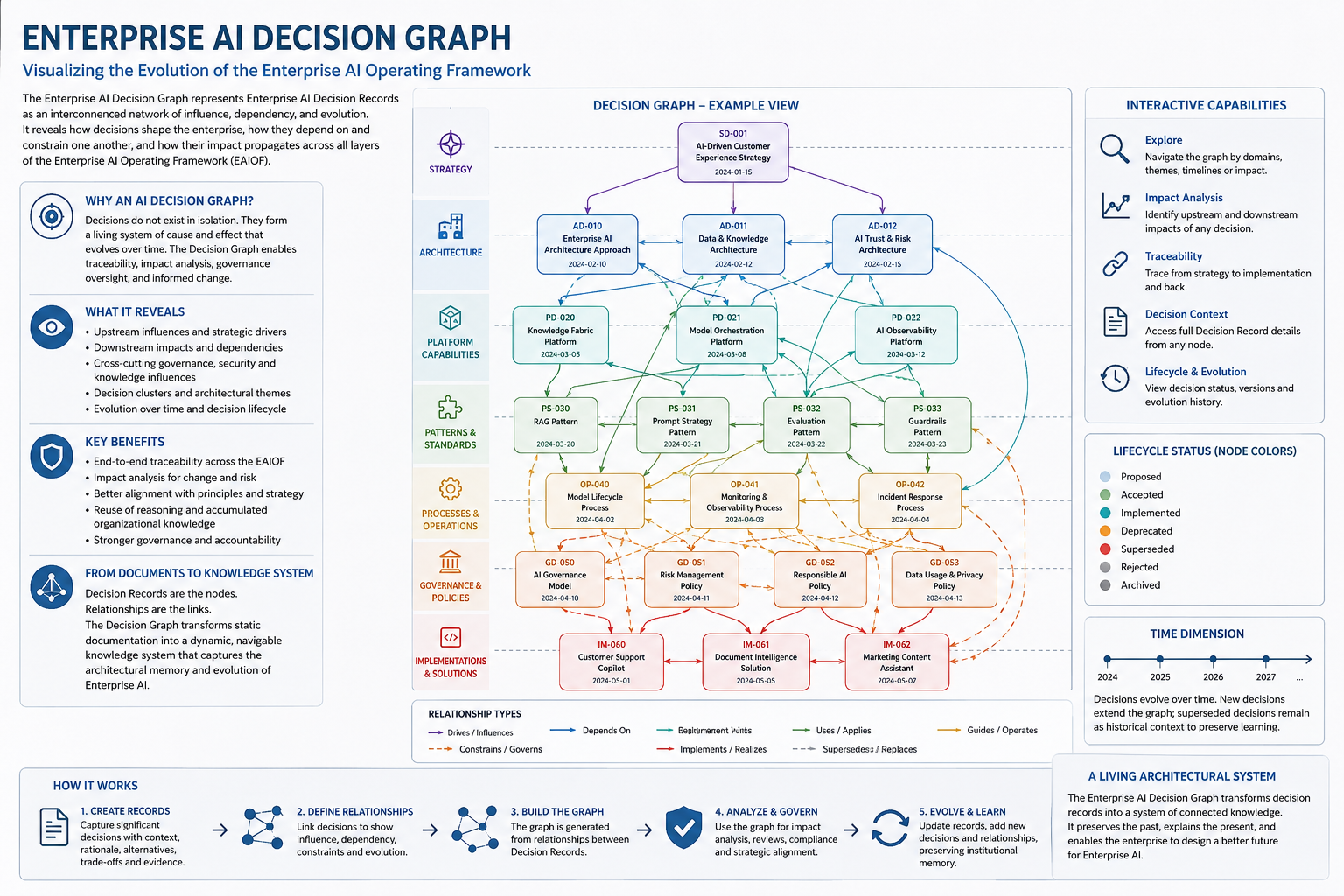
Introduction
Every mature enterprise architecture is the result of a continuous sequence of decisions. Some decisions establish strategic direction, while others define architectural principles, governance models, engineering standards, platform capabilities, operational processes, or organizational responsibilities. Individually, each decision addresses a specific need or challenge. Collectively, however, these decisions shape the way an organization designs, governs, implements, operates, and evolves its Enterprise AI capability over time.
For this reason, the long-term quality of an enterprise architecture depends not only on making sound decisions, but also on preserving the knowledge that explains those decisions. Architectural consistency cannot be sustained if future stakeholders understand only what was decided without understanding why those decisions were made. The rationale behind architectural choices is often as important as the choices themselves because it provides the context required to evaluate whether those decisions remain appropriate as business objectives, technologies, and organizational conditions evolve.
This challenge is frequently underestimated. Organizations generally retain the outcomes of architectural decisions in the form of standards, architectures, policies, and implementation guidance, while gradually losing the reasoning that justified them. During the lifetime of a project, architects understand why a particular architectural approach was selected, engineering teams implement the resulting standards, governance functions establish policies based on those decisions, and operations teams assume responsibility for sustaining the implemented capabilities. As time passes, however, the original business drivers, architectural constraints, alternatives considered, trade-offs evaluated, and assumptions that influenced those decisions often disappear.
The consequences become increasingly apparent as the organization evolves. New architects, engineers, and governance teams inherit established architectures without understanding the problems those architectures were originally intended to solve. Existing standards are followed because they have become accepted organizational practice rather than because their underlying rationale is understood. When new business requirements, regulatory changes, or technological advances challenge earlier decisions, the absence of historical context frequently results in unnecessary redesign, repeated architectural analysis, inconsistent decision-making, or the replacement of solutions that continue to satisfy their original objectives.
The result is more than incomplete documentation; it is the gradual erosion of institutional knowledge. Without access to the reasoning behind previous decisions, organizations repeatedly revisit problems that have already been solved. Similar alternatives are evaluated multiple times, different teams reach different conclusions when faced with comparable situations, and architectural consistency gradually declines as independent decisions accumulate without reference to the enterprise's architectural history. Over time, this loss of architectural memory contributes to fragmentation across enterprise architectures, engineering practices, governance models, and operational capabilities.
The Enterprise AI Operating Framework (EAIOF) addresses this challenge by establishing Enterprise AI Decision Records (EADR) as a formal mechanism for preserving architectural decision-making. An Enterprise AI Decision Record documents not only the decision itself, but also the business context in which it was made, the alternatives that were considered, the architectural reasoning that guided the evaluation, the trade-offs that influenced the outcome, and the consequences expected from its adoption. By preserving this information, an EADR enables future stakeholders to understand not only what was decided, but also why that decision represented the most appropriate course of action at the time.
This distinction is fundamental within the EAIOF. Architectures describe the structural organization of Enterprise AI capabilities. Standards define how those capabilities should be implemented. Policies establish the rules through which they are governed. Enterprise AI Decision Records preserve the reasoning that connects these artifacts, providing the architectural context that explains how and why they came into existence. They therefore serve as the historical thread that links strategy, architecture, governance, engineering, and operations throughout the evolution of the framework.
Within the EAIOF, Enterprise AI Decision Records become a key mechanism for maintaining architectural continuity. Strategic decisions, architectural choices, governance models, engineering standards, platform capabilities, operational practices, and organizational structures can all be traced to the decisions that shaped them. This traceability enables architects, engineers, governance bodies, and business leaders to evaluate existing approaches with a clear understanding of their original intent, making it possible to evolve the architecture deliberately rather than through assumption or institutional memory alone.
The value of Enterprise AI Decision Records extends well beyond documentation. They preserve institutional knowledge, strengthen architectural governance, improve transparency, support organizational learning, enable more informed decision-making, reduce unnecessary redesign, and promote consistency across projects, business units, and organizational boundaries. Most importantly, they establish architectural decision-making as a managed organizational capability rather than as an activity whose knowledge is retained primarily by the individuals involved.
As the Enterprise AI Operating Framework continues to mature, Enterprise AI Decision Records provide the historical continuity required to sustain long-term architectural evolution. Each significant decision becomes part of the organization's architectural knowledge, enriching the collective understanding of Enterprise AI and strengthening the framework through successive generations of strategic, architectural, engineering, governance, and operational experience.
For these reasons, the Enterprise AI Decision Records domain should be regarded as the architectural memory of the EAIOF. It preserves not only the decisions that shape Enterprise AI, but also the reasoning that allows those decisions to remain understandable, traceable, and valuable as the organization, its technologies, and its Enterprise AI capabilities continue to evolve.
Why Decision Records Matter
Enterprise Artificial Intelligence is characterized by continuous change. Foundation models evolve rapidly, orchestration technologies mature, engineering practices advance, governance expectations expand, regulatory frameworks are refined, and new architectural capabilities emerge on a regular basis. In such an environment, the long-term sustainability of an Enterprise AI architecture depends not only on the quality of the decisions that are made, but also on the organization's ability to preserve the reasoning that justified those decisions.
Architectural decisions are always made within a specific business and technological context. They reflect the strategic objectives of the organization, the architectural principles in effect at the time, the alternatives that were available, the constraints that had to be respected, and the trade-offs that were considered acceptable. As this context changes, the decisions themselves may eventually need to be revisited. Without an understanding of the reasoning that led to them, however, future stakeholders have no reliable basis for determining whether a decision should be retained, refined, or replaced.
This challenge becomes increasingly significant as Enterprise AI capabilities mature. Architectural standards may remain in use long after the business conditions that motivated them have changed. Platform capabilities may continue to exist even though the original problem they were intended to solve is no longer understood. Governance policies may be applied consistently without visibility into the assumptions upon which they were established. As organizational memory gradually fades, architectural decisions become disconnected from the intent that originally justified them, making it more difficult to evaluate their ongoing relevance.
The consequences affect every discipline involved in Enterprise AI. Enterprise Architects inherit architectural structures without understanding why they were designed in a particular way. Engineering teams implement established practices without visibility into the trade-offs those practices represent. Governance bodies evaluate compliance against policies whose original objectives may no longer be evident. Executive leadership reviews strategic investments without access to the business context that justified those decisions. In each case, the absence of architectural memory limits the organization's ability to make informed decisions about the future evolution of its Enterprise AI capabilities.
The Enterprise AI Operating Framework (EAIOF) addresses this challenge by treating architectural reasoning as a managed organizational asset. Enterprise AI Decision Records (EADR) preserve significantly more than the outcome of a decision. They document the business context in which the decision was made, the objectives it was intended to achieve, the alternatives that were evaluated, the assumptions that influenced the analysis, the risks that were accepted, the trade-offs that shaped the outcome, and the expected consequences of adopting the selected approach. This information enables future stakeholders to understand not only what was decided, but why that decision represented the most appropriate course of action under the circumstances that existed at the time.
Preserving this context fundamentally changes the way architectural reviews are conducted. Instead of relying on assumptions or incomplete historical knowledge, architects are able to evaluate existing capabilities against documented organizational reasoning. Questions such as why a capability was introduced, which business objectives it supported, which Enterprise AI Principles influenced the decision, which implementation alternatives were considered, why certain options were rejected, which assumptions were accepted, what risks were tolerated, and under which conditions the decision should be reconsidered can all be answered through the corresponding Enterprise AI Decision Record. Architectural governance therefore becomes an evidence-based process grounded in institutional knowledge rather than individual recollection.
Without this capability, organizations often experience a gradual decline in architectural efficiency. Similar architectural discussions are repeated across different initiatives, alternatives that were previously evaluated are analyzed again, engineering teams invest time rediscovering conclusions that have already been reached, and comparable business problems are solved using different architectural approaches. Valuable lessons remain confined within individual projects or teams, preventing organizational knowledge from accumulating over time. The enterprise repeatedly revisits familiar architectural debates instead of building upon the experience gained through previous initiatives.
Enterprise AI Decision Records help eliminate much of this inefficiency by making architectural reasoning a reusable organizational asset. Every significant decision contributes to the enterprise's architectural knowledge base, allowing future projects to benefit from previous analysis instead of repeating it. Governance becomes more transparent because decisions can be traced to their original context, engineering teams gain confidence that established practices are supported by documented reasoning rather than historical convention, and business stakeholders gain greater visibility into the relationship between strategic objectives and architectural decisions.
Equally important, Enterprise AI Decision Records support change rather than inhibit it. Architectural decisions are not intended to remain permanent. Business priorities evolve, technologies mature, regulatory requirements change, and new architectural alternatives emerge. The purpose of an Enterprise AI Decision Record is not to preserve decisions indefinitely, but to preserve the reasoning that enables those decisions to be re-evaluated intelligently. By understanding the assumptions and constraints that influenced an earlier decision, future architects can determine whether those conditions remain valid or whether the architectural context has changed sufficiently to justify a different approach.
For these reasons, Enterprise AI Decision Records should be regarded as a strategic mechanism for preserving architectural memory within the EAIOF. They transform individual decisions into reusable organizational knowledge, strengthen governance through transparency and traceability, reduce unnecessary architectural rework, and enable the framework to evolve through informed decision-making rather than repeated rediscovery. In doing so, they become an essential component of long-term architectural maturity and one of the primary mechanisms through which institutional knowledge is preserved across successive generations of Enterprise AI evolution.
Beyond Architecture Decision Records
The practice of documenting architectural decisions is well established within the software engineering community through the use of Architecture Decision Records (ADR). ADRs provide a structured mechanism for recording significant software architecture decisions together with the context and rationale that support them. By preserving this information, they improve architectural transparency, facilitate communication among development teams, and enable future engineers to understand why particular technical approaches were adopted instead of relying solely on the resulting implementation.
The Enterprise AI Operating Framework (EAIOF) recognizes the value of this practice and adopts the same fundamental principle: significant decisions should be documented together with the reasoning that justifies them. However, Enterprise Artificial Intelligence introduces a level of organizational complexity that extends well beyond the traditional scope of software architecture. Enterprise AI is not simply a software system or an engineering discipline; it is an enterprise capability that spans strategy, governance, architecture, engineering, operations, knowledge management, security, and organizational design. Consequently, many of the decisions that determine the success of Enterprise AI cannot be adequately represented through conventional Architecture Decision Records alone.
The evolution of an Enterprise AI capability is influenced by decisions made across multiple organizational domains. Strategic decisions establish the direction of Enterprise AI investment and business transformation. Governance decisions define organizational policies, accountability models, and compliance mechanisms. Engineering decisions standardize implementation practices and development approaches. Security decisions establish trust boundaries and protection mechanisms. Knowledge management decisions determine how enterprise information is created, governed, and consumed. Platform decisions define the reusable capabilities that support AI across the organization. Operational decisions shape monitoring, resilience, lifecycle management, and continuous improvement. Organizational decisions clarify ownership, responsibilities, and operating models, while business decisions define the objectives that Enterprise AI capabilities are expected to achieve.
Each of these decisions contributes to the evolution of Enterprise AI as an enterprise capability. Although they originate in different organizational disciplines, they collectively shape the architectural direction of the Enterprise AI ecosystem. Preserving only software architecture decisions would therefore capture only a fraction of the reasoning required to understand how Enterprise AI has evolved within the enterprise.
For this reason, the EAIOF introduces Enterprise AI Decision Records (EADR) as a broader organizational discipline for documenting significant decisions across the entire Enterprise AI ecosystem. Enterprise AI Decision Records preserve the structured and disciplined approach established by traditional ADRs while extending their scope beyond software architecture. Architectural decisions remain an important category, but they are considered alongside strategic, governance, engineering, platform, operational, security, knowledge management, and organizational decisions that collectively determine how Enterprise AI is designed, governed, implemented, and sustained.
Within the EAIOF, an Enterprise AI Decision Record may therefore document decisions such as the selection of an enterprise governance model, the definition of reusable platform capabilities, the adoption of engineering standards, the establishment of organizational responsibilities, the introduction of operational practices, or the selection of a knowledge management strategy. Each record preserves the business context, architectural reasoning, alternatives considered, assumptions made, and consequences expected from the decision, regardless of the organizational discipline in which it originated.
This broader perspective reflects the multidisciplinary nature of Enterprise AI itself. Designing and operating Enterprise AI requires coordinated decision-making across business leadership, enterprise architecture, solution architecture, engineering, governance, operations, security, knowledge management, and organizational management. Each discipline contributes a different perspective, and the long-term success of Enterprise AI depends upon maintaining coherence across all of them. Restricting decision management to software architecture would leave much of this organizational knowledge undocumented and difficult to recover over time.
Enterprise AI Decision Records therefore preserve the complete architectural narrative that underpins the evolution of the EAIOF. They document not only how Enterprise AI capabilities are implemented, but also why the organization adopted a particular strategic direction, governance model, engineering practice, operational approach, platform capability, or organizational structure. This broader historical perspective enables future architects, engineers, governance bodies, and executive leaders to evaluate existing capabilities with a clear understanding of the organizational context in which those decisions were originally made.
The adoption of Enterprise AI Decision Records also strengthens traceability throughout the framework. Business strategy can be related to the enterprise capabilities it seeks to develop. Those capabilities can be traced to the Reference Models that describe them, the architectural structures that organize them, the engineering standards that implement them, and the operational practices that sustain them. At each stage, Enterprise AI Decision Records document the reasoning that connects one layer of the framework to the next, preserving the continuity of architectural thinking across the entire Enterprise AI lifecycle.
For these reasons, Enterprise AI Decision Records should not be viewed merely as an extension of traditional Architecture Decision Records. They represent a broader organizational capability for managing enterprise knowledge through disciplined decision documentation. By capturing significant decisions across strategy, architecture, governance, engineering, platform capabilities, knowledge management, security, operations, and organizational design, Enterprise AI Decision Records preserve the reasoning that shapes the Enterprise AI Operating Framework and ensure that its future evolution remains informed by documented organizational knowledge rather than by fragmented institutional memory.
Decision Records as Organizational Memory
One of the defining characteristics of a mature enterprise is its ability to preserve organizational knowledge across time. Technologies evolve, organizational structures change, business priorities shift, and people move into new roles. Yet the enterprise continues to progress because it retains the knowledge that explains how its most important decisions were made. Without this continuity, every generation of architects and engineers is forced to rediscover conclusions that have already been reached, repeating analysis, revisiting previous debates, and reconstructing architectural reasoning from incomplete historical information.
Within the Enterprise AI Operating Framework, Enterprise AI Decision Records provide the mechanism through which this continuity is preserved.
They constitute the architectural memory of the framework.
While the Enterprise AI Body of Knowledge captures the concepts, principles, models, and patterns that define Enterprise AI, Enterprise AI Decision Records preserve the reasoning that explains how those assets have evolved over time. Together, they ensure that the framework records not only what Enterprise AI is, but also how it became what it is.
Every Enterprise AI Decision Record represents a permanent contribution to the organization's institutional knowledge.
Each documented decision captures the architectural thinking that existed at a particular point in the evolution of the enterprise. Rather than preserving only the final outcome, Decision Records retain the context that allowed informed decision-making, enabling future stakeholders to understand the circumstances under which the decision was made and to evaluate its continued relevance as the organization evolves.
To achieve this objective, every significant Decision Record should explain:
- The problem that required a decision.
- The organizational and architectural context in which the decision was made.
- The business objectives that influenced the analysis.
- The alternatives that were evaluated.
- The assumptions and constraints that shaped the decision.
- The selected approach.
- The reasoning that justified the selected approach.
- The expected benefits, trade-offs, and consequences.
- The risks that were accepted.
- Future considerations that may require the decision to be revisited.
Collectively, these elements provide far more than historical documentation.
They preserve architectural intent.
They preserve organizational reasoning.
They preserve enterprise learning.
This historical perspective enables future architects, engineers, governance bodies, and business leaders to understand the evolution of the Enterprise AI Operating Framework rather than simply inheriting its current state. Architectural standards no longer appear as arbitrary conventions. Governance policies no longer exist without explanation. Platform capabilities, engineering practices, and organizational structures can all be understood in the context of the decisions that created them.
Decision Records therefore transform Enterprise AI into a continuously learning enterprise capability.
Every important decision contributes to the collective architectural experience of the organization.
Every new project benefits from the reasoning established by previous initiatives.
Every architectural evolution builds upon documented knowledge instead of replacing undocumented assumptions.
Institutional learning becomes cumulative rather than episodic.
This capability also strengthens governance and continuous improvement. As business priorities, technologies, regulations, or organizational structures evolve, Decision Records provide the historical baseline against which existing decisions can be re-evaluated. Rather than asking whether a decision should simply be replaced, architects can determine whether the assumptions that originally justified it remain valid or whether the enterprise context has changed sufficiently to require a different approach. In this way, organizational evolution becomes deliberate, transparent, and evidence-based.
Over time, the collection of Enterprise AI Decision Records becomes one of the organization's most valuable architectural assets.
It captures the history of Enterprise AI.
It explains the evolution of the Enterprise AI Operating Framework.
It preserves the enterprise's accumulated architectural knowledge.
It enables every future generation of architects, engineers, and decision-makers to understand not only the framework itself, but also the reasoning that shaped it.
For this reason, Enterprise AI Decision Records should be regarded as the organizational memory of the Enterprise AI Operating Framework. They preserve the architectural narrative of Enterprise AI, transform individual decisions into enduring institutional knowledge, and ensure that the framework continues to evolve through informed reasoning rather than historical reconstruction. By making architectural thinking explicit, traceable, and reusable, Decision Records enable the EAIOF to become progressively more understandable, more consistent, and increasingly self-explanatory with each stage of its evolution.
Decision Records as Architectural Governance
Effective architectural governance depends on more than defining principles, standards, and policies. It also requires transparency in the decisions through which those principles are interpreted and applied. Enterprise AI architectures evolve through a continuous sequence of strategic, architectural, engineering, governance, and operational decisions. Unless the reasoning behind those decisions is preserved, governance gradually becomes detached from the architectural intent that originally guided it.
Within the Enterprise AI Operating Framework (EAIOF), Enterprise AI Principles and Enterprise AI Decision Records together establish a complementary governance model. Although they serve different purposes, they are closely connected and collectively provide the foundation for consistent and transparent architectural decision-making throughout the organization.
The Enterprise AI Principles define the architectural philosophy of the framework. They establish the enduring values, objectives, and beliefs that guide the design, governance, implementation, and evolution of Enterprise AI capabilities. Because principles operate at the highest level of architectural abstraction, they are intended to remain relatively stable over time, continuing to provide direction even as technologies, business priorities, organizational structures, and implementation approaches evolve.
Enterprise AI Decision Records perform a different, but equally important, governance function. Rather than defining the architectural beliefs of the organization, they document how those beliefs influenced specific decisions. Every significant Decision Record explains how the Enterprise AI Principles were interpreted within a particular business, architectural, engineering, or organizational context. In doing so, it preserves the reasoning that connected the principles of the framework to the decision that was ultimately made.
This distinction is fundamental to the governance model of the EAIOF. The Enterprise AI Principles answer the question, "What architectural values and objectives guide the organization?" Enterprise AI Decision Records answer the complementary question, "How were those values and objectives applied when this decision was made?" Principles therefore establish direction, while Decision Records provide evidence of how that direction has been translated into practice.
The relationship between these two governance mechanisms strengthens architectural consistency across the framework. Significant architectural decisions can be traced directly to the principles that motivated them. Engineering standards can be linked to the decisions that justified their adoption. Governance policies can be understood not only in terms of the rules they establish, but also in terms of the architectural reasoning that shaped their development. Platform capabilities, operational practices, organizational structures, and other architectural artifacts can all be related to documented decisions that explain why they were introduced and how they contribute to the enterprise's long-term architectural objectives.
This traceability substantially improves the effectiveness of architectural governance. Architecture reviews become more objective because proposed solutions can be evaluated against both the Enterprise AI Principles and the documented decisions that have previously interpreted those principles. Governance bodies gain greater transparency into the rationale behind existing standards, enabling them to distinguish between enduring architectural principles and decisions that reflected the circumstances of a particular point in time. Future architects are therefore able to determine not only whether a decision was appropriate when it was made, but also whether the assumptions that supported it remain valid as the organization evolves.
Enterprise AI Decision Records also support controlled architectural evolution. The purpose of documenting decisions is not to preserve them indefinitely, but to preserve the reasoning that allows them to be revisited intelligently. As business priorities change, technologies mature, regulatory expectations evolve, and new architectural alternatives become available, previously accepted decisions may need to be reconsidered. Because the original assumptions, trade-offs, and objectives remain documented, architects can evaluate proposed changes using evidence rather than relying on incomplete institutional memory or subjective interpretation.
This relationship between enduring principles and evolving decisions enables the EAIOF to balance architectural stability with organizational adaptability. Enterprise AI Principles remain intentionally stable because they define the long-term architectural philosophy of the organization. Enterprise AI Decision Records evolve continuously as new initiatives, technologies, governance requirements, and business objectives introduce new architectural questions. Each Decision Record therefore extends the architectural history of the framework while remaining anchored to the same set of guiding principles.
The result is a governance model that combines consistency with flexibility. Principles provide the architectural compass that guides the long-term evolution of Enterprise AI, while Decision Records provide the documented reasoning that explains how those principles have been applied in practice. Together, they ensure that governance is based not only on enduring architectural values, but also on transparent, traceable, and evidence-based decision-making.
For these reasons, Enterprise AI Decision Records should be regarded as an essential component of the architectural governance model of the EAIOF. By preserving the relationship between architectural principles and organizational decisions, they transform governance from a collection of static policies into a living discipline of continuous architectural reasoning. In doing so, they strengthen transparency, accountability, institutional learning, and the long-term architectural integrity of Enterprise AI across the enterprise.
Characteristics of Effective Decision Records
The long-term value of an Enterprise AI Decision Record depends not only on the significance of the decision it documents, but also on the quality of the information it preserves. A decision that lacks context, omits its rationale, or cannot be traced to the business objectives it was intended to support provides limited value for future architects, engineers, governance bodies, or business stakeholders.
For this reason, every Enterprise AI Decision Record should satisfy a common set of quality characteristics. These characteristics ensure that Decision Records remain understandable, trustworthy, reusable, and valuable throughout the continuous evolution of the Enterprise AI Operating Framework.
Together, they establish the quality standards expected of every Decision Record within the EAIOF.
Traceable
Every Decision Record should be traceable to the organizational context that motivated it.
This includes the business problem being addressed, the enterprise objectives it supports, the architectural principles that influenced the decision, the related Enterprise AI capabilities, and, where appropriate, the Reference Models, architectural patterns, engineering standards, and governance policies associated with the decision.
Traceability ensures that every decision can be understood within the broader context of the Enterprise AI Operating Framework.
Transparent
The reasoning behind every decision should be explicit and comprehensively documented.
Future stakeholders should understand not only the selected approach, but also why it was considered preferable to the available alternatives. The assumptions, constraints, trade-offs, risks, and expected outcomes that influenced the decision should all be clearly recorded.
Transparency transforms decisions from historical outcomes into understandable architectural knowledge.
Objective
Decision Records should be based upon evidence rather than individual preference or subjective opinion.
Business objectives, architectural analysis, technical evaluations, risk assessments, governance requirements, performance measurements, regulatory considerations, and organizational constraints should provide the basis for decision-making whenever possible.
An objective Decision Record enables future reviews to evaluate decisions using documented evidence rather than interpretation.
Versioned
Enterprise AI decisions are not necessarily permanent.
Business priorities evolve.
Technologies mature.
Regulatory expectations change.
Organizational capabilities expand.
When a significant decision changes, its evolution should be documented rather than replacing the previous record. Versioning preserves the architectural history of the framework and enables stakeholders to understand how organizational thinking has evolved over time.
Reviewable
Every Decision Record should remain open to periodic review.
The objective of documenting a decision is not to make it immutable, but to preserve the context required to determine whether it continues to represent the most appropriate course of action.
As new information becomes available, assumptions may change, alternative solutions may emerge, and enterprise priorities may evolve. Decision Records should therefore support informed reassessment rather than permanent acceptance.
Reusable
The knowledge captured by a Decision Record should extend beyond the project in which it originated.
Architectural reasoning, governance considerations, engineering lessons, implementation experience, and business trade-offs should become reusable organizational knowledge that informs future decisions across multiple projects, business domains, and organizational functions.
Every significant decision should strengthen the enterprise's collective understanding of Enterprise AI.
Consistent
Decision Records should follow a standardized structure and use the official terminology established by the Enterprise AI Semantic Model.
Consistent documentation improves readability, simplifies governance reviews, facilitates comparison between decisions, and strengthens the overall coherence of the Enterprise AI knowledge base.
Connected
Decision Records should not exist in isolation.
Where appropriate, they should establish explicit relationships with Enterprise AI Principles, Reference Models, Enterprise AI Patterns, Reference Architectures, engineering standards, governance policies, platform capabilities, and related Decision Records.
These relationships create end-to-end architectural traceability throughout the Enterprise AI Operating Framework and enable stakeholders to navigate the evolution of the framework through interconnected architectural knowledge.
Governed
Enterprise AI Decision Records are managed architectural assets.
They should be created, reviewed, approved, versioned, and retired through defined governance processes that ensure their accuracy, relevance, and alignment with the broader objectives of the Enterprise AI Operating Framework.
Governance preserves the integrity of the Decision Record library and ensures that it continues to reflect the current architectural direction of the enterprise.
Collectively, these characteristics ensure that Enterprise AI Decision Records remain valuable throughout the lifecycle of the Enterprise AI Operating Framework. They transform individual architectural decisions into durable organizational knowledge that can be understood, evaluated, reused, and continuously refined as Enterprise AI evolves.
By adhering to these characteristics, Decision Records become far more than historical documentation. They become trusted governance assets that preserve architectural reasoning, strengthen institutional memory, support evidence-based decision-making, and enable the enterprise to evolve with transparency, consistency, and confidence over successive generations of Enterprise AI.
Standard Structure for Every Decision Record
Enterprise AI Decision Records provide the greatest value when they are documented consistently. As the Enterprise AI Operating Framework evolves, hundreds of significant strategic, architectural, engineering, governance, operational, and organizational decisions may be recorded. Without a standardized structure, these records naturally diverge in scope, level of detail, terminology, and quality, making them increasingly difficult to understand, review, govern, and reuse.
For this reason, the Enterprise AI Operating Framework establishes a common specification for every Enterprise AI Decision Record.
This specification ensures that every significant decision is documented in a consistent manner, preserving not only the outcome of the decision but also the context, reasoning, evidence, and architectural relationships that justify it. A standardized structure also enables Decision Records to become interconnected knowledge assets that support governance, architectural traceability, organizational learning, and continuous evolution throughout the Enterprise AI Operating Framework.
Every Enterprise AI Decision Record should therefore include the following sections.
Decision Identifier
A unique identifier that distinguishes the Decision Record from every other decision within the Enterprise AI Operating Framework.
Examples include:
- EADR-001
- EADR-002
- EADR-003
The identifier provides a permanent reference that supports governance, traceability, and cross-referencing throughout the framework.
Title
A concise and descriptive title that clearly summarizes the decision.
The title should communicate the essence of the decision and remain meaningful without requiring the reader to examine the full document.
Category
The organizational category to which the decision belongs.
Representative categories include:
- Strategy
- Enterprise Architecture
- Platform
- Engineering
- Governance
- Security
- Knowledge Management
- Operations
- Organizational Design
- Business
Classifying decisions simplifies governance, reporting, and architectural navigation.
Status
The current lifecycle state of the decision.
Typical states include:
- Proposed
- Accepted
- Implemented
- Deprecated
- Superseded
- Rejected
- Archived
Maintaining decision status enables stakeholders to distinguish between active, historical, and obsolete decisions.
Context
A description of the business, architectural, organizational, regulatory, or technological context that required the decision.
This section explains the circumstances under which the decision became necessary and establishes the background required to understand the subsequent analysis.
Problem Statement
A clear description of the challenge, opportunity, or organizational need that the decision addresses.
The problem statement should focus on the underlying issue rather than the proposed solution.
Decision
A concise description of the selected approach.
This section records the decision itself without repeating the detailed reasoning that supports it.
Rationale
A comprehensive explanation of why the selected approach was chosen.
This section should document the reasoning that justified the decision, including, where appropriate:
- Business considerations
- Architectural considerations
- Engineering considerations
- Operational considerations
- Governance considerations
- Security considerations
- Risk considerations
- Strategic alignment
The objective is to preserve the architectural thinking that led to the decision rather than simply documenting its outcome.
Alternatives Considered
A summary of the alternative approaches that were evaluated.
For each significant alternative, the Decision Record should describe:
- The proposed approach
- Its advantages
- Its limitations
- The reasons it was not selected
- The principal trade-offs compared with the adopted solution
Recording rejected alternatives prevents future teams from repeating the same evaluation without awareness of previous analysis.
Consequences
The expected impact of the decision.
This section should identify both the anticipated benefits and the implications associated with adopting the selected approach.
Typical considerations include:
- Business impact
- Architectural impact
- Engineering implications
- Operational implications
- Governance implications
- Security implications
- Risks
- Long-term consequences
Understanding these effects supports future architectural reviews and continuous improvement.
Related Enterprise AI Principles
The Enterprise AI Principles that influenced or justified the decision.
This relationship establishes architectural traceability between organizational beliefs and individual decisions.
Related Reference Models
The Enterprise AI Reference Models affected by the decision.
These relationships demonstrate how the decision influences the conceptual architecture of Enterprise AI.
Related Platform Capabilities
The Enterprise AI Platform capabilities that are introduced, modified, governed, or otherwise affected by the decision.
Related Enterprise AI Patterns
The Enterprise AI Patterns that support, implement, or are influenced by the decision.
This relationship connects organizational decision-making with reusable architectural solutions.
Related Decision Records
Other Enterprise AI Decision Records that are related to, superseded by, dependent upon, or complementary to the current decision.
These relationships create an interconnected decision history throughout the Enterprise AI Operating Framework.
Supporting Evidence
The evidence that informed the decision.
Depending on the nature of the decision, this may include architectural assessments, proof-of-concept results, performance benchmarks, business analyses, regulatory requirements, security assessments, risk evaluations, pilot projects, or other supporting information.
Documenting evidence strengthens transparency and supports objective decision-making.
Decision Owner
The individual, team, committee, or governance body responsible for approving and maintaining the decision.
Clearly identifying ownership supports accountability and future governance activities.
Review and Future Considerations
Conditions under which the decision should be reviewed.
This section may identify assumptions that require validation, emerging technologies, changing business priorities, regulatory developments, organizational growth, or other factors that could justify revisiting the decision in the future.
Documenting review criteria reinforces the evolutionary nature of the Enterprise AI Operating Framework.
Governance Metadata
To support lifecycle management, every Enterprise AI Decision Record should include governance metadata such as:
- Decision Date
- Last Updated
- Review Date
- Version
- Approval Authority
- Change History
Although administrative in nature, this metadata enables Decision Records to be managed as governed enterprise assets throughout their lifecycle.
By documenting every Enterprise AI Decision Record according to this standardized structure, the Enterprise AI Operating Framework transforms architectural decisions into reusable organizational knowledge. Every significant decision becomes traceable, transparent, reviewable, and connected to the broader Enterprise AI architecture. Rather than preserving isolated historical records, the framework establishes a governed decision repository that strengthens architectural governance, institutional memory, organizational learning, and the continuous evolution of Enterprise AI across the enterprise.
Categories of Enterprise AI Decision Records
As the Enterprise AI Operating Framework evolves, the number of Enterprise AI Decision Records naturally increases. Strategic initiatives generate strategic decisions. Architectural evolution introduces new architectural decisions. Engineering practices mature. Governance mechanisms expand. Platform capabilities evolve. Operational experience produces continuous improvements. Over time, the organization accumulates a substantial body of decision knowledge that must remain organized, discoverable, and governable.
For this reason, the Enterprise AI Operating Framework organizes Enterprise AI Decision Records into a set of complementary decision categories.
These categories provide a structured classification system for the Enterprise AI Decision Record Library, enabling architects, engineers, governance bodies, business leaders, and operational teams to locate, review, govern, and reuse decisions according to their organizational purpose.
Although each category focuses on a particular dimension of Enterprise AI, Decision Records are not isolated. Strategic decisions influence architectural decisions. Architectural decisions shape platform capabilities. Platform decisions affect engineering practices. Governance decisions influence operations. Security decisions constrain implementation approaches. Knowledge decisions impact intelligent behavior. Collectively, these relationships document the continuous evolution of Enterprise AI as an enterprise capability.
The Enterprise AI Decision Record Library is initially organized into the following categories.
1. Strategy Decisions
Strategy Decisions define the long-term direction of Enterprise AI within the organization.
These decisions establish the business vision, organizational objectives, investment priorities, adoption strategy, and enterprise-wide transformation roadmap that guide every subsequent architectural and operational decision.
Representative examples include:
- Enterprise AI Vision
- Enterprise AI Operating Model
- Enterprise AI Adoption Strategy
- Business Priorities
- Investment Strategy
- Organizational Scope
- Enterprise Capability Roadmap
2. Architecture Decisions
Architecture Decisions define the structural evolution of the Enterprise AI ecosystem.
These decisions establish the architectural capabilities, conceptual structures, integration approaches, and enterprise architectural direction that support long-term consistency across the organization.
Representative examples include:
- Enterprise AI Gateway Adoption
- Model Registry Introduction
- Provider-Agnostic Architecture
- Event-Driven Architecture
- Enterprise Knowledge Platform
- Enterprise Memory Platform
- Enterprise Workflow Platform
- Enterprise AI Reference Architecture Evolution
3. Platform Decisions
Platform Decisions govern the evolution of the Enterprise AI Platform as a shared enterprise capability.
These decisions determine how reusable platform services are organized, standardized, and made available across the enterprise.
Representative examples include:
- Shared Prompt Management
- Centralized Agent Registry
- Unified Evaluation Platform
- Common Identity Model
- Enterprise AI Marketplace
- Platform Capability Decomposition
- Shared Tool Registry
- Enterprise Policy Engine
4. Engineering Decisions
Engineering Decisions define the standards, practices, and implementation approaches used to develop Enterprise AI solutions.
These decisions promote engineering consistency while enabling continuous technological evolution.
Representative examples include:
- Prompt as Code
- Engineering Configuration Standards
- Enterprise AI Pattern Adoption
- Testing Strategy
- Evaluation Methodology
- Versioning Strategy
- Coding Standards
- Reference Implementation Strategy
5. Governance Decisions
Governance Decisions establish the organizational mechanisms required to ensure that Enterprise AI operates responsibly, transparently, and in accordance with enterprise policies and regulatory requirements.
Representative examples include:
- Human Approval Requirements
- Responsible AI Policies
- Model Approval Process
- Knowledge Governance
- Risk Classification Framework
- Audit Mechanisms
- Lifecycle Governance
- AI Policy Framework
6. Security Decisions
Security Decisions define the architectural and operational controls that protect Enterprise AI capabilities, enterprise knowledge, users, and organizational assets.
These decisions establish the enterprise security posture for Artificial Intelligence.
Representative examples include:
- Identity Delegation
- Least Privilege Model
- Prompt Protection Strategy
- Knowledge Isolation
- Zero Trust Principles
- Data Protection
- Secret Management
- Agent Authorization Model
7. Operations Decisions
Operations Decisions define how Enterprise AI capabilities are deployed, monitored, maintained, supported, and continuously improved throughout their operational lifecycle.
These decisions establish the operational practices required to sustain Enterprise AI as a reliable enterprise capability.
Representative examples include:
- Observability Standards
- Incident Response Strategy
- Rollback Strategy
- Cost Governance
- Monitoring Requirements
- Release Management
- Capacity Planning
- Operational Service Levels
8. Knowledge Decisions
Knowledge Decisions define how enterprise knowledge is created, governed, curated, protected, and made available to intelligent systems.
Because knowledge represents one of the most valuable assets of Enterprise AI, these decisions have a direct impact on the quality, reliability, and business relevance of intelligent behavior.
Representative examples include:
- Knowledge Ownership
- Knowledge Lifecycle
- Metadata Standards
- Retrieval Strategy
- Knowledge Quality Criteria
- Knowledge Federation
- Knowledge Versioning
- Enterprise Knowledge Classification
Together, these categories form the Enterprise AI Decision Record Library.
Each category captures decisions related to a particular organizational dimension while remaining interconnected with the others through shared business objectives, architectural principles, governance mechanisms, and enterprise capabilities.
The Enterprise AI Decision Record Library is intentionally evolutionary.
As the Enterprise AI Operating Framework continues to mature, new decision categories may emerge to address additional organizational concerns, while existing categories will expand as new Enterprise AI capabilities, governance practices, engineering methodologies, and operational models are introduced. This approach enables the decision repository to grow without compromising its organizational structure or governance.
By organizing Decision Records into well-defined categories, the Enterprise AI Operating Framework transforms individual decisions into a coherent enterprise knowledge system. The Decision Record Library becomes more than a historical archive; it becomes a governed repository of organizational reasoning that enables consistent decision-making, strengthens architectural traceability, supports enterprise governance, and preserves the institutional memory required for the long-term evolution of Enterprise AI.
Relationships Between Decision Records
Enterprise AI Decision Records should not be viewed as independent governance artifacts. Every significant decision made within the Enterprise AI Operating Framework (EAIOF) is part of a broader organizational context in which decisions influence one another, build upon previous reasoning, and shape future architectural evolution. As the Enterprise AI capability matures, these decisions collectively form an interconnected body of architectural knowledge that documents not only individual outcomes, but also the evolution of the enterprise's strategic, architectural, engineering, governance, and operational thinking.
This interconnected nature is fundamental to effective architectural governance. Enterprise AI does not evolve through isolated decisions made independently by individual teams or organizational functions. Instead, it evolves through sequences of related decisions that collectively translate business objectives into enterprise capabilities, architectural structures, engineering practices, operational processes, and governance mechanisms. Understanding a single decision in isolation rarely provides sufficient context; its full significance becomes apparent only when considered alongside the decisions that preceded it and those that were influenced by it.
Within the EAIOF, Enterprise AI Decision Records therefore establish explicit relationships whenever meaningful dependencies or influences exist. These relationships preserve the continuity of architectural reasoning by documenting how one decision contributes to subsequent decisions and how changes in one area of the framework may affect others. As a result, architects, engineers, governance bodies, and business leaders are able to understand not only individual decisions, but also the broader decision-making process through which the Enterprise AI capability has evolved.
This progression is evident throughout the framework. Strategic decisions establish the long-term business direction for Enterprise AI and define the organizational objectives that AI initiatives are expected to achieve. These strategic decisions naturally influence architectural decisions, which determine the enterprise capabilities, conceptual structures, and architectural approaches required to support that strategic direction. Architectural decisions subsequently guide platform decisions by identifying the reusable capabilities that the Enterprise AI Platform should provide across the organization.
Platform decisions, in turn, influence engineering decisions that establish implementation standards, engineering methodologies, architectural patterns, testing strategies, evaluation practices, and development conventions required to realize those platform capabilities. Engineering decisions subsequently shape operational decisions that define how Enterprise AI capabilities are deployed, monitored, governed, maintained, and continuously improved throughout their operational lifecycle.
Not all relationships follow a purely sequential progression. Some decision categories influence multiple layers of the framework simultaneously. Governance decisions establish organizational policies, accountability models, approval mechanisms, compliance requirements, and risk management practices that constrain strategic, architectural, engineering, and operational decisions alike. Similarly, security decisions define trust boundaries, identity models, protection mechanisms, and information security requirements that influence architectural design, platform capabilities, engineering practices, governance processes, and operational procedures across the Enterprise AI ecosystem. Knowledge management decisions also have broad influence by determining how enterprise knowledge is created, governed, protected, and made available to intelligent systems, thereby affecting architecture, platform design, engineering, governance, and operations.
Viewed individually, each Enterprise AI Decision Record explains the reasoning behind a particular organizational decision. Viewed collectively, however, the Decision Record Library documents the architectural evolution of the EAIOF itself. The relationships between Decision Records provide a complete chain of architectural traceability, linking business strategy to enterprise capabilities, enterprise capabilities to conceptual and architectural models, architectural models to platform capabilities, platform capabilities to engineering standards, and engineering standards to operational practices. Governance, security, and knowledge management decisions provide cross-cutting guidance throughout this progression, ensuring that each layer of the framework evolves consistently with the others.
This traceability significantly strengthens architectural governance. Stakeholders are able to understand not only what decisions were made, but also how those decisions propagated throughout the enterprise and influenced subsequent architectural evolution. Architecture reviews become more comprehensive because reviewers can assess both the direct consequences of a decision and its dependencies on previous organizational choices. Likewise, proposed changes can be evaluated with a clearer understanding of their potential impact on related decisions throughout the framework.
The relationships between Decision Records also support continuous organizational learning and controlled architectural evolution. When an important decision is reviewed, superseded, or replaced, its documented relationships immediately identify other decisions that may require reassessment. Instead of relying on informal knowledge or individual experience to determine the impact of change, the organization can follow documented chains of architectural reasoning to evaluate the consequences systematically. This reduces the likelihood of inconsistent architectural evolution and helps preserve coherence as Enterprise AI capabilities continue to expand.
As the Enterprise AI Decision Record Library grows, these relationships become increasingly valuable. New Decision Records extend the existing network of organizational knowledge rather than replacing it, enriching the architectural history of the enterprise while preserving continuity with previous decisions. Over time, the library evolves into a comprehensive record of how the organization's Enterprise AI capability has developed, providing future generations of architects, engineers, governance professionals, and business leaders with the historical context necessary to make informed decisions.
For these reasons, Enterprise AI Decision Records should be regarded as an interconnected decision knowledge system rather than as a collection of independent governance documents. Their relationships preserve the continuity of architectural reasoning, strengthen governance through end-to-end traceability, and enable every significant decision to be understood within the broader context of the Enterprise AI Operating Framework. In doing so, they transform individual decisions into a coherent architectural history that supports informed decision-making, institutional learning, and the sustainable evolution of Enterprise AI as a strategic enterprise capability.
Decision Records as Living Knowledge
Enterprise Artificial Intelligence is a discipline characterized by continuous evolution. Business priorities change, organizational capabilities mature, technologies advance, regulatory expectations are refined, and architectural practices develop in response to new experience. As these changes occur, the decisions that shape an organization's Enterprise AI capability must also evolve. Some decisions remain relevant for many years because they are grounded in enduring architectural principles, while others become less appropriate as the assumptions that originally supported them are replaced by new business objectives, technological opportunities, or organizational requirements.
For this reason, Enterprise AI Decision Records should never be regarded as static documentation. Within the Enterprise AI Operating Framework (EAIOF), they are intended to function as living knowledge assets that preserve not only individual decisions, but also the continuous evolution of the architectural thinking that guides the framework. Their purpose extends beyond recording what was decided at a particular point in time; they provide the historical context necessary to understand how Enterprise AI has evolved as an enterprise capability and why that evolution occurred.
This distinction is fundamental. An Enterprise AI Decision Record captures the reasoning that justified a decision within the business, architectural, technological, and organizational context that existed when the decision was made. As that context changes, the reasoning itself may be confirmed, refined, expanded, superseded, or replaced. The original decision, however, continues to provide value because it documents the assumptions, constraints, alternatives, and trade-offs that shaped the enterprise at that moment in its evolution. Preserving this historical context enables future stakeholders to understand not only the current architectural direction, but also the sequence of decisions that led to it.
Accordingly, Enterprise AI Decision Records should not be removed simply because circumstances have changed. Instead, they should evolve through controlled governance processes that preserve continuity while accurately reflecting the current state of the framework. Significant changes in architectural reasoning or strategic direction should be documented through new or revised Decision Records rather than by overwriting historical information. Each record should clearly indicate its lifecycle status—for example, whether it is proposed, accepted, implemented, deprecated, superseded, rejected, or archived—and should establish explicit relationships with previous or subsequent decisions whenever appropriate. This disciplined approach ensures that architectural history remains intact while allowing the framework to adapt to changing business and technological conditions.
Maintaining historical Decision Records provides significant long-term value, even when those decisions are no longer active. A superseded decision explains why an earlier architectural approach was considered appropriate and what circumstances justified its replacement. A deprecated decision identifies assumptions or constraints that are no longer valid, helping future architects understand why the organization adopted a different direction. Decisions that were ultimately rejected preserve valuable analysis by documenting alternatives that were evaluated and the reasons they were not selected, reducing the likelihood that future initiatives will repeat the same investigations. Even decisions that proved unsuitable contribute to organizational learning by recording the lessons, trade-offs, and architectural insights that emerged through experience.
This accumulation of architectural knowledge strengthens every subsequent generation of Enterprise AI initiatives. Architects gain access to documented reasoning instead of relying on institutional memory or repeating historical evaluations. Engineering teams can understand how implementation practices have evolved and why certain standards were introduced or modified. Governance functions are able to trace the evolution of policies, controls, and accountability models, while executive leadership gains greater visibility into the strategic decisions that have shaped the organization's Enterprise AI capability. Organizational learning therefore becomes a continuous process in which each new decision builds upon the knowledge preserved by those that preceded it.
The evolution of Enterprise AI Decision Records also mirrors the evolution of the EAIOF itself. As new capabilities are introduced, governance models mature, engineering practices advance, and operational approaches evolve, the Decision Record Library grows alongside the framework. Over time, it becomes a chronological representation of the organization's architectural maturity, documenting not only the current state of Enterprise AI but also the sequence of decisions through which that state was achieved. This historical perspective enables stakeholders to distinguish between enduring architectural principles and decisions that reflected the circumstances of a particular period in the organization's evolution.
In this way, the Enterprise AI Decision Record Library becomes considerably more than a repository of historical documentation. It serves as the living architectural history of the enterprise, recording how Enterprise AI has evolved, explaining why that evolution occurred, and preserving the knowledge required to guide future architectural decisions with consistency and confidence. Rather than viewing change as a reason to discard previous decisions, the EAIOF treats each stage of architectural evolution as a valuable contribution to the enterprise's institutional knowledge.
For these reasons, Enterprise AI Decision Records should be regarded as living knowledge assets within the EAIOF. Their value lies not only in the decisions they preserve, but also in their ability to document the continuous evolution of enterprise thinking. By retaining historical context, capturing architectural learning, and evolving through disciplined governance, Decision Records ensure that every stage of the Enterprise AI Operating Framework contributes to an expanding body of institutional knowledge that strengthens the long-term maturity, resilience, and sustainable evolution of Enterprise AI across the enterprise.
Decision Records as Evidence-Based Architecture
One of the defining characteristics of a mature enterprise architecture is that significant decisions are based on documented evidence rather than individual preference. This principle becomes particularly important in the context of Enterprise Artificial Intelligence, where the rapid emergence of new models, platforms, architectural approaches, and engineering techniques can encourage decisions driven by technology trends, vendor influence, personal experience, or short-term experimentation instead of long-term enterprise objectives.
The Enterprise AI Operating Framework (EAIOF) adopts a different approach. Significant architectural decisions should be supported by evidence that can be examined, discussed, and reviewed over time. Enterprise AI Decision Records (EADR) provide the mechanism through which this evidence is documented, preserved, and incorporated into the organization's architectural knowledge. In this way, architectural decisions become transparent, explainable, and traceable rather than dependent on individual judgment or institutional memory.
Within the EAIOF, every significant Decision Record is expected to document not only the selected course of action, but also the evidence that demonstrates why it represented the most appropriate decision within the business, architectural, operational, and organizational context in which it was made. The objective is not simply to justify a decision after the fact, but to establish a disciplined decision-making process in which conclusions are derived from documented analysis rather than assumption.
The evidence supporting an Enterprise AI Decision Record may originate from multiple sources. Business objectives define the organizational outcomes that the decision is intended to support and provide the strategic context against which alternative approaches are evaluated. The Enterprise AI Principles establish the architectural values and long-term objectives that guide decision-making, while the Enterprise AI Reference Models provide the conceptual structures within which the decision is situated. Enterprise AI Patterns contribute reusable architectural knowledge by describing proven solutions to recurring challenges, and the Enterprise AI Reference Architectures provide the broader architectural context in which implementation decisions are made.
Additional forms of evidence arise from the operational and organizational experience of the enterprise itself. Operational metrics reveal how existing capabilities perform under real-world conditions and identify opportunities for improvement. Risk assessments evaluate the potential business, security, regulatory, operational, and organizational consequences associated with alternative approaches. Evaluation activities provide measurable evidence regarding quality, reliability, effectiveness, performance, and business value, while lessons learned from previous Enterprise AI initiatives contribute practical experience that helps inform future architectural decisions. Together, these sources provide a comprehensive and objective foundation for architectural reasoning.
Adopting this evidence-based approach fundamentally changes the nature of architectural decision-making. Rather than focusing discussions on which technology appears most attractive or which implementation approach is currently most popular, architects evaluate alternatives against documented business objectives, architectural principles, governance requirements, operational evidence, and accumulated organizational knowledge. Trade-offs become explicit rather than implicit, assumptions are documented rather than inferred, and decisions become explainable because they are supported by verifiable evidence instead of individual opinion.
This discipline also strengthens architectural governance throughout the EAIOF. Because every significant decision is accompanied by documented reasoning and supporting evidence, governance bodies are able to evaluate proposals against established enterprise criteria rather than relying on subjective interpretation. Architecture reviews become more transparent because the rationale for each decision is visible and traceable. Engineering recommendations become easier to justify because they are supported by documented analysis, and business stakeholders gain greater confidence that Enterprise AI investments are aligned with strategic objectives rather than driven by isolated technical preferences.
Evidence-based decision-making also supports continuous organizational learning. As Enterprise AI capabilities mature, new evidence emerges through operational experience, engineering practice, governance reviews, technological advances, and business outcomes. Enterprise AI Decision Records preserve this evolving body of evidence alongside the decisions it influenced, enabling future architects to understand not only what was decided, but also the empirical foundation upon which those decisions were based. Each new decision therefore builds upon the accumulated knowledge of the organization instead of beginning from unsupported assumptions or incomplete historical understanding.
Over time, this approach creates a governance model that continuously improves through experience. Every project contributes new evidence, every implementation expands the organization's architectural understanding, every evaluation refines future decision-making, and every Enterprise AI Decision Record enriches the enterprise knowledge base. Architectural evolution becomes a cumulative process driven by documented learning rather than isolated judgment, allowing the organization to strengthen its Enterprise AI capability through successive generations of experience.
For these reasons, Enterprise AI Decision Records should be regarded as one of the principal mechanisms through which the EAIOF establishes evidence-based architecture. By requiring significant decisions to be supported by business objectives, architectural principles, conceptual models, operational evidence, governance considerations, risk assessments, evaluation results, and accumulated organizational knowledge, the framework transforms architectural decision-making into a disciplined, transparent, and continuously improving enterprise capability. In doing so, it enables Enterprise AI to evolve through informed reasoning, measurable evidence, and institutional learning rather than through subjective opinion or technology-driven preference.
Decision Records as the Institutional Memory of the EAIOF
The Enterprise AI Decision Records domain occupies a distinctive role within the Enterprise AI Body of Knowledge. While the preceding domains establish the conceptual, architectural, and engineering foundations of Enterprise AI, the Decision Records domain preserves the reasoning that explains how those foundations have been interpreted, applied, and refined throughout the evolution of the Enterprise AI Operating Framework (EAIOF). In doing so, it transforms architectural decision-making into a permanent organizational capability and ensures that the framework evolves in a manner that remains transparent, traceable, and understandable over time.
Each domain of the Enterprise AI Body of Knowledge contributes a different form of organizational knowledge. The Foundations domain establishes the conceptual perspective that positions Enterprise AI as a strategic enterprise capability. The Enterprise AI Semantic Model provides the common language through which Enterprise AI is described and discussed, while the Enterprise AI Taxonomy organizes that knowledge into a consistent enterprise classification system. The Enterprise AI Principles define the enduring architectural beliefs that guide enterprise decision-making, the Enterprise AI Reference Models describe the conceptual structure of the Enterprise AI ecosystem, and the Enterprise AI Pattern Language captures proven solutions to recurring architectural and engineering challenges. Collectively, these domains define the conceptual foundations, architectural structures, and reusable practices that enable Enterprise AI to be designed and governed consistently across the enterprise.
The Enterprise AI Decision Records domain complements these domains by preserving the reasoning that explains how those concepts, principles, models, and patterns have been applied in practice. Whereas the other domains describe what Enterprise AI is, how it is organized, and how it should be designed, Enterprise AI Decision Records explain why specific architectural directions were chosen, how competing alternatives were evaluated, and under which circumstances particular decisions were considered appropriate. They document the business context, architectural assumptions, trade-offs, evidence, and organizational considerations that shaped the evolution of the framework, providing a historical perspective that cannot be captured through conceptual models or architectural standards alone.
This distinction is fundamental to the long-term value of the EAIOF. The Enterprise AI Body of Knowledge defines the architecture of Enterprise AI, while the Enterprise AI Decision Records preserve the evolution of that architecture. They explain why architectural choices were made, record the context in which those decisions occurred, capture the alternatives and trade-offs that were evaluated, preserve the evidence that supported each decision, and document how Enterprise AI has matured as an enterprise capability over time. In this way, the framework retains not only its architectural knowledge but also the architectural history that explains how that knowledge was developed.
As the EAIOF continues to evolve, it will be shaped by a growing number of strategic, architectural, governance, engineering, security, platform, operational, and organizational decisions. Each of these decisions contributes to the refinement of the Enterprise AI capability as business priorities change, technologies advance, governance expectations mature, and new forms of intelligent systems emerge. Without a structured mechanism for preserving the reasoning behind these decisions, the framework would gradually lose the context required to understand its own evolution.
The consequences of such a loss extend across every architectural discipline. Architectural standards would remain in effect without a documented explanation of the problems they were intended to solve. Governance policies would continue to be enforced even after the assumptions that justified them had been forgotten. Engineering practices would persist without a clear understanding of the trade-offs they represent. Future architects and engineers would inherit the outcomes of previous decisions without access to the reasoning that produced them, forcing successive generations to revisit questions that had already been carefully analyzed and resolved. Over time, valuable institutional knowledge would gradually disappear, weakening the organization's ability to evolve Enterprise AI consistently.
Enterprise AI Decision Records prevent this erosion of organizational knowledge by ensuring that every significant decision remains understandable and reviewable throughout the lifecycle of the framework. Architectural evolution becomes traceable because the reasoning behind each important decision is preserved. Governance changes can be reviewed within their original organizational context, engineering lessons become reusable across multiple initiatives, and each stage in the development of the EAIOF contributes to the enterprise's accumulated architectural knowledge rather than remaining confined to individual projects or teams.
This accumulated knowledge enables the framework to evolve through continuity rather than reinvention. New architectural decisions build upon previously documented reasoning instead of relying solely on individual experience. Engineering practices extend established architectural foundations rather than introducing isolated implementation approaches. Governance mechanisms mature through documented organizational learning, and innovation becomes cumulative because every generation of Enterprise AI practitioners inherits not only the current state of the framework, but also the knowledge that explains how it reached that state. The EAIOF therefore develops as a continuously learning enterprise capability whose architectural maturity increases as organizational experience grows.
In this way, Enterprise AI Decision Records provide the continuity that allows the Enterprise AI Operating Framework to mature as an integrated enterprise capability rather than as a collection of disconnected projects, technologies, or architectural initiatives. They preserve the institutional memory required to maintain coherence across successive generations of strategy, architecture, engineering, governance, and operations while enabling the framework to adapt confidently to changing business and technological conditions.
For these reasons, the Enterprise AI Decision Records domain should be regarded as one of the most valuable long-term knowledge assets within the Enterprise AI Body of Knowledge. It serves as the institutional memory of the EAIOF by preserving the architectural reasoning that connects enterprise strategy, principles, reference models, patterns, engineering practices, governance mechanisms, platform capabilities, and operational processes into a coherent and continuously evolving body of organizational knowledge. By ensuring that every significant decision remains understandable, traceable, reviewable, and reusable, the domain enables the experience accumulated by one generation of architects, engineers, and enterprise leaders to become the foundation upon which future generations continue to design, govern, and evolve Enterprise AI with consistency, confidence, and architectural integrity.