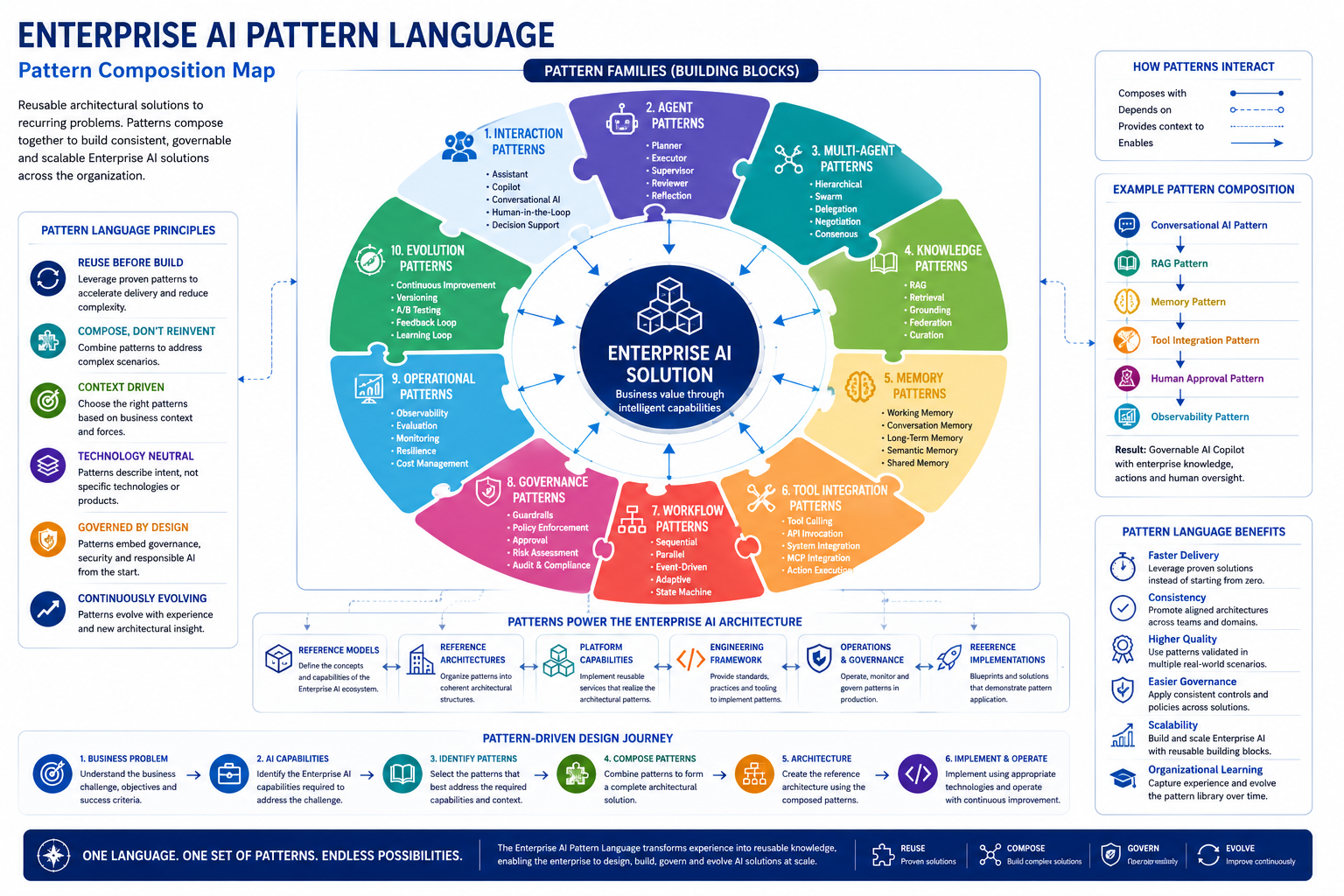
Introduction
As Enterprise Artificial Intelligence becomes an increasingly established enterprise capability, organizations begin to encounter recurring architectural and engineering challenges that extend beyond individual projects. Regardless of industry, business domain, or technology stack, many AI initiatives must address similar concerns, such as integrating enterprise knowledge with intelligent systems, orchestrating multiple AI agents, managing long-running reasoning processes, governing autonomous behavior, coordinating human and AI collaboration, preserving contextual memory, or connecting AI capabilities with enterprise applications and business processes.
Although the technologies used to address these challenges evolve rapidly, the underlying architectural problems are far more stable. Organizations repeatedly face the same categories of design decisions as they expand their Enterprise AI capabilities, and over time they discover that certain architectural approaches consistently produce better outcomes than others. Capturing and reusing these proven approaches is a hallmark of every mature engineering discipline.
This progression is well established across the broader field of enterprise architecture and software engineering. Architectural disciplines have long relied on patterns to capture solutions to recurring design problems. Software Engineering formalized design patterns to promote reusable object-oriented solutions. Enterprise Integration introduced messaging and integration patterns that continue to guide distributed systems decades after their original definition. Cloud Architecture has developed patterns for scalability, resilience, elasticity, and fault tolerance that remain applicable across successive generations of cloud technologies. In each case, patterns transform accumulated implementation experience into reusable organizational knowledge that can be applied consistently across future initiatives.
Enterprise Artificial Intelligence has reached a similar stage of maturity. As organizations build increasingly sophisticated AI ecosystems, recurring architectural solutions naturally emerge. Architects encounter the same integration challenges across different initiatives. Engineering teams repeatedly solve similar orchestration and workflow problems. Governance functions establish comparable control mechanisms for responsible AI adoption, while operations teams implement recurring approaches to monitoring, evaluation, resilience, and continuous improvement. These recurring solutions represent valuable organizational knowledge that should be documented, standardized, and reused rather than rediscovered within every new project.
The Enterprise AI Operating Framework (EAIOF) addresses this need by establishing an Enterprise AI Pattern Language. Rather than treating patterns as isolated recommendations, the framework organizes them into a coherent body of reusable architectural and engineering knowledge. Each pattern captures a proven solution to a recurring problem encountered during the design, implementation, governance, or operation of Enterprise AI capabilities. Collectively, these patterns establish a common vocabulary that enables architects, engineers, and governance teams to discuss reusable solutions with greater precision and consistency.
It is important to distinguish the role of patterns from other architectural artifacts defined by the EAIOF. The Enterprise AI Reference Models describe the conceptual structure of the Enterprise AI ecosystem and identify the capabilities and relationships that define the domain. The Enterprise AI Reference Architectures organize those concepts into architectural structures suitable for enterprise implementation. Enterprise AI Patterns, in contrast, address recurring architectural and engineering problems that arise within those structures. They describe approaches that have consistently demonstrated their effectiveness across multiple contexts without prescribing specific technologies or implementation products.
In this sense, patterns complement rather than replace the conceptual and architectural foundations established by the framework. Reference Models explain what constitutes the Enterprise AI ecosystem. Reference Architectures define how those concepts are organized into an enterprise architecture. Patterns explain how recurring architectural and engineering challenges can be addressed effectively within that architectural context. Together, these artifacts provide a progression from conceptual understanding to architectural organization and, finally, to reusable implementation guidance.
The objective of the Enterprise AI Pattern Language is therefore not to standardize technologies or mandate implementation choices. Instead, it captures architectural knowledge that remains valuable across different industries, organizational contexts, and technology landscapes. Each pattern documents a recurring problem, describes the architectural forces that influence its solution, presents an approach that has proven effective in practice, and discusses the benefits, consequences, and trade-offs associated with applying that approach. This structure enables architects and engineers to make informed design decisions based on accumulated organizational knowledge rather than relying solely on individual project experience.
The adoption of a common Pattern Language provides substantial benefits throughout the Enterprise AI lifecycle. Architectural consistency improves because similar challenges are addressed using comparable design approaches. Engineering teams accelerate delivery by building upon proven solutions instead of repeatedly solving the same problems from first principles. Reference Architectures become more consistent because they can incorporate standardized patterns rather than project-specific designs. Governance activities become more predictable because recurring architectural structures are understood uniformly across the organization. At the same time, knowledge becomes increasingly reusable across projects, business domains, and organizational units, enabling organizational learning to accumulate as each successful implementation contributes to the evolution of the enterprise pattern library.
Within the broader EAIOF, the Enterprise AI Pattern Language serves as the bridge between architecture and implementation. It transforms architectural intent into reusable design knowledge, allowing organizations to operationalize the concepts defined by the Reference Models and the structures defined by the Reference Architectures through proven architectural practices. In doing so, it strengthens consistency across engineering, governance, and operations while preserving the flexibility required to adopt new technologies and implementation approaches.
Ultimately, the Enterprise AI Pattern Language transforms individual implementation experience into an enterprise asset. By capturing proven solutions to recurring architectural and engineering challenges, it enables organizations to approach Enterprise AI with greater confidence, consistency, and architectural discipline. Rather than repeatedly reinventing solutions to familiar problems, the enterprise builds upon an evolving body of knowledge that reflects its accumulated experience, supporting the sustainable and scalable adoption of Artificial Intelligence across the organization.
What Is an Enterprise AI Pattern?
An Enterprise AI Pattern is a reusable solution to a recurring architectural or engineering problem encountered during the design, implementation, governance, or operation of Enterprise Artificial Intelligence. Rather than prescribing a specific implementation, an Enterprise AI Pattern captures proven architectural knowledge that has demonstrated its effectiveness across multiple initiatives, organizational contexts, and technology environments. Its purpose is to provide guidance for solving recurring problems in a consistent and repeatable manner while preserving the flexibility to adopt different implementation approaches.
The value of a pattern lies in its ability to transform practical experience into reusable organizational knowledge. As organizations mature their Enterprise AI capabilities, they repeatedly encounter similar architectural challenges. Enterprise knowledge must be integrated into intelligent systems, AI agents must be orchestrated to collaborate effectively, contextual information must be managed across interactions, governance controls must be embedded into autonomous processes, and AI capabilities must be integrated with enterprise applications and business workflows. Although the technologies used to address these challenges may differ from one project to another, the underlying architectural problems are often remarkably consistent.
Enterprise AI Patterns capture these recurring solutions so that they can be applied consistently across the organization. Instead of approaching each new initiative as a unique design exercise, architects and engineers can build upon proven approaches that have already demonstrated their value in comparable situations. This not only improves the quality and consistency of Enterprise AI solutions but also enables organizations to accumulate architectural knowledge over time rather than repeatedly solving the same problems from first principles.
Understanding what constitutes a pattern also requires distinguishing it from other architectural artifacts within the Enterprise AI Operating Framework (EAIOF). An Enterprise AI Pattern is not a framework. Frameworks provide implementation capabilities, runtime services, or technical infrastructure that support the development of AI solutions. Patterns, by contrast, describe reusable design approaches that can be realized through many different frameworks or technologies. They define architectural intent rather than technical implementation.
Similarly, an Enterprise AI Pattern is not a commercial product. Products represent specific vendor implementations with defined features, interfaces, and operational characteristics. Patterns remain independent of vendors and technologies, allowing the same architectural solution to be implemented using different products as technology landscapes evolve.
Enterprise AI Patterns also serve a different purpose from the Reference Models and Reference Architectures defined by the EAIOF. Reference Models describe the conceptual structure of the Enterprise AI ecosystem by identifying its capabilities, responsibilities, and relationships. Reference Architectures organize those concepts into coherent architectural structures suitable for enterprise implementation. Patterns complement these artifacts by describing proven approaches for addressing recurring architectural and engineering challenges that arise within those conceptual and architectural structures. In this way, patterns operationalize architectural knowledge without altering the conceptual foundation upon which the architecture is built.
Likewise, a pattern should not be confused with an implementation guide. Implementation guides explain how to configure, deploy, or use a particular technology, framework, or platform. Patterns deliberately avoid this level of specificity. By remaining technology-neutral, they retain their relevance as implementation technologies evolve, allowing organizations to modernize their solutions without abandoning the architectural knowledge captured by the pattern.
Within the EAIOF, every Enterprise AI Pattern is documented within a clearly defined architectural context. A pattern identifies the recurring problem that organizations encounter, explains the organizational and architectural circumstances in which that problem arises, and describes the forces, constraints, and trade-offs that influence possible solutions. It then presents an architectural approach that has consistently demonstrated its effectiveness across multiple scenarios and discusses the consequences of applying that approach, including both its advantages and its limitations. This structure enables architects and engineers to understand not only how a problem can be addressed, but also why the proposed solution is appropriate and under which circumstances it should be adopted.
By documenting patterns in this manner, the EAIOF provides architectural guidance rather than implementation instructions. Enterprise AI Patterns help architects evaluate alternative design approaches, enable engineering teams to build upon proven solutions instead of repeatedly rediscovering them, and promote architectural consistency by encouraging similar problems to be addressed using comparable design strategies. They also reduce unnecessary experimentation, accelerate solution delivery, and strengthen governance by promoting architectural structures that are already well understood throughout the organization.
Perhaps their greatest value lies in preserving the collective architectural experience of the enterprise. As Artificial Intelligence continues to evolve, new models, platforms, engineering frameworks, and infrastructure technologies will inevitably emerge. However, many of the architectural challenges associated with building, governing, and operating Enterprise AI will remain fundamentally the same. By capturing solutions at the level of architectural intent rather than technological realization, Enterprise AI Patterns continue to provide value across successive generations of AI technologies.
For these reasons, Enterprise AI Patterns should be regarded as strategic engineering assets within the EAIOF. They convert accumulated architectural experience into reusable organizational knowledge, enabling the enterprise to approach recurring challenges with greater consistency, confidence, and architectural discipline. In doing so, they provide a stable foundation for designing Enterprise AI solutions that remain maintainable, governable, and aligned with the long-term architectural vision of the Enterprise AI Operating Framework.
From Individual Patterns to a Pattern Language
Enterprise AI solutions are inherently multidisciplinary. A single solution frequently combines intelligent reasoning, enterprise knowledge, agent collaboration, orchestration, governance mechanisms, security controls, human interaction, operational monitoring, and platform services into a unified architecture. Because each of these concerns addresses a different aspect of the overall solution, no individual pattern can adequately capture the architectural complexity of an Enterprise AI system.
Each Enterprise AI Pattern is designed to solve a specific recurring problem within a clearly defined architectural context. A pattern provides guidance for addressing one particular concern—such as knowledge retrieval, conversational context management, agent coordination, or policy enforcement—but it is not intended to describe an entire solution. Enterprise AI architectures emerge through the deliberate composition of multiple complementary patterns, each contributing a distinct architectural responsibility while remaining consistent with the others.
This distinction is fundamental to the Enterprise AI Operating Framework (EAIOF). An individual pattern documents a proven solution to a recurring architectural or engineering challenge. A Pattern Language, however, extends beyond the individual pattern by defining how multiple patterns relate to one another and how they can be combined to address increasingly sophisticated enterprise problems. Rather than representing an inventory of independent design techniques, a Pattern Language provides a structured system of reusable architectural knowledge that supports the construction of complete Enterprise AI solutions.
Within the EAIOF, Enterprise AI Patterns are therefore designed to be composable rather than isolated. Each pattern addresses a well-defined responsibility while remaining compatible with other patterns across the Enterprise AI ecosystem. This composability enables architects to assemble solutions incrementally, selecting and combining the patterns that best address the requirements of a particular initiative. As additional patterns are introduced, the resulting architecture becomes progressively richer without sacrificing conceptual consistency or introducing unnecessary architectural complexity.
An Enterprise Customer Service Copilot provides a useful illustration of this approach. Although such a solution may appear to business stakeholders as a single intelligent application, its architecture typically consists of multiple interacting patterns, each responsible for addressing a specific architectural concern. A Copilot Pattern may define the interaction model between users and the intelligent assistant. A Conversation Pattern manages dialogue flow and conversational context, while a Retrieval-Augmented Generation (RAG) Pattern enables access to enterprise knowledge. A Knowledge Pattern governs the organization and lifecycle of enterprise information, and a Memory Pattern preserves contextual information across interactions. Additional patterns may enable interaction with enterprise applications through tool invocation, enforce organizational policies through guardrails, introduce human approval for sensitive decisions, evaluate response quality and business effectiveness, and provide the observability required to monitor, analyze, and continuously improve the solution throughout its operational lifecycle.
Viewed individually, each of these patterns addresses only a single aspect of the overall architecture. When combined, however, they form a cohesive Enterprise AI solution whose behavior is governed by a consistent set of reusable architectural practices. The value of the Pattern Language therefore lies not only in documenting individual solutions, but also in explaining how those solutions collaborate to address complex enterprise requirements.
This compositional approach provides significant architectural and organizational benefits. Complex solutions can be decomposed into smaller, reusable building blocks that are easier to understand, govern, implement, and evolve. Individual patterns can mature independently without disrupting the overall architecture, while architects retain the flexibility to select only those patterns that are appropriate for a given business context. Engineering teams benefit from proven architectural structures rather than repeatedly designing solutions from first principles, and governance becomes more consistent because recurring architectural concerns are addressed through standardized approaches that are understood across the organization. As patterns are reused across multiple initiatives, architectural knowledge accumulates and becomes increasingly valuable as an enterprise asset.
The Enterprise AI Pattern Language also plays a central role within the broader EAIOF. The Enterprise AI Reference Models define the conceptual structure of the Enterprise AI ecosystem, while the Reference Architectures organize those concepts into enterprise architectural structures. The Pattern Language complements these domains by providing reusable architectural solutions that enable those architectures to be realized consistently in practice. Engineering disciplines implement the selected patterns using appropriate technologies, and operational processes sustain the resulting capabilities throughout their lifecycle. In this way, patterns become the practical mechanism through which conceptual architecture is translated into repeatable engineering solutions without compromising architectural intent.
As the EAIOF evolves, the Pattern Language is expected to expand alongside the organization's architectural maturity. New patterns will emerge to address architectural challenges introduced by advances in Artificial Intelligence, while existing patterns will evolve as implementation experience grows and organizational knowledge accumulates. Equally important, the relationships between patterns will become increasingly rich, enabling the Pattern Language to provide a progressively more comprehensive architectural vocabulary for designing Enterprise AI systems.
For these reasons, the Enterprise AI Pattern Language should not be regarded as a simple catalog of independent design patterns. It represents an integrated system of reusable architectural knowledge in which each pattern contributes a specific solution and the Pattern Language defines how those solutions interact to form complete Enterprise AI architectures. By enabling architects to compose sophisticated solutions from proven and interoperable patterns, the Pattern Language establishes a repeatable design methodology that supports innovation while preserving the architectural consistency, governance, and long-term sustainability of Enterprise AI across the enterprise.
Why a Pattern Language Matters
As Enterprise AI adoption expands across an organization, architectural and engineering challenges inevitably begin to recur. Different business units develop similar intelligent capabilities, solution architects encounter comparable design problems, engineering teams implement equivalent integration and orchestration mechanisms, and governance functions address the same questions related to accountability, security, compliance, and operational oversight. While these initiatives may be independent from a business perspective, they frequently require solutions to the same underlying architectural problems.
Without a systematic approach for capturing and reusing these solutions, organizations tend to solve the same problems repeatedly. One team develops its own approach to agent orchestration, another implements a different strategy for contextual memory, while a third adopts an alternative method for integrating enterprise knowledge into intelligent systems. Governance mechanisms evolve independently across projects, observability capabilities are implemented inconsistently, human approval workflows vary from one solution to another, and engineering teams establish different architectural conventions for addressing similar requirements.
Although each implementation may successfully satisfy its immediate objectives, the enterprise gradually accumulates multiple architectural approaches for solving the same class of problems. Over time, this divergence creates unnecessary complexity. Solutions become more difficult to compare, reusable components become harder to identify, engineering practices lose consistency, governance policies become increasingly difficult to apply uniformly, and valuable architectural knowledge remains confined within individual project teams. As architectural diversity grows without deliberate coordination, long-term maintenance costs increase and the organization risks developing a portfolio of successful AI applications rather than a cohesive Enterprise AI capability.
The Enterprise AI Pattern Language addresses this challenge by transforming successful architectural experience into reusable organizational knowledge. Rather than allowing every project to develop its own design approach, the Pattern Language provides architects and engineers with a curated library of proven patterns that have demonstrated their effectiveness across multiple Enterprise AI initiatives. Recurring problems can therefore be addressed through established architectural solutions while preserving the flexibility required to accommodate different business requirements, organizational contexts, and implementation technologies.
This approach delivers benefits that extend well beyond individual projects. Architectural consistency improves because similar challenges are addressed using common design approaches derived from accumulated organizational experience. Engineering teams become more productive by building upon proven patterns instead of repeatedly designing solutions from first principles. Knowledge reuse becomes an integral part of the development process, allowing successful architectural practices to be shared across business units and continuously refined as the organization's experience grows.
The Pattern Language also strengthens governance by encouraging standardized architectural structures that can be governed consistently across the enterprise. When recurring concerns such as agent collaboration, knowledge integration, policy enforcement, observability, or human oversight are addressed through well-understood patterns, governance policies, security controls, and compliance requirements become easier to define, communicate, and enforce. At the same time, solution quality improves because architectural decisions are informed by approaches that have already demonstrated their effectiveness in practical implementations rather than relying exclusively on theoretical design or project-specific experimentation.
From an operational perspective, the use of standardized patterns also improves maintainability and scalability. Architects, engineers, and operations teams encounter familiar architectural structures across multiple initiatives, reducing the effort required to understand, support, and evolve Enterprise AI solutions over time. Because patterns encourage modular and composable architectures, individual capabilities can be extended, replaced, or refined without requiring extensive redesign of the surrounding system. This architectural modularity enables organizations to respond more effectively to evolving business needs and technological advances while preserving the integrity of the overall Enterprise AI ecosystem.
Perhaps the most important contribution of the Pattern Language is its ability to support continuous innovation without sacrificing architectural coherence. Artificial Intelligence is evolving rapidly, introducing new models, platforms, engineering techniques, and operational practices. By capturing architectural intent rather than technology-specific implementations, the Pattern Language allows individual patterns to evolve as new approaches emerge while preserving the broader architectural philosophy established by the Enterprise AI Operating Framework (EAIOF). Innovation therefore becomes an incremental process of architectural evolution rather than a sequence of disconnected technological reinventions.
Within the broader EAIOF, the Enterprise AI Pattern Language occupies a central position between architecture and engineering. The Enterprise AI Principles establish the architectural values that guide decision-making, while the Enterprise AI Reference Models define the conceptual structure of the Enterprise AI ecosystem. The Pattern Language complements these domains by providing reusable architectural solutions that enable those concepts to be realized consistently in practice. Engineering disciplines implement these patterns using technologies appropriate to their organizational context, and governance and operational functions ensure that the resulting capabilities remain secure, reliable, maintainable, and aligned with enterprise objectives throughout their lifecycle.
In this way, the Pattern Language becomes one of the principal mechanisms through which architectural knowledge is disseminated across the organization. Individual implementation experience is transformed into enterprise knowledge, allowing every new initiative to benefit from the architectural expertise accumulated through previous projects. Rather than repeatedly solving familiar problems, the organization continuously strengthens its collective engineering capability by refining and expanding its library of reusable patterns.
For these reasons, the Enterprise AI Pattern Language should be regarded as a strategic engineering asset of the EAIOF. It establishes a repeatable design methodology that promotes architectural consistency, accelerates engineering delivery, strengthens governance, improves solution quality, and supports the long-term evolution of Enterprise AI as a unified enterprise capability. By enabling organizations to reuse proven architectural knowledge while remaining adaptable to technological change, the Pattern Language provides an essential foundation for sustainable Enterprise AI adoption at enterprise scale.
Characteristics of Enterprise AI Patterns
The effectiveness of an Enterprise AI Pattern depends not only on the quality of the solution it describes, but also on the characteristics that make the pattern reusable, understandable, and applicable across a wide range of Enterprise AI initiatives. A pattern that is tightly coupled to a specific technology, applicable only to a single project, or difficult to understand cannot fulfill its purpose as a reusable architectural asset.
For this reason, every Enterprise AI Pattern defined within the Enterprise AI Operating Framework should exhibit a common set of architectural characteristics. These characteristics establish the quality criteria that ensure patterns remain valuable as Enterprise AI technologies, engineering practices, and organizational capabilities continue to evolve.
Together, they define the attributes expected of every pattern within the Enterprise AI Pattern Language.
Technology Neutral
Enterprise AI Patterns describe architectural solutions rather than implementation technologies.
They should remain independent of specific vendors, programming languages, orchestration frameworks, cloud platforms, databases, or AI models. This separation ensures that patterns remain applicable even as technologies evolve.
Problem-Oriented
Every pattern should address a clearly defined and recurring architectural or engineering problem.
The value of a pattern lies in solving challenges that organizations encounter repeatedly rather than documenting isolated implementation techniques or project-specific designs.
Reusable
Patterns should be applicable across multiple projects, business domains, and organizational contexts.
Although individual implementations may vary, the architectural intent of the pattern should remain sufficiently general to support enterprise-wide reuse.
Composable
Enterprise AI solutions are built through the combination of multiple patterns.
Each pattern should therefore integrate naturally with other patterns within the Enterprise AI Pattern Language, allowing architects to compose increasingly sophisticated solutions while preserving architectural consistency.
Context-Aware
Every pattern should clearly define the architectural context in which it applies.
Patterns are not universal solutions. Their effectiveness depends upon specific business objectives, architectural constraints, and organizational requirements. Clearly identifying the appropriate context enables architects to select patterns that are suitable for the problem they are addressing.
Proven
Patterns should represent solutions that have demonstrated their effectiveness through practical application.
They should capture architectural knowledge derived from successful implementations rather than theoretical design proposals or unvalidated ideas. This ensures that the Pattern Language reflects proven enterprise experience.
Consistent
Patterns should remain consistent with the Enterprise AI Semantic Model, the Enterprise AI Taxonomy, the Enterprise AI Principles, and the Enterprise AI Reference Models.
This consistency enables the Pattern Language to function as an integrated engineering knowledge base rather than as a collection of unrelated design techniques.
Traceable
Every Enterprise AI Pattern should be traceable to the architectural concepts and principles from which it is derived.
Patterns should reinforce the conceptual structures defined by the Reference Models and support the architectural direction established by the Enterprise AI Principles. This traceability ensures that engineering solutions remain aligned with the overall architecture of the Enterprise AI Operating Framework.
Documented
Patterns should be described using a clear, standardized structure that enables architects, engineers, governance teams, and business stakeholders to understand their purpose, applicability, benefits, and trade-offs without requiring detailed implementation knowledge.
A pattern should communicate architectural intent rather than technical complexity.
Evolutionary
Enterprise AI will continue to evolve.
New architectural challenges will emerge.
Existing solutions will mature.
Engineering practices will improve.
Patterns should therefore be treated as living architectural assets that evolve through accumulated organizational experience. Existing patterns may be refined, extended, or combined with new patterns as the Enterprise AI Pattern Language continues to mature, while preserving the architectural consistency of the Enterprise AI Operating Framework.
Collectively, these characteristics ensure that Enterprise AI Patterns remain durable, reusable, and strategically valuable. They enable the Pattern Language to capture proven architectural knowledge in a form that can be consistently applied across projects, business domains, and implementation technologies, while supporting the continuous evolution of Enterprise AI.
By adhering to these characteristics, Enterprise AI Patterns become far more than reusable design recommendations. They become managed engineering assets that preserve organizational knowledge, promote architectural consistency, accelerate solution delivery, and strengthen the long-term sustainability of the Enterprise AI Operating Framework.
Standard Structure for Every Pattern
A Pattern Language achieves its greatest value when every pattern is documented consistently. As the Enterprise AI Operating Framework evolves, the Enterprise AI Pattern Language will grow into a comprehensive library of reusable architectural solutions. Without a common documentation structure, patterns naturally diverge in terminology, level of detail, architectural focus, and engineering guidance, making them increasingly difficult to understand, compare, govern, and reuse.
For this reason, the Enterprise AI Operating Framework establishes a standardized specification for every Enterprise AI Pattern.
This specification ensures that each pattern captures not only the architectural solution itself, but also the reasoning behind that solution, the context in which it applies, the trade-offs involved, and its relationships with the broader Enterprise AI architecture. By documenting patterns according to a common structure, the Enterprise AI Pattern Language becomes a coherent engineering knowledge base rather than a collection of isolated design recommendations.
Every Enterprise AI Pattern should therefore include the following sections.
Pattern Name
The official name of the pattern.
The name should uniquely identify the architectural solution and remain consistent across architecture documentation, engineering standards, governance artifacts, training materials, and reference implementations.
Intent
A concise description of the purpose of the pattern.
This section explains the architectural objective that the pattern is intended to achieve and provides a high-level understanding of its role within the Enterprise AI ecosystem.
Problem
A clear description of the recurring architectural or engineering problem addressed by the pattern.
The problem should represent a challenge that organizations encounter repeatedly when designing, implementing, governing, or operating Enterprise AI solutions.
Context
The architectural situations in which the pattern is applicable.
This section identifies the business scenarios, architectural conditions, assumptions, and environmental characteristics under which the pattern provides an appropriate solution.
Forces
The architectural forces, constraints, quality attributes, competing concerns, and design trade-offs that influence the solution.
Understanding these forces enables architects to appreciate why the pattern is structured as it is and why alternative approaches may be less appropriate in similar situations.
Solution
A technology-independent description of the proven architectural solution.
The solution should explain the conceptual organization of the pattern without prescribing specific products, frameworks, programming languages, or implementation technologies.
Its objective is to describe architectural intent rather than implementation detail.
Consequences
The expected outcomes of applying the pattern.
This section should describe:
- Benefits
- Trade-offs
- Limitations
- Risks
- Operational implications
Understanding both the advantages and the consequences of a pattern enables informed architectural decision-making.
Applicability
Guidance describing when the pattern should—and should not—be used.
Patterns are context-dependent solutions rather than universal recommendations. This section helps architects determine whether the pattern is appropriate for a particular Enterprise AI scenario.
Related Patterns
Other Enterprise AI Patterns that naturally complement, extend, specialize, or compose with the current pattern.
These relationships reinforce the interconnected nature of the Enterprise AI Pattern Language and help architects construct complete Enterprise AI solutions by combining multiple patterns.
Anti-Patterns
Common implementation mistakes and architectural approaches that should be avoided.
Documenting anti-patterns enables organizations to learn from previous experience, avoid recurring design errors, and recognize solutions that may appear attractive but ultimately reduce architectural quality.
Related Reference Models
The Enterprise AI Reference Models that provide the conceptual foundation for the pattern.
This section establishes traceability between reusable engineering solutions and the architectural models from which they are derived.
Related Principles
The Enterprise AI Principles that motivate or justify the pattern.
Identifying these relationships demonstrates how the pattern reinforces the architectural philosophy of the Enterprise AI Operating Framework.
Related Capabilities
The Enterprise AI capabilities realized, supported, or enhanced by the pattern.
This section strengthens the relationship between reusable architectural solutions and the enterprise capabilities they enable.
Governance Considerations
Governance responsibilities associated with applying the pattern.
Where appropriate, this section should identify policy implications, security considerations, compliance requirements, human oversight expectations, audit concerns, or operational controls that should accompany the implementation of the pattern.
Implementation Considerations
Implementation guidance at a conceptual level.
Rather than prescribing technologies, this section highlights architectural considerations that implementation teams should evaluate when realizing the pattern within a specific Enterprise AI solution.
Optional Governance Metadata
To support lifecycle management, each pattern may include governance metadata such as:
- Version
- Status (Draft, Proposed, Approved, Deprecated, Retired)
- Owner
- Last Updated
- Change History
Although this metadata is not part of the pattern itself, it enables every Enterprise AI Pattern to be governed as a managed engineering asset throughout its lifecycle.
By documenting every pattern according to this standardized structure, the Enterprise AI Operating Framework ensures that the Enterprise AI Pattern Language remains coherent, navigable, and maintainable as it grows. Architects, engineers, governance teams, and business stakeholders can compare patterns consistently, understand their intent and applicability, and trace their relationships to Enterprise AI Principles, Reference Models, and enterprise capabilities.
More importantly, this common specification reinforces the role of patterns as strategic engineering assets. Every pattern becomes more than a reusable solution to a recurring problem; it becomes a governed component of the Enterprise AI knowledge architecture, contributing to a consistent, reusable, and continuously evolving engineering methodology for Enterprise AI across the organization.
Categories of Enterprise AI Patterns
As the Enterprise AI Pattern Language grows, patterns must be organized in a manner that enables architects, engineers, governance teams, and business stakeholders to discover, understand, and apply reusable architectural solutions efficiently. Without a structured organization, the pattern library would gradually become a collection of unrelated patterns, making navigation, reuse, and governance increasingly difficult.
For this reason, the Enterprise AI Operating Framework organizes Enterprise AI Patterns into a set of complementary architectural categories. Each category represents a distinct family of reusable solutions that addresses a specific dimension of Enterprise AI. Together, these pattern families provide comprehensive coverage of the architectural and engineering challenges encountered when designing, implementing, governing, and operating Enterprise AI solutions.
Although each category focuses on a particular architectural concern, the categories are not independent. Enterprise AI solutions are typically composed by combining patterns from multiple categories, allowing architects to construct sophisticated solutions while preserving consistency with the overall Enterprise AI architecture.
The Enterprise AI Pattern Language is initially organized into the following pattern families.
1. Interaction Patterns
Interaction Patterns describe how people and intelligent systems collaborate to achieve business objectives.
These patterns define user interaction models, decision-support mechanisms, approval processes, conversational experiences, and collaborative workflows that enable productive human–AI partnerships.
Representative patterns include:
- Assistant Pattern
- Copilot Pattern
- Conversational AI Pattern
- Decision Support Pattern
- Collaborative Intelligence Pattern
- Human-in-the-Loop Pattern
- Human Approval Pattern
- Feedback Pattern
2. Agent Patterns
Agent Patterns define the internal behavior and responsibilities of intelligent agents.
These patterns describe how agents reason, plan, coordinate actions, execute tasks, evaluate results, and pursue business objectives while operating within the architectural boundaries established by the Enterprise AI Operating Framework.
Representative patterns include:
- Task Agent Pattern
- Planner Pattern
- Executor Pattern
- Coordinator Pattern
- Supervisor Pattern
- Reviewer Pattern
- Evaluator Pattern
- Reflection Pattern
- Goal-Oriented Agent Pattern
- Autonomous Agent Pattern
- Digital Worker Pattern
3. Multi-Agent Patterns
Multi-Agent Patterns describe how multiple intelligent agents collaborate to solve problems that exceed the capabilities of an individual agent.
These patterns establish reusable approaches for coordination, delegation, supervision, negotiation, consensus, and distributed reasoning.
Representative patterns include:
- Sequential Collaboration Pattern
- Hierarchical Multi-Agent Pattern
- Peer Collaboration Pattern
- Swarm Pattern
- Delegation Pattern
- Negotiation Pattern
- Consensus Pattern
- Arbitration Pattern
- Supervisor–Worker Pattern
- Planner–Executor Pattern
4. Knowledge Patterns
Knowledge Patterns describe how enterprise knowledge is organized, governed, retrieved, and applied within Enterprise AI solutions.
These patterns ensure that intelligent systems operate using reliable, relevant, and governed organizational knowledge.
Representative patterns include:
- Retrieval-Augmented Generation (RAG) Pattern
- Knowledge Retrieval Pattern
- Grounding Pattern
- Knowledge Federation Pattern
- Knowledge Synchronization Pattern
- Semantic Search Pattern
- Knowledge Curation Pattern
- Context Assembly Pattern
5. Memory Patterns
Memory Patterns describe how intelligent systems preserve and use contextual information over time.
These patterns support conversational continuity, long-running reasoning, contextual awareness, organizational learning, and intelligent adaptation.
Representative patterns include:
- Working Memory Pattern
- Conversation Memory Pattern
- Long-Term Memory Pattern
- Semantic Memory Pattern
- Episodic Memory Pattern
- Shared Memory Pattern
- Memory Consolidation Pattern
- Memory Retrieval Pattern
6. Tool Integration Patterns
Tool Integration Patterns describe how Enterprise AI capabilities interact with enterprise systems, external services, business applications, and digital tools.
These patterns enable intelligent systems to extend reasoning into action through controlled integration mechanisms.
Representative patterns include:
- Tool Calling Pattern
- API Invocation Pattern
- Enterprise System Integration Pattern
- Database Access Pattern
- Workflow Invocation Pattern
- MCP Integration Pattern
- External Service Pattern
- Action Execution Pattern
7. Workflow Patterns
Workflow Patterns describe how Enterprise AI coordinates business activities, intelligent agents, enterprise services, and human participants to achieve business outcomes.
These patterns provide reusable orchestration mechanisms for deterministic and adaptive enterprise processes.
Representative patterns include:
- Sequential Workflow Pattern
- Parallel Workflow Pattern
- Event-Driven Pattern
- Adaptive Workflow Pattern
- Long-Running Workflow Pattern
- Compensation Pattern
- Checkpoint Pattern
- State Machine Pattern
8. Governance Patterns
Governance Patterns define reusable mechanisms that ensure Enterprise AI operates within organizational policies, regulatory requirements, ethical principles, and security constraints.
These patterns establish architectural approaches for organizational oversight, accountability, and responsible AI.
Representative patterns include:
- Policy Enforcement Pattern
- Guardrails Pattern
- Risk Assessment Pattern
- Approval Pattern
- Identity Delegation Pattern
- Audit Pattern
- Compliance Pattern
- Responsible AI Pattern
9. Operational Patterns
Operational Patterns describe how Enterprise AI solutions are monitored, evaluated, optimized, and operated throughout their lifecycle.
These patterns support reliability, resilience, observability, performance management, and operational excellence.
Representative patterns include:
- Observability Pattern
- Evaluation Pattern
- Continuous Evaluation Pattern
- Benchmark Pattern
- Cost Optimization Pattern
- Monitoring Pattern
- Fallback Pattern
- Resilience Pattern
- Circuit Breaker Pattern
- Model Routing Pattern
10. Evolution Patterns
Evolution Patterns describe how Enterprise AI capabilities continuously improve over time.
These patterns support experimentation, controlled deployment, organizational learning, model evolution, prompt optimization, and continuous adaptation as technologies and business requirements evolve.
Representative patterns include:
- Continuous Learning Pattern
- Experimentation Pattern
- Canary Pattern
- Shadow Deployment Pattern
- A/B Evaluation Pattern
- Prompt Evolution Pattern
- Model Evolution Pattern
- Knowledge Evolution Pattern
Together, these pattern families form the Enterprise AI Pattern Language. Each category contributes reusable solutions for a particular architectural concern, while remaining fully interoperable with the others. Enterprise AI solutions are therefore constructed by combining patterns drawn from multiple categories, enabling architects to assemble complex systems from proven architectural building blocks rather than designing every solution from first principles.
The Enterprise AI Pattern Language is intentionally evolutionary. As Artificial Intelligence continues to mature, new architectural challenges will emerge and additional patterns will be incorporated into existing categories or, where appropriate, new pattern families may be introduced. This approach enables the pattern library to expand while preserving the consistency, navigability, and architectural coherence of the Enterprise AI Operating Framework.
By organizing patterns into well-defined architectural categories, the EAIOF transforms a collection of reusable solutions into a structured engineering knowledge system. This organization enables architects and engineers to identify relevant patterns more efficiently, promotes enterprise-wide reuse, and ensures that the Enterprise AI Pattern Language remains a scalable and enduring engineering asset capable of supporting the continuous evolution of Enterprise AI.
Relationships Between Patterns
The Enterprise AI Pattern Language should not be interpreted as a collection of independent architectural solutions. Although each Enterprise AI Pattern addresses a specific recurring problem, Enterprise AI systems are inherently compositional. Intelligent solutions emerge through the coordinated application of multiple patterns, each contributing a distinct architectural responsibility within a broader enterprise architecture. Understanding these relationships is therefore as important as understanding the individual patterns themselves.
This characteristic distinguishes a true Pattern Language from a simple catalog of design patterns. An individual pattern captures a proven solution to a particular architectural or engineering challenge. A Pattern Language, however, defines how those individual solutions relate to one another, complement one another, and can be composed to address increasingly sophisticated enterprise requirements. The value of the Pattern Language lies not only in the quality of its individual patterns, but also in the architectural relationships that enable those patterns to operate together as a coherent system.
Within the Enterprise AI Operating Framework (EAIOF), Enterprise AI Patterns are intentionally designed to be interoperable. They share a common architectural philosophy, reinforce the Enterprise AI Principles, align with the Enterprise AI Reference Models, and support the architectural structures defined by the Enterprise AI Reference Architectures. Rather than competing as alternative approaches, the patterns address different architectural concerns that collectively contribute to the design, implementation, governance, and operation of Enterprise AI capabilities.
This compositional approach reflects the multidisciplinary nature of Enterprise AI itself. A complete Enterprise AI solution rarely consists of a single capability. Instead, it combines interaction models that support communication with users, intelligent agents that perform reasoning and decision-making, orchestration mechanisms that coordinate activities across multiple components, knowledge capabilities that provide organizational context, memory mechanisms that preserve continuity across interactions, integration capabilities that connect AI systems with enterprise applications, governance mechanisms that enforce organizational policies, and operational capabilities that ensure reliability, observability, and continuous improvement. Each pattern contributes one of these capabilities while relying on complementary patterns to complete the overall solution.
These relationships can be observed in many Enterprise AI architectures. A Planner Pattern, for example, may decompose a business objective into a series of executable activities and delegate their execution to a Supervisor Pattern responsible for coordinating the overall process. The Supervisor Pattern may then distribute work across multiple specialized Executor Patterns, each focused on a specific task or area of expertise while maintaining alignment with the overall objective.
During execution, individual Executor Patterns often collaborate with Tool Integration Patterns to interact with enterprise applications, business services, external APIs, workflow engines, or operational platforms. Where organizational knowledge is required, these integration mechanisms frequently work in conjunction with the Retrieval-Augmented Generation (RAG) Pattern, which retrieves relevant enterprise information before reasoning occurs. The RAG Pattern itself depends upon broader Knowledge Patterns that define how enterprise knowledge is organized, governed, versioned, and made available throughout the organization.
Knowledge retrieval is commonly complemented by Memory Patterns that preserve conversational context, historical interactions, and long-term organizational knowledge. By combining enterprise knowledge with contextual memory, intelligent systems are able to produce more accurate reasoning, maintain continuity across interactions, and improve the consistency of their decisions over time.
Governance is embedded throughout this execution model rather than applied as an afterthought. Governance Patterns—particularly Guardrails Patterns—operate continuously to enforce organizational policies, security requirements, ethical constraints, and operational boundaries. Where business, regulatory, financial, or operational risk requires additional oversight, Human Approval Patterns introduce review and authorization mechanisms that ensure critical decisions remain subject to appropriate human accountability.
Operational concerns are addressed through another complementary set of patterns. Evaluation Patterns continuously assess the quality, reliability, groundedness, accuracy, and business effectiveness of Enterprise AI capabilities, while Observability Patterns and other operational patterns provide visibility into execution, performance, operational health, and opportunities for continuous improvement. Together, these patterns ensure that Enterprise AI solutions remain measurable, governable, and sustainable throughout their operational lifecycle.
These examples illustrate a defining characteristic of the Enterprise AI Pattern Language: patterns rarely operate in isolation. They reinforce one another, depend upon one another, and collectively provide architectural solutions that are considerably more capable than any individual pattern considered independently. The effectiveness of an Enterprise AI architecture therefore depends not only on selecting appropriate patterns, but also on understanding how those patterns interact to form a coherent and balanced solution.
The relationships between patterns also establish architectural traceability across the EAIOF. The Enterprise AI Principles define the architectural values that motivate the design of the patterns. The Enterprise AI Reference Models identify the conceptual structures to which those patterns apply, while the Enterprise AI Reference Architectures organize the patterns into enterprise architectural structures. Engineering disciplines implement the selected patterns using technologies appropriate to the organizational context, and operational practices sustain the resulting capabilities throughout their lifecycle. This progression ensures that implementation decisions remain connected to the conceptual and architectural foundations established by the framework.
As the Enterprise AI Pattern Language evolves, new patterns will naturally emerge to address architectural challenges introduced by advances in Artificial Intelligence and changing organizational requirements. These new patterns should extend the existing Pattern Language rather than exist independently. By establishing meaningful relationships with previously defined patterns, they enrich the architectural knowledge of the enterprise while preserving the consistency and integrity of the overall engineering methodology.
For these reasons, the Enterprise AI Pattern Language should be understood as an interconnected system of reusable architectural knowledge rather than as a collection of isolated design techniques. Its greatest value lies in the relationships that enable individual patterns to collaborate in the construction of sophisticated, governable, maintainable, and scalable Enterprise AI solutions. Through this integrated approach, the Pattern Language transforms accumulated architectural experience into a coherent engineering methodology that supports consistent design, effective governance, continuous evolution, and the long-term maturity of Enterprise AI across the enterprise.
Pattern Selection
One of the most common causes of architectural inconsistency in Enterprise AI initiatives is allowing technology selection to drive solution design. Organizations frequently begin projects by evaluating foundation models, orchestration frameworks, vector databases, AI platforms, or other implementation technologies before establishing a clear understanding of the business problem they intend to solve or the enterprise capabilities they need to develop. Although this technology-first approach may accelerate initial implementation, it often produces architectures that are tightly coupled to specific products and increasingly difficult to govern, reuse, and evolve over time.
The Enterprise AI Operating Framework (EAIOF) promotes a fundamentally different approach. Architectural design should be driven by business objectives, enterprise capabilities, and reusable architectural knowledge rather than by implementation technologies. Within this approach, pattern selection is not a technical activity performed after architectural decisions have been made; it is a core architectural activity that bridges conceptual understanding and solution design. Enterprise AI Patterns provide reusable solutions to recurring architectural problems, and selecting the appropriate patterns establishes the architectural direction that implementation technologies are expected to realize.
For this reason, the EAIOF defines a deliberate progression for designing Enterprise AI solutions. The process begins with the identification of the business problem or organizational opportunity that motivates the initiative. From this understanding, the required business capabilities are identified, providing a clear view of the organizational outcomes that the solution is expected to support. These business capabilities are then translated into Enterprise AI capabilities, which define the functional responsibilities that the Enterprise AI ecosystem must provide.
At this stage, the Enterprise AI Reference Models provide the conceptual framework that positions those capabilities within the broader Enterprise AI ecosystem. By establishing their responsibilities, relationships, and architectural boundaries, the Reference Models ensure that the required capabilities are understood consistently before architectural solutions are considered. Only after this conceptual understanding has been established do architects select the Enterprise AI Patterns that address the recurring architectural and engineering challenges associated with those capabilities.
The selected patterns are subsequently incorporated into the Enterprise AI Reference Architectures, where they are organized into coherent architectural structures that satisfy the requirements of the enterprise. Only after the architecture has been defined are implementation technologies selected to realize the architectural solution. Technologies therefore become mechanisms for implementing architectural intent rather than factors that determine the architecture itself.
This progression can be summarized as follows:
Business Problem → Business Capability → Enterprise AI Capability → Reference Models → Enterprise AI Patterns → Reference Architecture → Implementation Technologies
Each stage in this progression builds upon the previous one. Business requirements establish architectural intent, the conceptual structure of the Enterprise AI ecosystem provides the context for architectural reasoning, reusable patterns address recurring design challenges, and Reference Architectures organize those patterns into complete enterprise solutions. Technologies are selected only after these architectural decisions have been made, ensuring that implementation remains aligned with long-term enterprise objectives rather than with short-term technology preferences.
Adopting this sequence provides significant architectural and organizational benefits. Similar business challenges are addressed through consistent architectural approaches because architects draw upon the same library of reusable patterns. Engineering teams benefit from established architectural structures rather than designing each solution independently, reducing both implementation effort and architectural variability. Technology choices become more flexible because they are driven by architectural requirements instead of defining those requirements. As technologies evolve, organizations can replace implementation components without redesigning the underlying architecture, thereby improving long-term maintainability and reducing unnecessary technological dependency.
Pattern selection also strengthens architectural governance. Because architectural decisions are expressed through reusable patterns rather than product-specific implementations, governance functions can evaluate solutions against Enterprise AI Principles, Reference Models, and established architectural practices instead of focusing solely on individual technologies. This improves consistency across projects, facilitates architecture reviews, and enables governance policies to be applied uniformly throughout the Enterprise AI landscape.
Equally important, pattern selection reinforces the relationships between the major architectural domains of the EAIOF. The Enterprise AI Principles establish the architectural values that guide decision-making. The Enterprise AI Reference Models define the conceptual structure of the Enterprise AI ecosystem. Enterprise AI Patterns provide reusable solutions for realizing those conceptual structures, while the Enterprise AI Reference Architectures organize the selected patterns into complete enterprise architectures. Engineering disciplines implement those architectures using technologies appropriate to the organizational context, and operational functions sustain the resulting capabilities throughout their lifecycle. This progression creates end-to-end architectural traceability, ensuring that every implementation remains connected to the conceptual foundations established by the framework.
Enterprise AI architects should therefore regard pattern selection as a strategic architectural activity rather than as an implementation detail. Patterns are not optional design techniques applied after technologies have been chosen; they are reusable architectural assets that connect conceptual architecture with practical engineering. Selecting appropriate patterns before evaluating implementation technologies enables organizations to develop Enterprise AI solutions that are consistent, reusable, governable, maintainable, and capable of evolving as technologies and business requirements change.
For these reasons, pattern selection represents one of the most important architectural disciplines within the EAIOF. By ensuring that business objectives and architectural intent determine the selection of reusable patterns before implementation technologies are considered, the framework establishes a disciplined design methodology that promotes architectural consistency, minimizes unnecessary technological coupling, and supports the sustainable evolution of Enterprise AI as an enterprise capability.
Pattern Language as Organizational Knowledge
One of the most significant strategic contributions of an Enterprise AI Pattern Language extends well beyond its role in architecture and engineering. While patterns provide reusable solutions to recurring design problems, their broader value lies in their ability to capture, preserve, and continuously expand the organization's architectural knowledge. Every Enterprise AI initiative generates valuable experience through the architectural decisions that are made, the challenges that are overcome, and the solutions that prove effective in practice. Unless this experience is systematically captured, much of it remains confined to individual projects or the teams that participated in their delivery.
This is a common challenge in large organizations. Architects often solve similar problems independently, engineering teams repeatedly rediscover design approaches that have already been validated elsewhere, and valuable lessons learned are gradually lost as projects conclude, technologies evolve, or organizational priorities change. Although the enterprise may accumulate a growing portfolio of successful AI solutions, it does not necessarily accumulate the architectural knowledge that enabled those solutions to succeed. As a result, organizational learning progresses more slowly than technological adoption, limiting the organization's ability to build Enterprise AI capabilities consistently and efficiently.
The Enterprise AI Operating Framework (EAIOF) addresses this challenge by treating architectural knowledge as a strategic enterprise asset. The Enterprise AI Pattern Language provides the mechanism through which this knowledge is institutionalized. Rather than documenting isolated implementations or technology-specific solutions, it captures the architectural intent that made those implementations successful. Each pattern records a recurring problem, the context in which it occurs, the architectural forces that influence the solution, the design approach that has proven effective, and the consequences associated with its application. In doing so, the Pattern Language preserves the reasoning behind successful architectures rather than simply describing their technical realization.
This distinction is fundamental to the long-term value of the framework. Technologies inevitably evolve, implementation platforms are replaced, engineering practices mature, projects conclude, and organizational structures change. Architectural knowledge, however, can remain relevant across these changes when it is captured at the appropriate level of abstraction. By documenting reusable patterns rather than technology-specific implementations, the EAIOF ensures that the knowledge accumulated through one generation of Enterprise AI solutions continues to inform future generations, regardless of how the underlying technology landscape evolves.
As organizations gain experience with Enterprise AI, the Pattern Language naturally becomes richer and more valuable. Successful initiatives contribute new insights that refine existing patterns or reveal opportunities for additional ones. Recurring architectural challenges strengthen the organization's understanding of proven design approaches, while new engineering practices and governance experiences expand the body of reusable knowledge available to future initiatives. Over time, the Pattern Language evolves from a collection of architectural patterns into a strategic repository of enterprise engineering knowledge that reflects the organization's accumulated experience in designing, implementing, governing, and operating Enterprise AI.
This continuous accumulation of knowledge produces substantial organizational benefits. New initiatives can begin with proven architectural foundations instead of developing solutions from first principles. Engineering teams benefit from the collective experience of previous projects, reducing unnecessary experimentation and accelerating delivery. Architectural consistency improves because successful approaches are reused across business domains, while governance becomes more effective because recurring architectural structures are understood, documented, and applied consistently throughout the organization. The Pattern Language also supports professional development by providing architects and engineers with a structured body of organizational knowledge that complements project-based experience and facilitates the transfer of expertise across teams.
Perhaps most importantly, institutionalizing architectural knowledge enables innovation to occur more effectively. When recurring problems are addressed through established patterns, architects and engineers can concentrate their efforts on genuinely new challenges rather than repeatedly solving familiar ones. The organization therefore spends less effort rediscovering existing knowledge and more effort extending its architectural capabilities, allowing Enterprise AI to evolve through continuous learning instead of repeated reinvention.
This capability directly supports one of the central objectives of the EAIOF: transforming Enterprise AI from a collection of independent initiatives into a sustainable enterprise capability. As architectural knowledge becomes institutionalized through the Pattern Language, every project contributes not only to immediate business outcomes but also to the long-term evolution of the organization's architectural maturity. Individual experience becomes enterprise knowledge, and enterprise knowledge becomes a reusable asset that benefits future initiatives across business units, engineering teams, and organizational boundaries.
The value of this knowledge extends beyond the lifecycle of any individual project. Because it is captured independently of specific technologies, products, or implementation approaches, it provides continuity despite changes in organizational structures, engineering practices, or technology platforms. This continuity enables the EAIOF to evolve incrementally while preserving the architectural reasoning that underpins its engineering discipline, ensuring that the framework becomes stronger as organizational experience accumulates.
For these reasons, the Enterprise AI Pattern Language should be regarded as considerably more than a library of reusable architectural patterns. It represents a managed repository of organizational engineering knowledge that captures, preserves, and continuously refines the collective architectural experience of the enterprise. By enabling systematic reuse, promoting organizational learning, and strengthening architectural consistency, it becomes one of the most valuable strategic assets of the EAIOF, supporting the organization's ability to design, engineer, govern, and evolve Enterprise AI with increasing confidence, maturity, and long-term sustainability.
Pattern Language as the Bridge Between Architecture and Engineering
The Enterprise AI Pattern Language occupies a unique position within the Enterprise AI Body of Knowledge. It represents the point at which the conceptual foundations established by the preceding domains are transformed into reusable architectural solutions that can be consistently applied throughout the engineering lifecycle. In doing so, it bridges the gap between architectural intent and engineering execution, enabling Enterprise AI to be implemented through proven design approaches rather than isolated technical decisions.
This role is fundamental to the Enterprise AI Operating Framework.
The Foundations domain establishes the conceptual worldview that defines Enterprise AI as an enterprise capability.
The Enterprise AI Semantic Model provides the common language through which that capability is described.
The Enterprise AI Taxonomy organizes Enterprise AI knowledge into a coherent enterprise classification system.
The Enterprise AI Principles establish the architectural beliefs that guide enterprise decision-making.
The Enterprise AI Reference Models describe the conceptual structure of the Enterprise AI ecosystem and define the architectural context within which Enterprise AI operates.
Building upon these domains, the Enterprise AI Pattern Language introduces the reusable architectural solutions that address the recurring design challenges encountered when translating conceptual architecture into practical enterprise solutions. Rather than defining new concepts or introducing new architectural structures, it captures proven approaches for realizing the architecture established by the Reference Models while remaining aligned with the Enterprise AI Principles and the broader architectural philosophy of the EAIOF.
This progression illustrates one of the central design philosophies of the Enterprise AI Operating Framework.
Concepts establish understanding.
Classifications organize knowledge.
Principles guide decisions.
Reference Models describe architecture.
Patterns realize architecture.
Engineering implements patterns.
Operations sustain the resulting capabilities.
Each domain builds upon the knowledge established by the domains that precede it, creating a continuous and traceable path from enterprise strategy to operational execution.
The Enterprise AI Pattern Language therefore serves as the architectural bridge between conceptual design and practical engineering. It translates architectural intent into reusable solution structures that engineering teams can consistently apply across projects, business domains, and implementation technologies. Instead of beginning with vendor products, programming frameworks, or project-specific designs, engineering teams begin with proven architectural patterns that embody the accumulated experience of the enterprise.
This approach provides significant organizational advantages.
Reference Architectures can be constructed from standardized architectural patterns rather than project-specific solutions.
Engineering standards can define consistent implementation approaches for patterns that are already understood across the organization.
Platform capabilities can be designed to support reusable architectural structures instead of isolated application requirements.
Governance can evaluate solutions against established architectural patterns rather than technology-specific implementations.
Operations can support recurring architectural structures that exhibit consistent behavior, operational characteristics, and lifecycle management requirements.
Most importantly, the Pattern Language ensures that Enterprise AI solutions are engineered from reusable architectural knowledge rather than from isolated implementation decisions. Every pattern captures organizational experience, every solution reinforces the enterprise architecture, and every successful implementation contributes to the continuous refinement of the organization's engineering knowledge.
This role becomes increasingly valuable as the Enterprise AI Operating Framework evolves. New technologies, engineering practices, platform capabilities, and implementation frameworks may emerge, but the Pattern Language continues to provide a stable architectural methodology for designing Enterprise AI solutions. Engineering practices can evolve without abandoning the architectural knowledge accumulated by the organization, ensuring that innovation strengthens rather than fragments the Enterprise AI ecosystem.
For this reason, the Enterprise AI Pattern Language should be regarded as one of the defining architectural assets of the Enterprise AI Operating Framework. It transforms architectural knowledge into reusable engineering guidance, establishes a common methodology for designing Enterprise AI solutions, and creates the essential connection between conceptual architecture and practical implementation.
Ultimately, the Enterprise AI Pattern Language enables the Enterprise AI Operating Framework to move from understanding Enterprise AI to engineering Enterprise AI. By providing a reusable architectural language for solving recurring design challenges, it ensures that Enterprise AI systems are constructed with consistency, governed through shared architectural practices, and continuously evolved upon a foundation of accumulated organizational knowledge rather than isolated technical experience. In doing so, it establishes one of the defining characteristics of the EAIOF: an enterprise-wide architectural language for designing, engineering, governing, operating, and continuously evolving Artificial Intelligence at enterprise scale.