Introduction
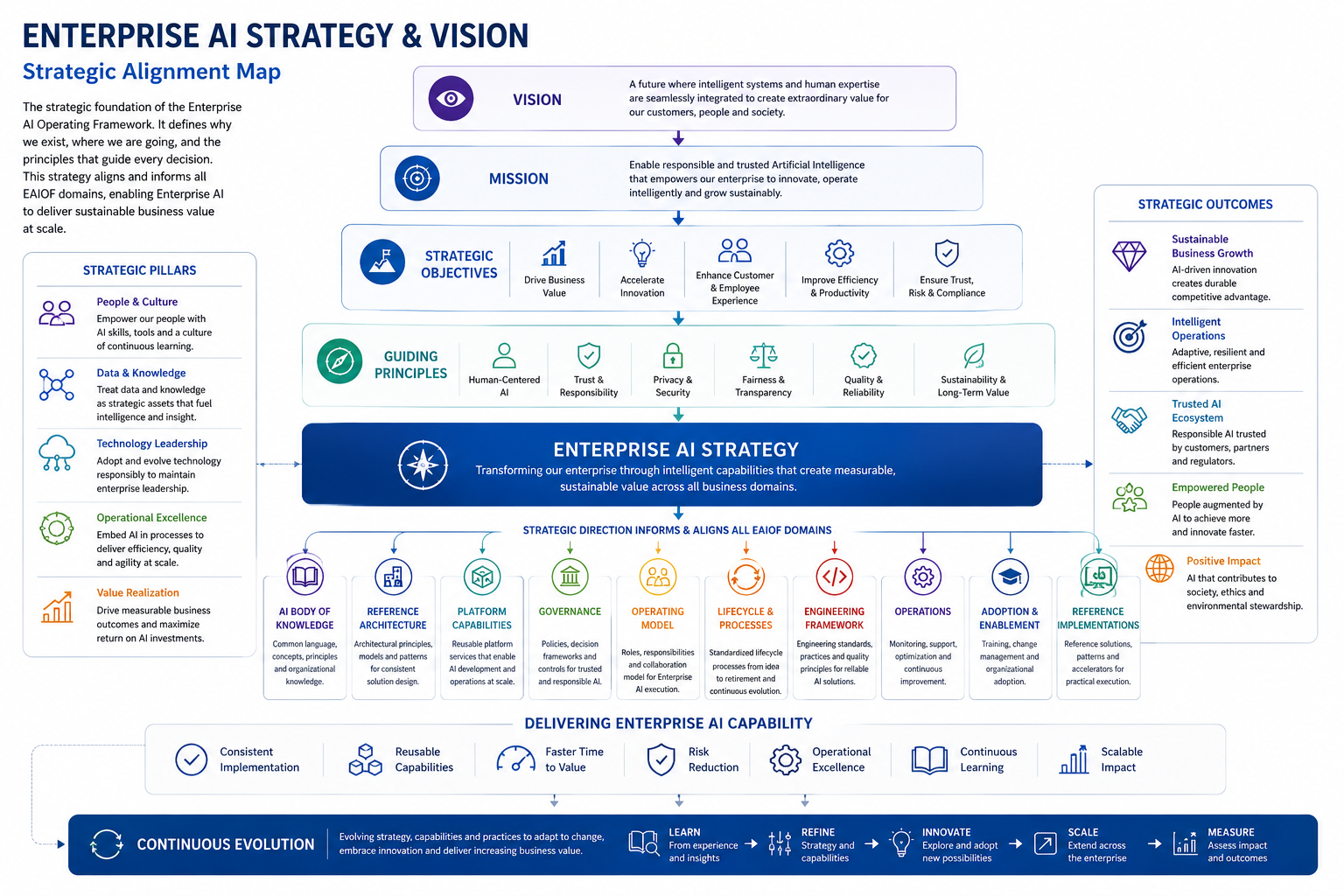
The Enterprise Strategy & Vision project establishes the strategic foundation of the Enterprise AI Operating Framework (EAIOF). Its purpose is to define why the organization is adopting Artificial Intelligence, what long-term outcomes it intends to achieve, and how AI contributes to the organization's overall business strategy.
Before defining enterprise architectures, platform capabilities, governance models, operating models, engineering frameworks, or implementation approaches, an organization must first establish a clear strategic direction. Every subsequent decision within the Enterprise AI Operating Framework derives its purpose from this direction. Without a shared vision, technology initiatives risk becoming isolated projects that deliver localized improvements without contributing to a coherent enterprise transformation.
Every mature organizational transformation begins with strategy.
Enterprise Architecture begins by defining the future state of the enterprise and the architectural vision required to achieve it.
Digital Transformation begins by establishing a strategic vision for how technology will reshape business capabilities, customer experiences, and operating models.
Business Strategy defines the long-term direction of the organization before investments, organizational structures, and operational initiatives are aligned to support that vision.
Artificial Intelligence should be approached in exactly the same manner.
Despite the rapid evolution of AI technologies, many organizations still approach Artificial Intelligence primarily as a technology initiative. Discussions frequently focus on Large Language Models, AI Agents, prompt engineering, Retrieval-Augmented Generation, vector databases, orchestration frameworks, cloud platforms, and implementation tools. These technologies are important, and they represent essential building blocks for modern AI solutions. However, they constitute only the implementation layer of Enterprise AI.
The true impact of Artificial Intelligence extends far beyond technology.
Artificial Intelligence fundamentally changes how organizations operate. It transforms the way decisions are made by augmenting human reasoning with intelligent recommendations and automated analysis. It changes how employees access, consume, and create knowledge. It reshapes business processes by introducing intelligent automation, autonomous execution, and continuous optimization. It influences software architecture by introducing reasoning capabilities, intelligent services, and autonomous agents as first-class architectural components. It redefines governance by requiring new approaches to accountability, transparency, risk management, and responsible AI. It changes operating models by enabling new forms of collaboration between people and intelligent systems. Ultimately, it transforms the relationship between humans, technology, and organizational knowledge.
For this reason, Enterprise AI cannot be understood solely through the perspective of technology adoption.
It must be understood as an enterprise transformation initiative.
Technology enables Artificial Intelligence, but strategy determines why it is adopted. Platforms provide technical capabilities, but vision determines how those capabilities contribute to business outcomes. Engineering delivers AI solutions, but organizational strategy determines where those solutions create value and how they support the long-term evolution of the enterprise.
This distinction is fundamental to the Enterprise AI Operating Framework.
The EAIOF does not begin with technologies because technologies continuously evolve. It begins with strategy because strategy provides the enduring direction that guides every architectural, governance, engineering, operational, and organizational decision made throughout the framework.
The purpose of the Enterprise Strategy & Vision project is therefore to establish this strategic direction.
It defines the enterprise vision for Artificial Intelligence, the mission that guides its adoption, the strategic objectives that justify investment, the principles that shape decision-making, the business capabilities the organization intends to develop, and the future operating state it seeks to achieve. Together, these elements provide the strategic alignment required to ensure that every subsequent project within the Enterprise AI Operating Framework contributes to a single, coherent organizational transformation.
In this sense, the Enterprise Strategy & Vision project represents far more than a strategic planning exercise. It establishes the enterprise-wide vision that aligns business leadership, enterprise architecture, governance, engineering, operations, and business domains around a common purpose. It provides the strategic foundation upon which the Enterprise AI Operating Framework is executed, ensuring that Artificial Intelligence is adopted not as a collection of disconnected technologies, but as a coordinated enterprise capability that continuously creates value for the organization.
The Evolution of Enterprise Technology
The history of enterprise technology can be understood as a continuous progression toward increasing organizational capability. Each major wave of technological innovation has fundamentally changed the way organizations operate, not simply by introducing new tools, but by expanding the role that technology plays in supporting business objectives, organizational performance, and decision-making.
Each generation has built upon the capabilities established by the previous one, gradually transforming technology from an operational enabler into a strategic organizational asset.
The first major generation of enterprise technology focused primarily on automation. Organizations replaced manual, paper-based activities with digital business applications capable of executing predefined processes more efficiently, accurately, and consistently. Enterprise Resource Planning (ERP) systems, Customer Relationship Management (CRM) platforms, Human Resources Management Systems (HRMS), and numerous line-of-business applications enabled organizations to digitize operational workflows and significantly improve productivity. Technology became the mechanism through which repetitive work could be standardized and executed at scale.
As organizations expanded their digital capabilities, a new challenge emerged. Business applications successfully automated individual processes, but they frequently operated in isolation. Information became distributed across independent systems, creating data silos and limiting end-to-end business visibility.
This challenge gave rise to the second major generation of enterprise technology: integration.
Organizations invested heavily in connecting applications through Application Programming Interfaces (APIs), Enterprise Service Buses (ESBs), messaging platforms, service-oriented architectures, and, more recently, event-driven architectures. The objective was no longer simply to automate individual activities, but to enable enterprise-wide business processes capable of flowing seamlessly across multiple systems. Technology evolved from supporting isolated applications to enabling connected enterprises.
As digital integration matured, organizations began generating unprecedented volumes of data. Operational systems, customer interactions, connected devices, digital channels, and integrated business processes continuously produced valuable information. The ability to collect data, however, did not automatically translate into the ability to understand it.
This realization initiated the third major generation of enterprise technology: the data-driven enterprise.
Organizations invested extensively in data platforms, data lakes, analytics, business intelligence, machine learning, and advanced reporting capabilities. Technology evolved once again, shifting its primary role from executing business processes to enabling organizations to understand those processes through data. Decision-making became increasingly informed by analytical insight, predictive models, and evidence-based business intelligence.
Artificial Intelligence represents the next stage in this evolutionary progression.
Unlike previous technological generations, Enterprise AI is not simply another application layer, integration mechanism, or analytical capability added to existing architectures. It introduces an entirely new organizational capability: the ability for enterprise systems to reason.
Traditional enterprise software executes predefined logic created by human designers. Business rules determine how applications respond to specific inputs, workflows define how processes are executed, and algorithms perform calculations according to explicitly programmed instructions.
Artificial Intelligence extends this model by introducing systems capable of interpreting information, understanding natural language, generating content, synthesizing knowledge, supporting complex decision-making, planning actions, interacting conversationally with users, invoking enterprise capabilities through tools, collaborating with other intelligent systems, and continuously adapting their behavior within established governance boundaries.
This represents a fundamental architectural shift.
Organizations are no longer designing systems whose primary responsibility is simply to execute business processes.
They are designing systems capable of understanding, reasoning about, and intelligently participating in those processes.
The implications of this transition extend well beyond software engineering.
Business processes become collaborative interactions between people and intelligent systems rather than sequences of predefined activities. Enterprise applications evolve from passive systems of record into active participants capable of providing recommendations, generating insights, automating knowledge work, and supporting operational decision-making. Organizational knowledge becomes directly accessible through intelligent interfaces instead of being confined to documents or structured databases. Employees increasingly collaborate with AI-powered assistants and autonomous agents that augment their capabilities rather than merely supporting administrative tasks.
As reasoning capabilities become embedded throughout the enterprise, the role of technology changes once again.
Technology no longer serves only to automate work, connect systems, or analyze information.
It becomes an active participant in organizational operations.
This transition fundamentally changes the way enterprises must approach architecture, governance, engineering, operations, security, and organizational design. New capabilities introduce new responsibilities, new risks, and new opportunities that cannot be addressed using traditional technology management practices alone.
It is precisely this transformation that justifies the Enterprise AI Operating Framework.
The Enterprise AI Operating Framework recognizes that Artificial Intelligence represents more than another technological innovation. It represents the emergence of reasoning as a first-class enterprise capability. As organizations move from systems that execute predefined logic to systems capable of interpreting, planning, collaborating, and supporting intelligent decision-making, they require a new strategic, architectural, governance, and operational foundation capable of managing this new generation of enterprise technology.
Understanding this evolution is essential because it explains why Enterprise AI cannot be managed as merely another software initiative. It represents the next stage in the evolution of the enterprise itself, requiring organizations to rethink not only the technologies they adopt, but also the way they design, govern, operate, and continuously evolve their business capabilities in an increasingly intelligent and autonomous world.
Enterprise AI as an Organizational Capability
One of the fundamental principles of the Enterprise AI Operating Framework is that Artificial Intelligence should not be understood as a collection of independent technology initiatives. Although organizations often begin their AI journey through individual projects, Enterprise AI reaches its full potential only when it is recognized as an organizational capability that can be shared, governed, and continuously evolved across the entire enterprise.
Most organizations initially adopt Artificial Intelligence by addressing specific business problems. A customer service department may introduce an intelligent assistant to improve customer interactions. A legal department may develop a document analysis solution. Human Resources may implement an employee support assistant. Engineering teams may adopt AI-assisted software development. Marketing may use Generative AI to accelerate content creation. Each initiative delivers value within its own business context and demonstrates the practical benefits of Artificial Intelligence.
However, when these initiatives evolve independently, they often establish their own architectures, governance approaches, engineering practices, knowledge repositories, prompts, evaluation methods, and operational processes. Although the projects may be successful individually, the organization gradually accumulates multiple implementations that solve similar problems using different concepts, different standards, and different technologies.
The result is an enterprise that possesses many AI solutions but lacks a unified Enterprise AI capability.
This distinction is fundamental.
A project delivers a solution to a specific business problem.
A capability enables the organization to solve an entire class of business problems repeatedly, consistently, and at enterprise scale.
Enterprise Architecture has long recognized the importance of organizational capabilities as reusable building blocks that support multiple business domains. Identity and Access Management is not implemented separately for every application; it is established as a shared enterprise capability. API Management provides standardized mechanisms that can be consumed across the organization. Data Management enables every business domain to manage information according to common principles. Cybersecurity establishes enterprise-wide capabilities that protect the organization regardless of individual applications or business processes.
Artificial Intelligence should be approached in exactly the same manner.
Rather than treating AI as a series of isolated implementations, organizations should establish Enterprise AI as a shared organizational capability that provides common services, standardized practices, governance mechanisms, architectural principles, engineering patterns, platform capabilities, and operational models that can be reused across every business domain.
This shift fundamentally changes the questions the organization asks.
Instead of asking, "How do we build this chatbot?", the organization begins asking, "How do we enable every business domain to build AI solutions consistently?"
Instead of asking, "Which model should this project use?", the organization asks, "How should enterprise models be governed, evaluated, and made available across the organization?"
Instead of asking, "How do we implement AI for this department?", the organization asks, "How do we establish Enterprise AI capabilities that every department can adopt according to its own business needs?"
These questions reflect a transition from project thinking to capability thinking.
Capability thinking recognizes that the long-term value of Artificial Intelligence does not reside primarily in individual solutions, but in the organization's ability to repeatedly design, govern, engineer, operate, and continuously improve AI across multiple business domains. Every new initiative should strengthen the enterprise's overall AI capability rather than creating another independent implementation.
This perspective has significant implications for enterprise architecture.
When AI is treated as an enterprise capability, platform capabilities become reusable organizational services rather than project-specific components. Governance becomes standardized instead of being recreated for each initiative. Engineering practices evolve into enterprise standards. Knowledge generated by one project becomes available to every subsequent project. Architectural patterns become reusable enterprise assets rather than isolated implementation decisions. Operational experience contributes to organizational learning instead of remaining confined to individual teams.
Over time, the enterprise develops an increasingly mature AI ecosystem in which every new initiative builds upon capabilities that already exist. Innovation accelerates because teams begin from an established foundation rather than repeatedly creating the same capabilities. Architectural consistency improves because projects share common principles and reference models. Governance becomes more effective because enterprise-wide standards replace local interpretations. Organizational knowledge grows continuously as each implementation contributes to the evolution of the Enterprise AI capability.
This transition from isolated projects to enterprise capability represents one of the most significant organizational shifts introduced by Artificial Intelligence.
It changes the role of technology from delivering individual solutions to enabling enterprise-wide transformation.
It changes the role of architecture from designing applications to designing reusable organizational capabilities.
It changes the role of governance from controlling individual projects to governing a strategic enterprise capability.
It changes the role of engineering from building isolated systems to continuously expanding a shared enterprise platform.
It changes the role of business domains from consuming technology to participating in the evolution of a common organizational capability.
For this reason, the Enterprise AI Operating Framework is not designed to help organizations build individual AI solutions.
Its purpose is to help organizations establish Artificial Intelligence as a sustainable enterprise capability that continuously enables innovation, operational excellence, organizational learning, and business transformation.
This distinction defines the philosophy of the EAIOF.
Artificial Intelligence is not the objective.
Building an enterprise capable of leveraging Artificial Intelligence consistently, responsibly, and at scale is the objective.
Everything defined within the Enterprise AI Operating Framework is ultimately intended to support that transformation.
From AI Projects to Enterprise AI
Most organizations begin their Artificial Intelligence journey through individual projects. A business need is identified, a team explores available technologies, an AI solution is developed, and the project delivers value within its specific business context. This approach is both natural and appropriate during the early stages of AI adoption, as it allows organizations to experiment, validate use cases, and develop practical experience with emerging technologies.
However, as the number of AI initiatives grows, a fundamental limitation begins to emerge.
Each project is typically designed to solve its own business problem rather than to strengthen the organization's overall AI capability. Technology selections are made independently. Architectural decisions are localized. Governance models evolve within individual projects. Engineering practices differ between teams. Knowledge assets are created for specific initiatives. Operational models are established according to local requirements rather than enterprise-wide principles.
This project-centric approach often delivers successful individual solutions while unintentionally preventing the organization from developing Enterprise AI as a coherent organizational capability.
As a result, different business units frequently adopt different foundation models according to local preferences. Engineering teams establish their own architectural patterns and implementation approaches. Prompt libraries evolve independently across projects. Knowledge repositories are duplicated. Retrieval strategies vary. Evaluation methodologies differ. Security mechanisms are implemented inconsistently. Governance practices evolve according to individual project requirements rather than enterprise standards.
Although each initiative may successfully achieve its immediate objectives, the enterprise itself does not become proportionally more capable.
Knowledge generated by one project rarely becomes institutional knowledge.
Architectural experience is not consistently reused across business domains.
Platform capabilities are recreated rather than shared.
Engineering practices remain localized.
Governance maturity develops unevenly.
Operational complexity increases as each new initiative introduces additional technologies, processes, and implementation models.
Over time, the organization accumulates an expanding portfolio of AI solutions without establishing a unified Enterprise AI capability.
The challenge, therefore, is not the existence of AI projects.
Projects will always remain the primary mechanism through which organizations deliver business change.
The challenge arises when enterprise capabilities are created within projects instead of projects consuming enterprise capabilities.
This distinction represents one of the central principles of the Enterprise AI Operating Framework.
The EAIOF promotes a transition from project-centric AI to enterprise-centric AI.
In a project-centric model, each initiative independently defines its architecture, governance approach, engineering practices, knowledge assets, operational processes, and supporting technologies. Every project effectively establishes its own miniature AI ecosystem.
In an enterprise-centric model, these foundational capabilities are established once at the enterprise level and become shared organizational assets. Projects no longer create their own AI foundations. Instead, they consume standardized enterprise capabilities that provide common architectural principles, governance mechanisms, platform services, engineering practices, lifecycle processes, operational models, and organizational knowledge.
This transition fundamentally changes the role of AI projects within the organization.
Projects continue to deliver business value, but they no longer operate as isolated initiatives.
Each project contributes to the evolution of Enterprise AI while simultaneously benefiting from the capabilities that previous initiatives have already established.
The relationship between individual projects and the enterprise becomes mutually reinforcing.
Projects consume enterprise capabilities.
Projects generate organizational learning.
That learning enriches the Enterprise AI capability.
The strengthened capability improves every future project.
As this cycle continues, the organization progressively develops a mature Enterprise AI ecosystem characterized by standardization, governance, architectural consistency, reusable platform capabilities, shared engineering practices, institutional knowledge, and continuous organizational learning.
Enterprise AI is therefore not defined by the number of AI projects an organization has implemented.
It is defined by the organization's ability to deliver those projects using a common enterprise foundation that is shared, governed, reusable, and continuously evolving.
This perspective represents a significant shift in organizational thinking.
The objective is no longer to maximize the number of AI initiatives.
The objective is to maximize the enterprise capability that enables those initiatives.
Within the Enterprise AI Operating Framework, every project becomes both a consumer and a contributor to that capability. Rather than creating isolated AI solutions, projects continuously strengthen the organization's ability to design, govern, engineer, operate, and evolve Artificial Intelligence across every business domain.
This transformation from project-centric AI to enterprise-centric AI represents one of the defining characteristics of organizational maturity. It marks the point at which Artificial Intelligence ceases to be a collection of successful experiments and becomes a strategic enterprise capability capable of supporting long-term business transformation.
Enterprise AI Is More Than Generative AI
The rapid adoption of Generative AI has fundamentally changed the way organizations perceive Artificial Intelligence. The emergence of Large Language Models has made AI accessible to a much broader audience by enabling people to interact with intelligent systems through natural language. Activities that previously required specialized technical expertise—such as information retrieval, content generation, software development assistance, document analysis, and conversational interaction—can now be performed through intuitive human language.
This accessibility has accelerated AI adoption across virtually every industry and has established Generative AI as one of the most visible forms of Artificial Intelligence in modern enterprises.
Despite its significance, Generative AI represents only one category within a much broader Enterprise AI landscape.
Artificial Intelligence is not defined by a single technology, model architecture, or implementation approach. Rather, it encompasses a diverse collection of capabilities that enable enterprise systems to perceive, analyze, predict, reason, recommend, optimize, automate, learn, and support decision-making across a wide range of business scenarios.
Long before the emergence of Large Language Models, organizations were already applying Artificial Intelligence through predictive analytics, machine learning, optimization algorithms, recommendation systems, computer vision, speech recognition, anomaly detection, forecasting models, and decision support systems. These capabilities continue to play an essential role within modern enterprises and remain highly complementary to Generative AI rather than being replaced by it.
As Enterprise AI continues to evolve, organizations are increasingly combining multiple forms of intelligence within integrated business solutions. Predictive models forecast future outcomes. Optimization engines identify optimal decisions under complex constraints. Knowledge retrieval systems provide grounded access to enterprise information. AI Agents coordinate reasoning, planning, and tool execution across business processes. Workflow automation orchestrates intelligent activities across enterprise systems. Computer vision interprets images and video streams. Speech technologies enable natural voice interaction. Decision Intelligence combines analytical reasoning with business context to support human judgment. Autonomous decision-support systems increasingly participate in operational processes while remaining subject to enterprise governance.
Each of these capabilities contributes to a broader Enterprise AI ecosystem.
The Enterprise AI Operating Framework intentionally adopts this broader perspective.
Its purpose is not to define a framework specifically for Generative AI, Large Language Models, or any individual AI technology. Instead, the EAIOF establishes the organizational principles, architectural foundations, governance models, engineering practices, operational capabilities, and strategic direction required to manage Artificial Intelligence as an enterprise capability regardless of the technologies through which that capability is implemented.
This distinction is particularly important because Artificial Intelligence continues to evolve at an extraordinary pace.
New foundation models continue to emerge.
Reasoning capabilities improve rapidly.
Agentic Systems are becoming increasingly sophisticated.
Multimodal AI is expanding the ways intelligent systems perceive and interact with information.
Scientific research continues to introduce new architectural paradigms, learning techniques, and forms of intelligent computation.
It is reasonable to expect that entirely new categories of Artificial Intelligence will emerge in the coming years, introducing capabilities that cannot yet be fully anticipated.
A framework that is tightly coupled to today's technologies would therefore have a limited lifespan.
The Enterprise AI Operating Framework avoids this limitation by remaining intentionally technology-neutral.
Rather than defining how a specific model should be used, the EAIOF defines the principles through which models should be governed.
Rather than prescribing a particular orchestration framework, it establishes the architectural concepts that support intelligent orchestration.
Rather than focusing on individual AI products, it defines the enterprise capabilities that those products enable.
Rather than describing current implementation techniques, it establishes organizational practices that remain applicable as technologies continue to evolve.
This technology-neutral approach ensures that the framework remains relevant despite continuous innovation.
As new forms of Artificial Intelligence emerge, they can be incorporated into the Enterprise AI Operating Framework without requiring its conceptual foundations to be redefined. New technologies become additional implementations of existing enterprise capabilities rather than reasons to redesign the framework itself.
Ultimately, the EAIOF is not a framework for Generative AI.
It is not a framework for Large Language Models.
It is not a framework for AI Agents.
It is not a framework for any individual category of Artificial Intelligence.
It is a framework for Enterprise AI.
Its purpose is to enable organizations to adopt, govern, engineer, operate, and continuously evolve every form of Artificial Intelligence that contributes to enterprise value, both today and in the future.
By separating enduring organizational principles from continuously evolving technologies, the Enterprise AI Operating Framework provides a stable foundation capable of supporting successive generations of Artificial Intelligence without sacrificing architectural consistency, governance maturity, or strategic direction. This future-oriented perspective is essential to ensuring that Enterprise AI remains a sustainable organizational capability rather than a framework constrained by the technologies of a particular moment in time.
Enterprise AI Is Not Defined by Models
The rapid evolution of Large Language Models has naturally placed foundation models at the center of many discussions about Artificial Intelligence. Organizations frequently compare models according to reasoning capabilities, context windows, latency, multimodal support, benchmark performance, pricing, and provider ecosystems. As new generations of models are released, considerable attention is given to determining which model represents the current state of the art.
While these discussions are important, they often create the impression that Enterprise AI is fundamentally defined by the models it uses.
The Enterprise AI Operating Framework deliberately adopts a different perspective.
Within an enterprise, a model is not the architecture.
It is not the operating model.
It is not the governance model.
It is not the enterprise capability.
It is one component within a much broader organizational ecosystem.
An AI model provides the computational capability required to perform specific forms of reasoning, prediction, generation, classification, or decision support. However, the quality and business value of an Enterprise AI solution depend upon far more than the characteristics of the underlying model.
An effective Enterprise AI capability is built upon the coordinated interaction of multiple organizational components.
Knowledge must be accurate, governed, and continuously maintained.
Data must be reliable, complete, and aligned with enterprise quality standards.
Architecture must provide consistency, scalability, interoperability, and long-term sustainability.
Governance must establish accountability, transparency, compliance, and responsible use of Artificial Intelligence.
Evaluation must continuously measure quality, reliability, and business effectiveness.
Security must protect enterprise information, identities, models, and operational processes.
Observability must provide visibility into the behavior, performance, costs, and reliability of AI systems operating in production.
Business processes must define how intelligent capabilities are integrated into enterprise operations.
Human oversight must ensure that autonomous behavior remains aligned with organizational objectives, ethical principles, regulatory obligations, and acceptable risk boundaries.
Business strategy must determine where Artificial Intelligence creates meaningful organizational value and how that value contributes to long-term enterprise transformation.
Each of these elements is essential.
Removing or weakening any one of them significantly reduces the effectiveness of the overall Enterprise AI capability, regardless of how advanced the underlying model may be.
This perspective fundamentally changes the role of models within enterprise architecture.
Rather than treating foundation models as the center of the architecture, the Enterprise AI Operating Framework treats them as replaceable execution engines operating within a stable enterprise ecosystem.
Models provide intelligence.
The enterprise provides context.
Models generate responses.
The enterprise governs how those responses are used.
Models execute reasoning.
The enterprise defines the objectives, constraints, policies, knowledge, and operational environment within which that reasoning occurs.
This separation is intentional.
Foundation models continue to evolve at an extraordinary pace. New providers enter the market. Existing models improve continuously. New reasoning paradigms emerge. Capabilities that are considered state of the art today may become standard features tomorrow, while entirely new categories of intelligent models may eventually replace current approaches.
If an organization's architecture is centered around a particular model, every significant technological advance risks triggering architectural redesign, governance changes, engineering refactoring, operational disruption, and unnecessary organizational complexity.
The Enterprise AI Operating Framework avoids this dependency by deliberately separating enduring enterprise capabilities from continuously evolving execution technologies.
Within the EAIOF, enterprise architecture is designed around capabilities rather than models.
Governance is designed around principles rather than providers.
Engineering is organized around reusable patterns rather than implementation-specific techniques.
Operations are structured around lifecycle management rather than individual technologies.
Knowledge is managed independently of the models that consume it.
Business capabilities remain stable even as execution technologies evolve.
This architectural separation provides organizations with strategic flexibility.
New models can be evaluated, adopted, or replaced without fundamentally changing the enterprise operating model.
Multiple models can coexist within the same enterprise architecture, each selected according to business, technical, regulatory, or operational requirements.
Future generations of Artificial Intelligence can be incorporated without requiring the conceptual foundations of the organization to be redesigned.
Ultimately, Enterprise AI is not defined by the models it uses.
It is defined by the organizational capabilities that enable those models to create sustainable business value.
Models will continue to evolve.
Enterprise capabilities will continue to mature.
The Enterprise AI Operating Framework is intentionally designed around the latter.
By treating models as replaceable execution engines operating within a stable organizational architecture, the EAIOF enables enterprises to embrace continuous technological innovation while preserving the architectural consistency, governance maturity, engineering discipline, and strategic alignment required for long-term Enterprise AI adoption.
Enterprise AI Requires Systems Thinking
Artificial Intelligence cannot be successfully adopted through a series of isolated technical decisions. Although individual AI initiatives may focus on specific business problems, every solution ultimately operates within a broader organizational context where technology, people, processes, governance, and business strategy continuously influence one another.
This interconnected nature distinguishes Enterprise AI from many traditional technology initiatives.
An AI solution is never simply a model deployed into production or an application enhanced with intelligent capabilities. Every implementation affects multiple organizational dimensions simultaneously. Business objectives determine why Artificial Intelligence is introduced. Architectural decisions define how intelligent capabilities are integrated into the enterprise. Engineering practices influence quality, scalability, and maintainability. Operational processes determine how solutions are monitored, supported, and continuously improved. Governance establishes accountability, risk management, and compliance. Security protects enterprise assets and ensures responsible use of intelligent systems. Human oversight defines the appropriate balance between automation and organizational control.
None of these elements operates independently.
Each influences the others, creating a network of relationships that collectively determines the success of Enterprise AI.
A decision to introduce autonomous agents, for example, is not merely an engineering decision. It influences governance by introducing new accountability requirements. It affects security by expanding the scope of authorization and identity management. It changes operational models by requiring new monitoring and incident management capabilities. It impacts business processes by redefining the interaction between people and intelligent systems. It may even require organizational changes as new roles, responsibilities, and governance mechanisms are introduced.
Similarly, improvements in governance influence trust. Increased trust encourages broader adoption. Greater adoption generates additional operational experience. Operational experience strengthens engineering practices. Improved engineering enhances architectural consistency. Better architecture enables the development of more reusable enterprise capabilities. These capabilities, in turn, create greater business value, reinforcing the strategic importance of Enterprise AI.
The relationships are continuous and mutually reinforcing.
Understanding this complexity requires a different way of thinking.
Systems Thinking is the discipline of understanding how individual components interact within a larger system rather than evaluating each component in isolation. Rather than focusing exclusively on individual technologies, projects, or organizational functions, Systems Thinking emphasizes the relationships, dependencies, feedback loops, and emergent behaviors that arise when multiple capabilities operate together.
This perspective is particularly important for Enterprise AI because the value of Artificial Intelligence rarely originates from individual technologies alone.
Enterprise value emerges from the coordinated interaction of strategy, architecture, governance, platform capabilities, engineering practices, organizational processes, operational excellence, business knowledge, and human collaboration.
Optimizing one component while neglecting the others rarely produces sustainable results.
For example, deploying the most advanced foundation model available will not create enterprise value if organizational knowledge is poorly managed, governance is insufficient, architectural consistency is lacking, operational processes are immature, or business objectives are unclear. Likewise, investing heavily in platform capabilities without establishing common architectural principles, organizational processes, and governance mechanisms may increase technological sophistication while reducing organizational coherence.
The Enterprise AI Operating Framework is intentionally designed according to Systems Thinking principles.
Rather than treating Enterprise AI as a collection of independent technologies or isolated initiatives, the EAIOF views the organization as an interconnected system composed of multiple enterprise capabilities that continuously influence one another.
Strategy defines direction.
Architecture provides structure.
Platform capabilities enable implementation.
Engineering transforms concepts into solutions.
Operations ensure reliability and continuous improvement.
Governance establishes trust, accountability, and organizational control.
Knowledge enables learning and reuse.
Business domains generate value through the coordinated use of these capabilities.
Each capability contributes to the effectiveness of the entire enterprise system.
No capability can achieve its full potential independently.
This systemic perspective also changes the nature of architectural decision-making.
Every significant decision should be evaluated not only according to its immediate technical impact, but also according to its influence on governance, engineering, operations, organizational learning, business processes, platform evolution, and long-term enterprise capability.
Architectural decisions therefore become enterprise decisions rather than purely technical ones.
Within the Enterprise AI Operating Framework, Systems Thinking provides the conceptual foundation that connects every project, capability, and organizational function into a single operating model. It ensures that Enterprise AI is developed as an integrated organizational ecosystem rather than as a collection of disconnected technologies.
Ultimately, the success of Enterprise AI depends not on optimizing individual components in isolation, but on continuously improving the interactions between them. The Enterprise AI Operating Framework embraces this principle by treating Artificial Intelligence as a dynamic enterprise system whose value emerges from the coordinated evolution of all its interconnected capabilities.
For this reason, Systems Thinking is not simply another architectural principle within the EAIOF.
It is the perspective through which the entire framework is understood, designed, governed, and continuously evolved.
The Enterprise AI Operating Framework
The Enterprise AI Operating Framework (EAIOF) provides the organizational structure through which Artificial Intelligence is established, governed, engineered, operated, and continuously evolved as an enterprise capability. It serves as the enterprise operating model for AI, defining the organizational capabilities required to transform isolated technology initiatives into a coordinated, scalable, and sustainable Enterprise AI ecosystem.
The purpose of the EAIOF is not to prescribe specific technologies, products, programming languages, cloud providers, or implementation frameworks. Technologies will continue to evolve, and organizations must retain the flexibility to adopt innovations as they emerge. Instead, the framework defines the enduring organizational foundations that remain necessary regardless of how Artificial Intelligence evolves.
These foundations establish how Enterprise AI should be strategically aligned with business objectives, architected across the enterprise, governed consistently, engineered according to common standards, operated reliably, and continuously improved through organizational learning.
This distinction is fundamental to the philosophy of the Enterprise AI Operating Framework.
The EAIOF is not a technology framework.
It is an organizational framework for Enterprise AI.
Rather than focusing on individual solutions, the framework defines the capabilities that enable the organization itself to adopt Artificial Intelligence in a disciplined, repeatable, and enterprise-wide manner. Every AI initiative, regardless of its business domain or technical implementation, should contribute to strengthening these enterprise capabilities while simultaneously benefiting from them.
To achieve this objective, the Enterprise AI Operating Framework is organized into a collection of complementary domains. Each domain addresses a distinct aspect of Enterprise AI while remaining closely integrated with the others. Together, they provide a comprehensive operating model that supports the complete lifecycle of Artificial Intelligence across the enterprise.
The Enterprise Strategy & Vision domain establishes the strategic direction of Enterprise AI by defining the organization's vision, mission, objectives, guiding principles, and target operating state.
The Enterprise AI Body of Knowledge provides the shared conceptual foundation that standardizes terminology, principles, reference models, and organizational knowledge across the enterprise.
The Enterprise AI Reference Architecture defines the architectural principles, reference models, and structural patterns that guide the design of Enterprise AI capabilities.
The Enterprise AI Platform Capabilities domain identifies and organizes the reusable platform services required to support AI development and operations at enterprise scale.
The Enterprise AI Governance domain establishes the policies, decision frameworks, accountability models, and governance mechanisms necessary to ensure that Artificial Intelligence is developed and operated responsibly, securely, and consistently.
The Enterprise AI Operating Model defines organizational structures, roles, responsibilities, collaboration models, and operating practices that enable Enterprise AI to function effectively across business and technology teams.
The Enterprise AI Lifecycle & Processes domain standardizes the processes through which AI capabilities are conceived, designed, developed, deployed, monitored, evolved, and retired throughout their lifecycle.
The Enterprise AI Engineering Framework defines engineering standards, development practices, quality principles, testing approaches, and implementation guidance that enable consistent delivery of Enterprise AI solutions.
The Enterprise AI Operations domain establishes the operational capabilities required to monitor, support, secure, evaluate, optimize, and continuously improve AI systems operating in production.
The Enterprise AI Adoption & Enablement domain focuses on organizational adoption by promoting education, change management, communities of practice, capability development, and enterprise-wide AI literacy.
Finally, the Enterprise AI Reference Implementations domain demonstrates how the principles defined throughout the framework can be applied in practice through reusable reference solutions, implementation patterns, and architectural exemplars.
Although each domain addresses a specific aspect of Enterprise AI, none operates independently. The value of the framework emerges from the interaction between these complementary capabilities. Strategy provides direction. Knowledge establishes a common conceptual foundation. Architecture provides structural consistency. Platform capabilities enable implementation. Governance ensures trust and accountability. Operating models define organizational responsibilities. Lifecycle processes provide repeatability. Engineering transforms concepts into working solutions. Operations ensure reliability and continuous improvement. Adoption enables organizational transformation. Reference implementations demonstrate how the framework is applied in practice.
Together, these domains form a coherent enterprise operating model that enables Artificial Intelligence to evolve as a strategic organizational capability rather than as a collection of independent technology initiatives.
This integrated approach is one of the defining characteristics of the Enterprise AI Operating Framework. Instead of treating strategy, architecture, governance, engineering, operations, and organizational adoption as separate disciplines, the EAIOF recognizes them as interdependent capabilities that collectively determine the success of Enterprise AI.
As the framework matures, each domain continuously strengthens the others. Strategic direction guides architectural evolution. Architectural principles shape engineering practices. Engineering experience improves operational models. Operational insights refine governance. Governance decisions contribute to organizational knowledge. Organizational learning enhances future strategy. This continuous feedback cycle enables the Enterprise AI Operating Framework to evolve as a living organizational system rather than a static collection of standards.
Ultimately, the EAIOF provides organizations with far more than guidance for implementing Artificial Intelligence.
It provides a comprehensive operating framework for building an enterprise that is capable of continuously adopting, governing, engineering, operating, and evolving Artificial Intelligence regardless of future technological change.
In this sense, the Enterprise AI Operating Framework should not be viewed as a methodology for delivering AI projects.
It should be understood as the organizational blueprint for Enterprise AI itself, providing the strategic direction, architectural consistency, governance maturity, engineering discipline, operational excellence, and organizational capabilities required to transform Artificial Intelligence into a sustainable enterprise capability.
The Role of the Enterprise AI Platform
The Enterprise AI Platform is one of the most visible components of an Enterprise AI initiative. It provides the technical capabilities through which AI solutions are developed, deployed, operated, and consumed across the organization. Because of its visibility, many organizations mistakenly view the platform as the center of their AI strategy.
The Enterprise AI Operating Framework intentionally adopts a different perspective.
Within the EAIOF, the Enterprise AI Platform is recognized as a critical organizational capability, but it is not the framework itself. It represents the technical foundation that enables Enterprise AI, while the Enterprise AI Operating Framework defines how that capability is strategically aligned, architected, governed, engineered, operated, and continuously evolved.
This distinction is fundamental.
A platform provides technology.
A framework provides organizational direction.
A platform enables implementation.
A framework enables transformation.
A platform delivers technical services.
A framework establishes the principles through which those services create sustainable enterprise value.
Understanding this relationship is essential for building Enterprise AI at scale.
The Enterprise AI Platform provides a collection of reusable technical capabilities that can be consumed consistently across multiple business domains and AI initiatives. Rather than requiring every project to independently implement common infrastructure, the platform offers standardized enterprise services that accelerate development, improve consistency, and reduce operational complexity.
These capabilities typically include services such as AI Gateway, Prompt Management, Agent Registry, Model Registry, Tool Registry, Knowledge Platform, Vector Platform, Memory Platform, Guardrails, Policy Engine, Evaluation, Observability, Cost Management, Workflow Orchestration, Identity Integration, Security Services, and other shared capabilities required to support Enterprise AI throughout its lifecycle.
By centralizing these capabilities, the platform enables engineering teams to focus on solving business problems rather than repeatedly building foundational infrastructure. Projects become consumers of enterprise platform capabilities instead of creating their own technical ecosystems, improving reuse, consistency, and operational efficiency across the organization.
Although the platform plays a critical role in Enterprise AI, technology alone is insufficient to establish Enterprise AI as an organizational capability.
A platform cannot define the organization's strategic vision.
It cannot establish enterprise architecture.
It cannot determine governance principles.
It cannot define organizational roles and responsibilities.
It cannot standardize engineering practices.
It cannot establish lifecycle processes.
It cannot drive organizational adoption or build AI literacy.
These responsibilities belong to the Enterprise AI Operating Framework.
The EAIOF positions the Enterprise AI Platform within a much broader organizational context. Strategy determines why the platform exists. Enterprise Architecture defines how platform capabilities integrate into the overall technology landscape. Governance establishes the policies that regulate their use. Engineering defines how those capabilities are consumed during solution development. Operations ensure that platform services remain reliable, secure, observable, and continuously optimized. Adoption and enablement ensure that business and technology teams are prepared to use the platform effectively and consistently.
In this way, the platform becomes one capability within a coordinated enterprise operating model rather than an isolated technology initiative.
This distinction addresses one of the most common challenges encountered during Enterprise AI adoption.
Many organizations invest heavily in platform technology while underinvesting in the organizational capabilities required to govern and sustain its use. Sophisticated AI platforms are deployed without corresponding investments in governance, architecture, engineering standards, operating models, organizational processes, change management, or workforce enablement. As a result, organizations possess advanced technical infrastructure but struggle to achieve consistent enterprise-wide adoption or measurable business transformation.
The Enterprise AI Operating Framework recognizes that long-term success depends upon balancing technological capabilities with organizational capabilities.
The platform enables Artificial Intelligence.
The framework enables the organization.
Technology provides execution capabilities.
The Enterprise AI Operating Framework provides strategic alignment, architectural consistency, governance maturity, engineering discipline, operational excellence, and organizational coordination.
Both are essential.
Neither is sufficient on its own.
An Enterprise AI Platform without an operating framework risks becoming an advanced technology stack that lacks strategic direction, governance, and organizational consistency. Conversely, an operating framework without a capable enterprise platform lacks the technical foundation required to transform strategic objectives into operational reality.
The greatest value is achieved when both evolve together.
The Enterprise AI Platform provides the reusable technical capabilities that enable Enterprise AI solutions to be developed efficiently and consistently. The Enterprise AI Operating Framework ensures that those capabilities are used responsibly, governed effectively, aligned with business strategy, and continuously improved as organizational needs evolve.
Together, they establish the technical and organizational foundations required to transform Artificial Intelligence from a collection of isolated implementations into a sustainable enterprise capability.
Within the EAIOF, the Enterprise AI Platform is therefore not the destination of the Enterprise AI journey.
It is one of the key capabilities that enables the journey to succeed.
Human-Centered Artificial Intelligence
The Enterprise AI Operating Framework recognizes that Artificial Intelligence is fundamentally a capability intended to enhance the performance of the enterprise. While technological innovation continues to increase the autonomy and sophistication of intelligent systems, the primary objective of Enterprise AI is not simply to automate work. Its purpose is to improve the way organizations create value by strengthening the capabilities of both people and intelligent systems working together.
This perspective places people at the center of Enterprise AI.
Throughout the history of enterprise technology, digital transformation has consistently reshaped the relationship between people and technology. Business applications automated manual activities. Integrated platforms connected organizational processes. Data platforms enabled evidence-based decision-making. Artificial Intelligence represents the next stage in this evolution by introducing reasoning capabilities that augment human judgment, accelerate knowledge work, and support increasingly complex operational activities.
The role of Enterprise AI, however, extends beyond automation.
Artificial Intelligence enhances the ability of employees to access organizational knowledge, analyze information, generate ideas, identify patterns, and perform complex tasks more efficiently. Decision-makers benefit from more comprehensive analysis and intelligent recommendations. Engineers accelerate software delivery through AI-assisted development. Customer-facing teams provide more responsive and personalized experiences. Business processes become increasingly adaptive by combining automation with contextual reasoning. Across the enterprise, AI serves as a force multiplier that enables individuals and teams to achieve outcomes that would be significantly more difficult, slower, or less consistent using traditional approaches alone.
This collaborative relationship represents one of the defining principles of the Enterprise AI Operating Framework.
Within the EAIOF, Artificial Intelligence is not viewed as a replacement for organizational expertise. Rather, it is recognized as a complementary capability that extends human potential while allowing people to focus on activities that require judgment, creativity, ethical reasoning, strategic thinking, interpersonal collaboration, and organizational leadership.
As AI capabilities continue to mature, the distribution of responsibilities between humans and intelligent systems will naturally evolve. Some activities will become highly automated. Others will remain primarily human-driven. Many will be performed collaboratively, with AI providing analysis, recommendations, reasoning support, or autonomous execution within clearly defined boundaries while people retain responsibility for oversight, validation, and accountability.
Determining the appropriate balance between human involvement and intelligent automation is therefore an organizational responsibility rather than a purely technical decision.
The Enterprise AI Operating Framework provides the governance, architectural principles, operating models, and decision frameworks required to establish that balance consistently across the enterprise.
This approach recognizes that different business contexts require different levels of autonomy.
Routine operational activities may benefit from extensive automation supported by well-defined governance controls.
Knowledge-intensive processes may rely upon AI to augment human expertise while leaving final decisions to qualified professionals.
High-impact decisions involving legal, financial, regulatory, safety, ethical, or strategic consequences may require explicit human oversight regardless of the sophistication of the underlying AI capabilities.
The appropriate level of human participation should therefore be determined according to business objectives, organizational risk, regulatory obligations, and governance principles rather than technological capability alone.
This philosophy aligns with one of the central objectives of Enterprise AI: building trust.
Trust is established when intelligent systems operate transparently, predictably, responsibly, and within clearly defined governance boundaries. Human oversight contributes to this trust by ensuring that organizational accountability remains explicit, decisions can be reviewed when necessary, and enterprise objectives continue to guide the behavior of intelligent systems.
As Enterprise AI becomes increasingly integrated into business operations, the relationship between people and Artificial Intelligence should be understood as a partnership rather than a competition. Human expertise and machine intelligence provide different but complementary strengths. Sustainable organizational value emerges not from maximizing one while minimizing the other, but from designing enterprise systems in which both contribute according to their respective capabilities.
For this reason, Human-Centered Artificial Intelligence represents a foundational principle of the Enterprise AI Operating Framework. Every architectural decision, governance policy, platform capability, engineering practice, operational model, and organizational process should be designed with the objective of enabling effective collaboration between people and intelligent systems.
Within the EAIOF, the success of Enterprise AI is measured not only by the sophistication of its technology, but by its ability to empower people, strengthen organizational capabilities, build trust, and create sustainable business value through the responsible collaboration of human expertise and Artificial Intelligence.
Knowledge as a Strategic Enterprise Asset
One of the most significant shifts introduced by Enterprise AI is the recognition that organizational knowledge has become one of the enterprise's most valuable strategic assets. While recent advances in Artificial Intelligence have been driven by increasingly capable foundation models, the long-term value created by Enterprise AI depends far less on the models themselves than on the quality, accessibility, governance, and continuous evolution of the knowledge those models are able to leverage.
This distinction is fundamental to the Enterprise AI Operating Framework.
Foundation models provide general intelligence. They are capable of understanding natural language, reasoning about a wide range of topics, generating content, and supporting increasingly sophisticated interactions. However, by themselves, they possess only general knowledge. They do not understand the organization's business context, operational procedures, architectural standards, customer relationships, regulatory obligations, institutional experience, or strategic priorities.
Organizational knowledge provides that context.
It is organizational knowledge that enables Artificial Intelligence to move beyond generic responses and become capable of supporting enterprise-specific decision-making. Policies, procedures, technical documentation, business rules, architectural standards, operational experience, lessons learned, product knowledge, customer information, and institutional expertise collectively define the context within which Enterprise AI creates meaningful business value.
The competitive advantage of Enterprise AI therefore does not originate solely from increasingly powerful models.
It originates from the organization's ability to combine those models with high-quality enterprise knowledge.
As this knowledge becomes available to intelligent systems, AI evolves from a general-purpose reasoning capability into a domain-aware enterprise capability. Intelligent assistants become knowledgeable about the organization's business. AI Agents execute tasks according to enterprise policies and operating procedures. Decision-support systems incorporate institutional expertise into their recommendations. Engineering copilots understand internal architectural standards and development practices. Customer-facing solutions provide responses grounded in enterprise-approved information rather than generic model knowledge.
This transformation fundamentally changes the role of knowledge within the enterprise.
Knowledge is no longer viewed simply as documentation stored in repositories or information maintained for human consumption. It becomes an active enterprise capability that continuously enables intelligent systems to reason, support decisions, execute processes, and augment human expertise.
For this reason, the Enterprise AI Operating Framework treats knowledge as a strategic enterprise asset.
Like any other strategic asset, enterprise knowledge requires deliberate management throughout its lifecycle.
Knowledge must be governed to ensure that ownership, accountability, and stewardship are clearly defined.
It must be curated so that enterprise information remains accurate, relevant, and aligned with business objectives.
It must be versioned to preserve traceability, support change management, and maintain historical context.
It must be evaluated to verify quality, completeness, consistency, and fitness for AI consumption.
It must be protected through appropriate security, privacy, and access-control mechanisms that safeguard sensitive enterprise information.
Most importantly, it must evolve continuously as the organization acquires new experience, refines its business practices, updates its governance models, and expands its institutional expertise.
Treating knowledge as a strategic asset also changes the way Enterprise AI platforms are designed.
Rather than positioning knowledge as a passive repository that AI systems occasionally consult, the Enterprise AI Operating Framework places knowledge at the center of the enterprise intelligence ecosystem. Enterprise knowledge becomes a shared capability that can be securely accessed, governed, enriched, and reused across multiple AI solutions, business domains, and organizational processes.
This perspective directly influences the architecture of the Enterprise AI Platform. Capabilities such as Knowledge Platforms, Retrieval-Augmented Generation (RAG), Memory Platforms, semantic retrieval services, metadata management, knowledge governance, evaluation frameworks, and information lifecycle management become essential architectural components rather than optional technical features. Their purpose is not simply to store information, but to ensure that enterprise knowledge remains trustworthy, accessible, and continuously available to every AI capability operating within the organization.
More importantly, this approach ensures that organizational knowledge becomes progressively more valuable over time. Every project, operational experience, architectural decision, governance improvement, and business lesson contributes to an expanding body of enterprise knowledge that can be reused across future initiatives. As this knowledge grows, the intelligence of the enterprise grows with it.
Ultimately, models will continue to evolve, providers will change, and new forms of Artificial Intelligence will emerge. Enterprise knowledge, however, represents the organization's unique intellectual capital. It embodies the experience, expertise, processes, standards, and business understanding that distinguish one enterprise from another and that cannot be replicated simply by adopting more advanced models.
For this reason, the Enterprise AI Operating Framework considers knowledge to be one of the primary strategic assets of the enterprise. Models provide the capability to reason, but knowledge provides the context that gives that reasoning business meaning. By governing, protecting, enriching, and continuously evolving enterprise knowledge, organizations establish the foundation upon which sustainable, trustworthy, and differentiated Enterprise AI capabilities can be built for many years to come.
Continuous Evolution
One of the defining characteristics of Artificial Intelligence is the unprecedented pace at which the discipline continues to evolve. New foundation models are introduced regularly, reasoning capabilities improve rapidly, engineering techniques mature continuously, regulatory expectations expand, and entirely new categories of intelligent systems emerge with remarkable frequency. At the same time, organizations continue to discover new business opportunities, operational models, and ways of integrating Artificial Intelligence into their products, services, and enterprise processes.
This constant evolution creates both opportunity and complexity.
Organizations that successfully embrace innovation can continuously improve productivity, decision-making, customer experience, and operational performance. However, organizations that adopt new technologies without a stable organizational foundation often experience increasing architectural fragmentation, inconsistent governance, duplicated capabilities, and growing operational complexity.
The challenge is therefore not whether Artificial Intelligence will continue to evolve.
The challenge is whether the organization can evolve with it while preserving strategic alignment, architectural integrity, governance maturity, and organizational consistency.
The Enterprise AI Operating Framework is intentionally designed to address this challenge.
Rather than defining a fixed methodology for implementing today's AI technologies, the EAIOF establishes an adaptive organizational framework capable of evolving alongside the discipline itself. Its purpose is to provide continuity in an environment characterized by continuous technological change.
This distinction is fundamental to the philosophy of the framework.
The EAIOF is not tied to a particular technology provider.
It is not dependent upon a specific model architecture.
It is not built around a single orchestration framework, development platform, or implementation methodology.
Instead, it is grounded in enduring organizational concepts that remain applicable regardless of how Artificial Intelligence continues to evolve.
Strategy continues to provide long-term direction even as business opportunities change.
Architectural principles continue to provide structural consistency even as new technologies emerge.
Governance continues to establish trust, accountability, and responsible AI regardless of changing regulatory environments.
Engineering practices continue to mature without requiring the enterprise to redefine its architectural foundations.
Operational models continue to evolve while preserving reliability, observability, and continuous improvement.
Knowledge continues to accumulate as an enduring organizational asset independent of the technologies that consume it.
This separation between enduring organizational capabilities and continuously evolving technologies is one of the defining characteristics of the Enterprise AI Operating Framework.
It enables organizations to adopt innovation incrementally rather than disruptively.
New models can be evaluated and incorporated without redesigning enterprise architecture.
New engineering techniques can be adopted without replacing governance principles.
Emerging platform capabilities can extend the Enterprise AI Platform without changing the organization's operating model.
Future forms of Artificial Intelligence can be integrated without redefining the conceptual foundations established by the framework.
As a result, the EAIOF evolves through continuous refinement rather than periodic reinvention.
Each new generation of Artificial Intelligence contributes additional knowledge, capabilities, patterns, and practices that enrich the framework while preserving its architectural coherence. Organizational learning becomes cumulative, allowing every innovation to strengthen the enterprise rather than introducing unnecessary complexity.
This philosophy also recognizes that Enterprise AI is not a destination, but an ongoing organizational capability. There is no final architecture, no definitive operating model, and no permanent implementation of Artificial Intelligence. As business priorities evolve, technologies mature, regulations change, and organizational experience grows, the framework evolves accordingly.
The objective is therefore not to preserve the framework unchanged.
The objective is to preserve the principles that enable the framework to evolve responsibly.
For this reason, the Enterprise AI Operating Framework should be understood as a living organizational framework. Its value lies not in prescribing a fixed approach to Artificial Intelligence, but in providing a stable strategic, architectural, and governance foundation capable of supporting continuous innovation over many years.
By anchoring the organization in enduring principles rather than transient technologies, the EAIOF enables enterprises to embrace change without sacrificing consistency. Innovation becomes continuous rather than disruptive, organizational learning becomes cumulative rather than fragmented, and Enterprise AI evolves as a coherent organizational capability that remains aligned with business strategy despite the constant evolution of the technological landscape.
This commitment to continuous evolution ensures that the Enterprise AI Operating Framework remains relevant not because it predicts the future of Artificial Intelligence, but because it provides the organizational foundations required to adapt successfully to whatever that future may become.
Enterprise Strategy & Vision as the Strategic Foundation of the EAIOF
The Enterprise Strategy & Vision domain establishes the strategic direction upon which every subsequent domain of the Enterprise AI Operating Framework is built. It defines the organizational purpose of Enterprise AI, the future state the organization intends to achieve, and the strategic principles that guide every architectural, governance, engineering, operational, and organizational decision made throughout the framework.
Without a clearly defined strategy, Enterprise AI initiatives inevitably become disconnected technology projects. Individual business units pursue independent objectives, architectural decisions are made in isolation, governance evolves reactively, and investments become increasingly difficult to align with long-term business priorities. Technology may continue to advance, but the organization lacks a common direction capable of transforming isolated innovation into sustainable enterprise capability.
The Enterprise Strategy & Vision domain addresses this challenge by establishing a shared strategic foundation for the entire organization. It defines why Enterprise AI exists, how it contributes to business transformation, what organizational capabilities must be developed, and which principles should guide the enterprise as Artificial Intelligence continues to evolve.
This strategic perspective provides the context within which every subsequent domain of the Enterprise AI Operating Framework operates.
The Enterprise AI Body of Knowledge establishes the common language, conceptual foundations, and organizational knowledge that support a shared understanding of Enterprise AI.
The Enterprise AI Reference Architecture translates strategic direction into a coherent architectural vision that can be applied consistently across business domains.
The Enterprise AI Platform Capabilities domain defines the reusable technical services that enable Enterprise AI solutions to be developed efficiently at enterprise scale.
The Enterprise AI Governance domain establishes the policies, decision frameworks, accountability models, and organizational controls required to ensure that Artificial Intelligence is adopted responsibly and consistently.
The Enterprise AI Operating Model defines the organizational structures, roles, responsibilities, and collaboration models necessary to operate Enterprise AI as a shared enterprise capability.
The Enterprise AI Lifecycle & Processes domain standardizes the activities through which Enterprise AI capabilities are conceived, developed, deployed, operated, monitored, and continuously improved.
The Enterprise AI Engineering Framework defines the engineering principles, practices, quality standards, and implementation guidance that enable consistent solution delivery across the enterprise.
The Enterprise AI Operations domain ensures that Enterprise AI capabilities remain reliable, observable, secure, efficient, and continuously optimized throughout their operational lifecycle.
The Enterprise AI Adoption & Enablement domain enables organizational transformation by developing AI literacy, supporting change management, building communities of practice, and encouraging enterprise-wide adoption.
Finally, the Enterprise AI Reference Implementations domain demonstrates how the concepts, principles, and capabilities defined throughout the framework can be translated into practical, reusable enterprise solutions.
Although each domain addresses a distinct aspect of Enterprise AI, none exists independently. Every architectural decision should support the strategic objectives established by the Enterprise Strategy & Vision. Every governance policy should reinforce the organizational principles defined by the strategy. Every engineering practice should contribute to the enterprise capabilities the organization intends to develop. Every operational process should support the long-term evolution of Enterprise AI as a strategic organizational capability.
This interconnected structure reflects one of the central principles of the Enterprise AI Operating Framework: Enterprise AI succeeds only when strategy, knowledge, architecture, platform capabilities, governance, engineering, operations, and organizational adoption evolve together as complementary dimensions of a single enterprise system.
For this reason, the Enterprise Strategy & Vision domain should not be regarded simply as the first step in planning Enterprise AI initiatives.
It establishes the strategic foundation upon which the entire Enterprise AI Operating Framework is constructed.
Every enterprise capability defined by the EAIOF derives its purpose from the strategic vision established here.
Every architectural model supports the enterprise direction defined here.
Every governance mechanism reinforces the organizational principles established here.
Every engineering practice contributes to the long-term objectives defined here.
Every operational capability exists to enable the future enterprise envisioned here.
In this sense, the Enterprise Strategy & Vision domain represents far more than a strategic planning document.
It is the strategic cornerstone of the Enterprise AI Operating Framework, providing the long-term direction that enables every subsequent domain to operate as part of a coherent, governed, and continuously evolving Enterprise AI capability.