Introduction
As Artificial Intelligence continues to evolve, the volume, diversity, and complexity of Enterprise AI concepts increase at an extraordinary pace. New architectural patterns emerge, new categories of intelligent systems are introduced, engineering practices mature, governance models evolve, and technology providers continuously introduce new products, services, and terminology. At the same time, research communities refine existing concepts while proposing entirely new approaches to intelligent computing.
This rapid evolution creates an important organizational challenge.
The difficulty is no longer simply understanding individual concepts.
It is understanding how an ever-expanding body of knowledge should be organized.
Without a structured classification system, Enterprise AI knowledge quickly becomes fragmented. Different teams develop their own conceptual groupings, architectural documentation adopts inconsistent classifications, engineering disciplines organize capabilities differently, governance models evolve independently, and enterprise knowledge gradually loses the coherence required for effective communication, reuse, and long-term governance.
As a result, organizations often possess definitions for individual concepts while lacking a consistent structure that explains how those concepts relate as part of a broader body of knowledge.
The Enterprise AI Operating Framework addresses this challenge through the Enterprise AI Taxonomy.
A taxonomy provides a systematic method for organizing knowledge into a logical and hierarchical structure. Rather than defining the meaning of concepts, a taxonomy classifies concepts into categories that reflect their role within the discipline. This classification enables knowledge to be discovered more easily, compared more consistently, governed more effectively, and expanded without introducing unnecessary complexity.
This distinction is fundamental.
The Enterprise AI Semantic Model defines what concepts mean and establishes the semantic relationships that exist between them.
The Enterprise AI Taxonomy defines how those concepts are classified and organized into a coherent knowledge structure.
The two domains are complementary.
The semantic model provides conceptual meaning.
The taxonomy provides conceptual organization.
Together, they establish the intellectual structure of the Enterprise AI Operating Framework.
The Enterprise AI Taxonomy therefore serves as the organizational framework for Enterprise AI knowledge. It groups related concepts into logical domains, establishes hierarchical relationships between broader and more specialized concepts, and provides a consistent structure through which the enterprise can navigate an increasingly complex body of knowledge.
This classification extends beyond documentation.
Enterprise architects use the taxonomy to organize architectural capabilities and reference models.
Engineering teams classify reusable components, implementation patterns, and technical capabilities according to a common enterprise structure.
Governance bodies apply policies consistently because concepts are organized within clearly defined domains.
Knowledge management initiatives benefit from a navigable classification system that improves discoverability and reuse.
Training programs introduce concepts according to a structured learning progression rather than as isolated definitions.
Reference implementations align with a common enterprise classification model, making architectural comparison significantly more consistent.
The taxonomy also provides the scalability required for long-term evolution.
As Enterprise AI continues to mature, new concepts can be incorporated into existing classifications without disrupting the overall structure of the framework. Emerging technologies, architectural patterns, governance models, and engineering practices become extensions of an organized body of knowledge rather than isolated additions to enterprise documentation.
For this reason, the Enterprise AI Taxonomy should not be viewed simply as a classification scheme.
It is the knowledge architecture of the Enterprise AI Operating Framework.
It provides the organizational structure through which Enterprise AI knowledge is classified, navigated, governed, and continuously expanded.
Together with the Enterprise AI Semantic Model, it establishes the conceptual foundations that enable every subsequent domain of the Enterprise AI Operating Framework to describe Enterprise AI with consistency, precision, and organizational coherence.
As the Enterprise AI Operating Framework continues to evolve, the taxonomy ensures that the organization's knowledge grows in a structured and sustainable manner. Rather than allowing Enterprise AI concepts to accumulate organically, it provides a deliberate classification model that preserves clarity, improves discoverability, strengthens governance, and transforms an expanding collection of concepts into a coherent enterprise knowledge system.
Why Taxonomy Matters
One of the defining characteristics of every mature discipline is its ability to organize knowledge through a coherent system of classification. As knowledge expands, the number of concepts, relationships, methods, and practices increases accordingly. Without a structured approach to classification, that knowledge gradually becomes fragmented, difficult to navigate, and increasingly challenging to govern.
Classification is therefore far more than an organizational convenience.
It is a fundamental mechanism through which disciplines transform information into structured knowledge.
This principle can be observed across virtually every established field of knowledge.
Biology organizes living organisms into a hierarchical taxonomy that enables scientists to understand relationships between species, genera, families, and higher classifications.
Chemistry classifies elements according to their physical and chemical properties, allowing new discoveries to be interpreted within an established scientific framework.
Finance classifies financial instruments according to their characteristics, risk profiles, and regulatory treatment, enabling consistent reporting and governance.
Software Engineering classifies architectural styles, design patterns, testing strategies, and implementation approaches, creating a common structure through which engineering knowledge can be shared and reused.
Enterprise Architecture organizes business capabilities, application portfolios, information assets, and technology domains into structured architectural landscapes that support planning, governance, and enterprise transformation.
Artificial Intelligence requires the same level of organizational discipline.
As Enterprise AI continues to evolve, organizations are exposed to an expanding collection of concepts that span strategy, architecture, engineering, governance, platform capabilities, operations, knowledge management, intelligent agents, reasoning models, orchestration patterns, and emerging AI technologies. Without a structured classification model, this growing body of knowledge quickly becomes difficult to understand, navigate, and govern.
The consequences become evident as Enterprise AI adoption expands across the organization.
Engineering teams classify intelligent agents according to their own implementation approaches.
Business units organize AI capabilities according to local business objectives.
Architectural documentation adopts different conceptual structures across projects.
Governance models categorize Enterprise AI risks using inconsistent classifications.
Training materials introduce concepts in different sequences.
Knowledge repositories evolve independently, making information increasingly difficult to locate and reuse.
Although each classification may appear reasonable within its own context, the organization gradually loses the ability to describe Enterprise AI through a single, coherent knowledge structure.
This fragmentation affects much more than documentation.
Architectural comparisons become increasingly difficult because similar capabilities are classified differently.
Engineering standards become harder to apply consistently across projects.
Governance policies reference concepts that may belong to different conceptual structures.
Knowledge reuse declines because information cannot be discovered efficiently.
Organizational learning slows as teams spend more time interpreting classifications than applying knowledge.
The Enterprise AI Taxonomy addresses this challenge by establishing a single enterprise classification model.
Rather than allowing every organizational function to classify Enterprise AI independently, the taxonomy provides a common hierarchical structure through which every concept defined by the Enterprise AI Semantic Model can be organized consistently. Related concepts are grouped into coherent knowledge domains. Broad enterprise capabilities are progressively refined into more specialized concepts. New knowledge can be incorporated without disrupting the overall structure of the framework.
This classification provides significant benefits throughout the Enterprise AI Operating Framework.
Enterprise architects navigate architectural capabilities using a consistent organizational structure.
Engineering teams locate related concepts more efficiently when designing solutions.
Governance bodies apply policies to clearly defined knowledge domains rather than isolated concepts.
Training programs introduce Enterprise AI according to a structured learning progression.
Knowledge management initiatives benefit from improved discoverability and semantic organization.
Reference implementations align with a common conceptual classification, making architectural comparison and reuse substantially easier.
More importantly, the taxonomy establishes a stable organizational structure capable of supporting continuous growth.
As new Enterprise AI concepts emerge, they are incorporated into an existing classification model rather than creating disconnected areas of knowledge. The framework expands systematically while preserving conceptual coherence across every domain.
For this reason, taxonomy should not be viewed simply as a method for organizing terminology.
It is the organizational structure of Enterprise AI knowledge.
It provides the classification framework through which concepts become discoverable, comparable, governable, reusable, and continuously expandable.
Without semantic definitions, Enterprise AI lacks conceptual precision.
Without taxonomy, Enterprise AI lacks conceptual organization.
Together, the Enterprise AI Semantic Model and the Enterprise AI Taxonomy establish the intellectual structure upon which the entire Enterprise AI Operating Framework is built, enabling the organization to manage an increasingly complex body of knowledge with clarity, consistency, and long-term sustainability.
Taxonomy as an Enterprise Classification System
The primary objective of the Enterprise AI Taxonomy is to classify enterprise knowledge rather than technologies. While technologies play an essential role in implementing Artificial Intelligence, they represent only one layer of a much broader Enterprise AI ecosystem. Products evolve, implementation frameworks mature, vendors introduce new capabilities, and technical architectures continuously change. Enterprise knowledge, however, must remain stable despite this continuous technological evolution.
For this reason, the Enterprise AI Taxonomy intentionally classifies concepts rather than implementations.
This distinction is fundamental to the Enterprise AI Operating Framework.
A concept represents an enduring element of Enterprise AI knowledge.
A capability represents the organizational ability to realize that concept.
A technology provides one possible technical implementation of that capability.
A product represents a specific realization of that technology.
Each layer serves a different purpose.
Enterprise knowledge should be organized according to concepts.
Enterprise architecture should be designed around capabilities.
Engineering should select technologies according to architectural requirements.
Implementation teams should choose products according to technical, operational, commercial, and organizational criteria.
By separating these layers, the Enterprise AI Operating Framework preserves the stability of its conceptual foundations while allowing technological innovation to occur continuously.
The distinction can be illustrated through several examples.
An AI Agent is an enterprise concept. It describes an intelligent capability capable of reasoning, planning, interacting with enterprise resources, and performing actions according to defined objectives and governance constraints. Whether that capability is implemented using LangGraph, Semantic Kernel, CrewAI, custom runtimes, or future orchestration frameworks does not alter the underlying concept.
A Vector Platform represents an enterprise capability responsible for storing, indexing, and retrieving semantic representations of organizational knowledge. That capability may be implemented using pgvector, dedicated vector databases, managed cloud services, or technologies that have yet to emerge. The concept remains constant even as implementation technologies evolve.
A Tool represents the ability of an intelligent system to invoke external capabilities beyond its internal reasoning process. The mechanism through which this interaction occurs may involve the Model Context Protocol (MCP), REST APIs, event-driven integrations, direct service invocations, or future interoperability standards. The implementation mechanism may change, but the enterprise concept of a Tool remains stable.
This separation between concepts and implementations is one of the defining characteristics of the Enterprise AI Taxonomy.
Rather than organizing Enterprise AI according to the technologies that happen to be popular at a particular point in time, the taxonomy organizes the enduring knowledge of the discipline. As technologies evolve, they are simply mapped to existing concepts within the taxonomy instead of requiring the conceptual structure itself to be redesigned.
This approach provides significant long-term benefits.
Enterprise knowledge remains stable despite continuous technological innovation.
Architectural classifications remain applicable across multiple generations of platforms and products.
Engineering teams can evaluate new technologies without redefining enterprise concepts.
Governance policies continue to regulate organizational capabilities rather than individual vendor solutions.
Training materials emphasize enduring principles instead of transient implementation details.
Reference architectures remain relevant because they describe concepts and capabilities rather than products.
The taxonomy therefore becomes resilient to technological change.
New products can be introduced without altering the enterprise classification model.
Emerging technologies enrich existing categories rather than creating entirely new conceptual structures.
Future innovations become additional implementations of established enterprise concepts rather than reasons to reorganize the organization's body of knowledge.
This philosophy reflects one of the central principles of the Enterprise AI Operating Framework.
Technologies are implementation choices.
Products are market offerings.
Capabilities are organizational assets.
Concepts are enterprise knowledge.
Only the last of these provides the stability required to support Enterprise AI over the long term.
For this reason, the Enterprise AI Taxonomy should be understood as an enterprise classification system for knowledge rather than for technology. By organizing concepts instead of products, and capabilities instead of implementations, it provides a durable conceptual structure that enables the Enterprise AI Operating Framework to evolve continuously while preserving architectural consistency, semantic integrity, and organizational coherence across successive generations of Artificial Intelligence.
Principles of the Enterprise AI Taxonomy
A taxonomy is effective only when its structure evolves according to well-defined principles. As the Enterprise AI Operating Framework expands, new concepts, capabilities, architectural patterns, and emerging technologies will continuously enrich the Enterprise AI body of knowledge. Without clear principles governing how concepts are classified, the taxonomy would gradually lose consistency, making Enterprise AI knowledge increasingly difficult to navigate, compare, govern, and maintain.
For this reason, the Enterprise AI Taxonomy is governed by a set of fundamental classification principles that ensure its long-term stability while allowing it to evolve as the discipline of Artificial Intelligence continues to mature.
These principles guide every decision related to the creation, refinement, and maintenance of the enterprise classification model.
Technology Neutrality
The taxonomy classifies enterprise concepts rather than technologies, vendors, or products.
Classification should remain independent of implementation choices so that the conceptual structure of the Enterprise AI Operating Framework remains stable despite continuous technological innovation. New technologies should be incorporated by mapping them to existing concepts rather than redefining the taxonomy itself.
Extensibility
The taxonomy must support continuous growth.
As Enterprise AI evolves, new concepts, capabilities, architectural patterns, and organizational practices will inevitably emerge. The taxonomy should accommodate these additions without requiring its overall structure to be redesigned. Expansion should occur through controlled refinement rather than structural disruption.
Mutual Exclusivity
Each concept should belong to the category that best represents its primary conceptual meaning.
Although Enterprise AI concepts are often interconnected, the taxonomy should minimize unnecessary overlap between categories. Clear classification boundaries improve navigation, simplify governance, and reduce semantic ambiguity while preserving relationships through the Enterprise AI Semantic Model.
Collective Exhaustiveness
The taxonomy should collectively represent the complete Enterprise AI knowledge landscape.
Its categories should provide comprehensive coverage of the discipline, ensuring that every enterprise concept can be classified within an appropriate conceptual domain. As Enterprise AI continues to expand, the taxonomy should evolve to maintain this comprehensive representation.
Hierarchical Organization
Knowledge should be organized from general concepts to increasingly specialized concepts.
Broad conceptual domains should be progressively refined into more specific categories, enabling users to navigate Enterprise AI knowledge through logical levels of abstraction. This hierarchical structure improves discoverability, learning, governance, and architectural understanding.
Consistency
Concepts with similar characteristics should be classified according to the same organizational rules.
Classification criteria should be applied consistently throughout the taxonomy so that equivalent concepts are organized using equivalent principles. This consistency enables predictable navigation, simplifies maintenance, and strengthens the overall coherence of the enterprise knowledge structure.
Semantic Stability
The taxonomy should evolve deliberately rather than reactively.
Although Enterprise AI continues to change rapidly, the underlying classification structure should remain sufficiently stable to preserve the continuity of enterprise knowledge. Existing classifications should only be modified when there is a clear conceptual justification and an appropriate governance process. Stability enables long-term reuse, protects architectural consistency, and preserves the integrity of knowledge accumulated across multiple generations of the framework.
Together, these principles establish the governance foundation of the Enterprise AI Taxonomy.
They ensure that the taxonomy remains structured, predictable, and resilient while accommodating continuous innovation across the Enterprise AI ecosystem. More importantly, they ensure that the classification model evolves without compromising the conceptual consistency upon which the Enterprise AI Operating Framework depends.
By applying these principles consistently, the Enterprise AI Taxonomy becomes far more than a hierarchical catalog of concepts. It becomes a governed enterprise knowledge structure capable of supporting architecture, engineering, governance, operations, organizational learning, and continuous evolution over the long term.
In this way, the taxonomy fulfills one of its primary objectives within the Enterprise AI Operating Framework: providing a stable organizational structure for Enterprise AI knowledge while remaining sufficiently adaptable to incorporate the innovations that will define future generations of Artificial Intelligence.
The Enterprise AI Classification Model
Enterprise Artificial Intelligence is a multidimensional discipline. Its concepts cannot be adequately described through a single hierarchical classification because they represent different perspectives of the enterprise ecosystem. An AI capability may belong simultaneously to a business domain, provide a reusable service, execute a particular workflow, consume enterprise knowledge, invoke tools, operate under specific governance policies, and be implemented through multiple platform capabilities.
For this reason, the Enterprise AI Operating Framework does not rely upon a single taxonomy.
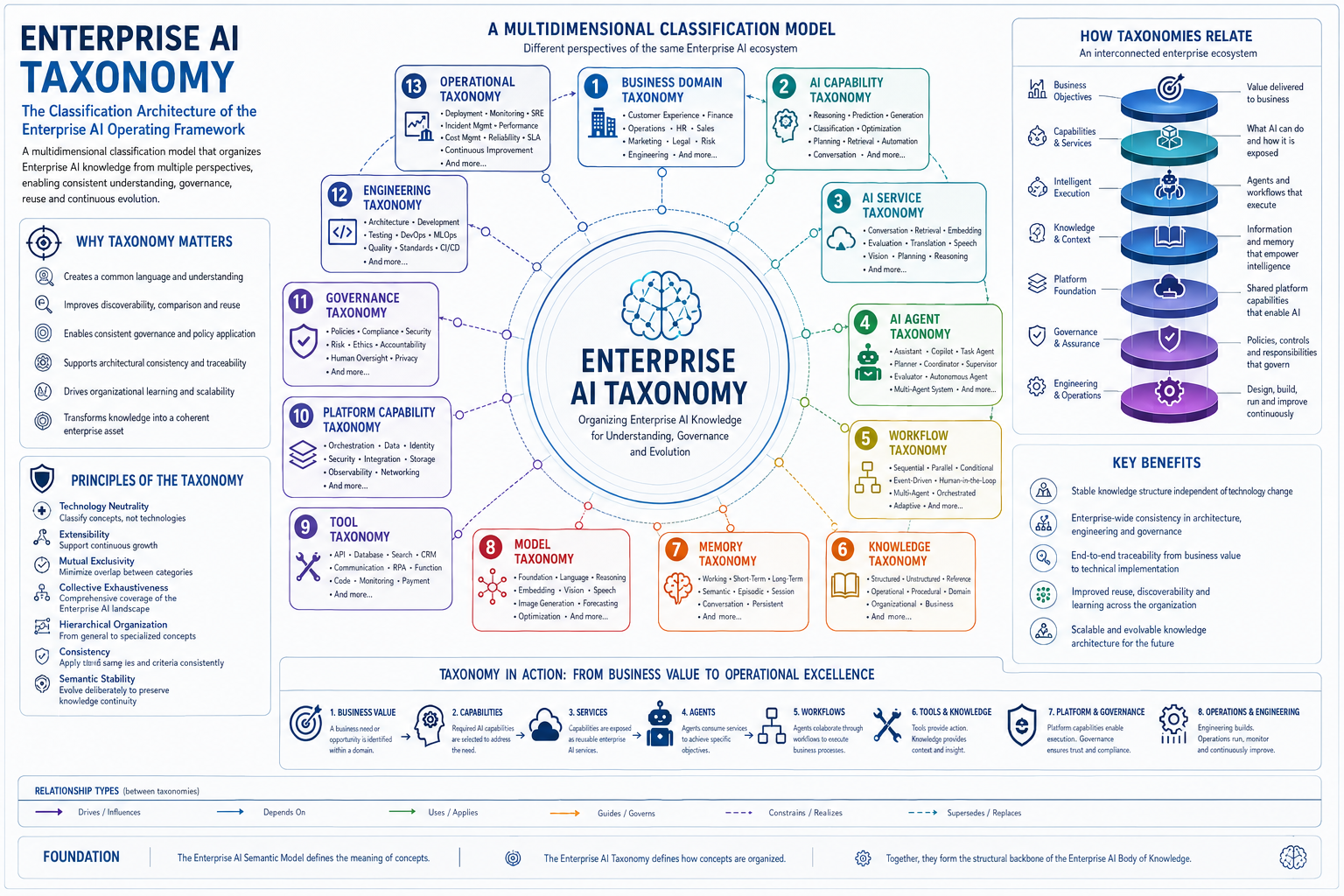
Instead, it establishes an Enterprise AI Classification Model composed of multiple complementary taxonomies.
Each taxonomy classifies Enterprise AI concepts from a different perspective.
Together, these taxonomies provide a comprehensive classification system capable of describing the Enterprise AI ecosystem without reducing its complexity.
This multidimensional approach reflects the reality of Enterprise AI.
A single concept may appear in multiple taxonomies because it possesses multiple characteristics.
For example, a Planner Agent can be simultaneously classified as:
- an AI Agent because it represents an autonomous intelligent entity;
- an AI Capability because it performs planning;
- an Enterprise AI Service when exposed as a reusable enterprise capability;
- a participant in a Workflow because it coordinates execution activities;
- a governed capability within the Governance Taxonomy because its autonomy must operate within defined organizational policies.
These classifications do not conflict with one another.
They describe different dimensions of the same enterprise capability.
Collectively, they create a complete conceptual representation of Enterprise AI.
The Enterprise AI Classification Model is therefore composed of the following complementary taxonomies.
1. Business Domain Taxonomy
This taxonomy classifies Enterprise AI according to the business domains it supports.
Artificial Intelligence exists to create business value, and every Enterprise AI capability should ultimately contribute to one or more organizational functions.
Representative business domains include:
- Customer Experience
- Sales
- Marketing
- Finance
- Human Resources
- Legal
- Cybersecurity
- Engineering
- Operations
- Network Management
- Supply Chain
- Procurement
- Knowledge Management
- Risk Management
- Compliance
2. AI Capability Taxonomy
This taxonomy classifies Enterprise AI according to the capabilities it provides.
These capabilities represent reusable organizational abilities that can be consumed across multiple business domains.
Representative capabilities include:
- Prediction
- Classification
- Generation
- Summarization
- Translation
- Recommendation
- Optimization
- Planning
- Reasoning
- Decision Support
- Knowledge Retrieval
- Conversation
- Automation
- Monitoring
- Simulation
- Forecasting
- Learning
- Evaluation
3. AI Service Taxonomy
This taxonomy classifies reusable Enterprise AI services that expose AI functionality to applications, intelligent agents, workflows, and other enterprise systems.
Representative services include:
- Conversation Service
- Retrieval Service
- Embedding Service
- Evaluation Service
- Translation Service
- Speech Service
- Vision Service
- Planning Service
- Reasoning Service
- Classification Service
- Recommendation Service
- Knowledge Service
- Tool Invocation Service
4. AI Agent Taxonomy
This taxonomy classifies intelligent software entities according to their responsibilities, autonomy, and collaboration model.
Representative agent categories include:
- Assistant
- Copilot
- Task Agent
- Workflow Agent
- Planner Agent
- Coordinator Agent
- Supervisor Agent
- Executor Agent
- Evaluator Agent
- Reviewer Agent
- Learning Agent
- Decision Agent
- Autonomous Agent
- Collaborative Agent
- Multi-Agent System
- Swarm System
- Digital Worker
5. Workflow Taxonomy
This taxonomy classifies the execution models through which Enterprise AI capabilities coordinate business activities.
Representative workflow categories include:
- Sequential Workflow
- Parallel Workflow
- Conditional Workflow
- Event-Driven Workflow
- Long-Running Workflow
- Human-in-the-Loop Workflow
- Multi-Agent Workflow
- Adaptive Workflow
- Orchestrated Workflow
- Choreographed Workflow
- Autonomous Workflow
6. Knowledge Taxonomy
This taxonomy classifies the different forms of enterprise knowledge consumed and produced by Enterprise AI.
Representative knowledge categories include:
- Structured Knowledge
- Semi-Structured Knowledge
- Unstructured Knowledge
- Reference Knowledge
- Operational Knowledge
- Procedural Knowledge
- Business Knowledge
- Technical Knowledge
- Regulatory Knowledge
- Historical Knowledge
- Domain Knowledge
- Organizational Knowledge
- Knowledge Assets
- Knowledge Collections
- Knowledge Sources
7. Memory Taxonomy
This taxonomy classifies the mechanisms through which intelligent systems preserve information across reasoning activities.
Representative memory categories include:
- Working Memory
- Conversation Memory
- Session Memory
- Short-Term Memory
- Long-Term Memory
- Semantic Memory
- Episodic Memory
- Organizational Memory
- Shared Memory
- Persistent Memory
8. Model Taxonomy
This taxonomy classifies Artificial Intelligence models according to their primary purpose within the Enterprise AI ecosystem.
Representative model categories include:
- Foundation Models
- Language Models
- Reasoning Models
- Embedding Models
- Vision Models
- Speech Models
- Image Generation Models
- Video Models
- Re-ranking Models
- Classification Models
- Forecasting Models
- Optimization Models
- Specialized Domain Models
9. Tool Taxonomy
This taxonomy classifies the external capabilities that extend the functionality of intelligent systems.
Representative tool categories include:
- Internal APIs
- External APIs
- Enterprise Applications
- Databases
- File Systems
- Knowledge Repositories
- Search Engines
- Workflow Engines
- MCP Servers
- Automation Platforms
- Communication Platforms
- Productivity Applications
- Infrastructure Services
10. Platform Capability Taxonomy
This taxonomy classifies the reusable technical capabilities that collectively compose the Enterprise AI Platform.
Representative platform capabilities include:
- AI Gateway
- Prompt Management
- Agent Registry
- Model Registry
- Tool Registry
- Workflow Platform
- Knowledge Platform
- Vector Platform
- Memory Platform
- Policy Engine
- Guardrails
- Identity
- Evaluation
- Observability
- Cost Management
- Marketplace
- Analytics
- Simulation
- Developer Portal
11. Governance Taxonomy
This taxonomy classifies the governance capabilities required to ensure that Enterprise AI operates responsibly, securely, and consistently.
Representative governance concepts include:
- Policies
- Standards
- Controls
- Compliance
- Risk
- Audit
- Ethics
- Responsible AI
- Privacy
- Security
- Identity
- Approvals
- Human Oversight
- Change Management
- Lifecycle Governance
12. Engineering Taxonomy
This taxonomy classifies the engineering assets and implementation artifacts used to design, develop, test, and maintain Enterprise AI solutions.
Representative engineering concepts include:
- Prompts
- Templates
- Skills
- Actions
- Functions
- Tools
- Workflows
- Patterns
- Components
- Libraries
- SDKs
- Reference Implementations
- Testing Assets
- Benchmarks
- Golden Datasets
13. Operational Taxonomy
This taxonomy classifies the operational capabilities required to deploy, observe, support, evaluate, and continuously improve Enterprise AI solutions throughout their lifecycle.
Representative operational concepts include:
- Monitoring
- Tracing
- Metrics
- Logging
- Alerting
- Incident Management
- Capacity Management
- Performance
- Cost
- Availability
- Reliability
- Release
- Version
- Rollback
- Continuous Evaluation
Together, these complementary taxonomies form the Enterprise AI Classification Model.
Rather than describing Enterprise AI from a single perspective, they provide multiple, interconnected views of the same enterprise ecosystem. Each taxonomy answers a different organizational question, while collectively creating a comprehensive and extensible classification system for Enterprise AI.
As the Enterprise AI Operating Framework evolves, additional taxonomies may be introduced to represent new dimensions of Enterprise AI. The classification model has therefore been intentionally designed to be extensible, allowing the enterprise knowledge structure to grow without compromising consistency, navigability, or conceptual coherence.
In this way, the Enterprise AI Classification Model becomes much more than a hierarchical catalog of concepts. It provides the organizational structure through which Enterprise AI knowledge can be classified, discovered, governed, compared, reused, and continuously expanded across the entire enterprise.
Relationships Between Taxonomies
The Enterprise AI Classification Model should never be interpreted as a collection of independent taxonomies. Although each taxonomy organizes concepts according to a specific perspective, Enterprise AI itself is an interconnected enterprise system in which business objectives, architectural capabilities, intelligent systems, platform services, governance mechanisms, engineering practices, and operational processes continuously interact.
For this reason, the true value of the Enterprise AI Taxonomy lies not only in the individual classifications it provides, but also in the relationships that connect those classifications into a coherent enterprise knowledge structure.
Each taxonomy represents a different perspective of the same Enterprise AI ecosystem.
The Business Domain Taxonomy describes where Enterprise AI creates business value.
The AI Capability Taxonomy describes what Enterprise AI is capable of doing.
The AI Service Taxonomy describes how those capabilities are exposed as reusable enterprise services.
The AI Agent Taxonomy describes which intelligent entities consume and orchestrate those services.
The Workflow Taxonomy describes how intelligent capabilities collaborate to execute business processes.
The Knowledge and Memory Taxonomies describe the information and contextual resources required to support intelligent reasoning.
The Tool Taxonomy describes the enterprise capabilities through which AI systems interact with external applications, services, and operational environments.
The Platform Capability Taxonomy describes the shared technical capabilities that enable Enterprise AI across the organization.
The Governance Taxonomy establishes the policies, controls, responsibilities, and organizational constraints within which every Enterprise AI capability must operate.
The Engineering and Operational Taxonomies describe how Enterprise AI solutions are designed, implemented, deployed, monitored, evaluated, and continuously improved throughout their lifecycle.
Viewed independently, each taxonomy provides only a partial understanding of Enterprise AI.
Viewed together, they describe a complete enterprise ecosystem.
This interconnected perspective can be illustrated through a typical Enterprise AI capability.
A business objective within the Customer Experience domain may require an intelligent recommendation capability.
That business objective is realized through one or more AI Capabilities, such as reasoning, recommendation, and knowledge retrieval.
These capabilities are exposed as reusable AI Services that can be consumed throughout the enterprise.
One or more AI Agents orchestrate those services to accomplish specific business objectives.
The agents execute one or more Workflows that coordinate reasoning, tool invocation, and business process execution.
During execution, the agents invoke enterprise Tools to interact with applications, databases, communication platforms, and external services.
Those tools access enterprise Knowledge, supported by appropriate Memory mechanisms that preserve context throughout the reasoning process.
Underlying Platform Capabilities provide the infrastructure required for orchestration, retrieval, identity, observability, policy enforcement, evaluation, and operational support.
Throughout the entire process, Governance establishes the policies, security controls, human oversight, compliance requirements, and decision boundaries that regulate intelligent behavior.
Finally, Engineering and Operations ensure that these capabilities are implemented according to enterprise standards, monitored effectively, continuously evaluated, and improved over time.
This example illustrates an essential characteristic of the Enterprise AI Classification Model.
Enterprise AI should not be understood as a collection of isolated concepts.
It should be understood as a system of interconnected enterprise capabilities.
The relationships between taxonomies provide the conceptual structure through which this system can be understood.
They enable architects to trace business objectives to technical implementations.
They allow governance policies to be connected directly to the capabilities they regulate.
They enable engineering teams to understand how reusable services support intelligent agents.
They demonstrate how platform capabilities enable enterprise-wide AI.
They reveal how knowledge, memory, reasoning, workflows, tools, and governance collectively contribute to business value.
These relationships also enable end-to-end traceability across the Enterprise AI Operating Framework.
Business strategy can be traced to enterprise capabilities.
Capabilities can be traced to services.
Services can be traced to agents.
Agents can be traced to workflows.
Workflows can be traced to tools.
Tools can be traced to platform capabilities.
Platform capabilities can be traced to governance controls.
Governance can be traced to engineering standards and operational practices.
This traceability transforms the taxonomy from a simple classification system into a navigable enterprise knowledge architecture.
As the Enterprise AI Operating Framework continues to evolve, new taxonomies, concepts, and capabilities can be incorporated without disrupting this conceptual structure. New relationships simply extend the existing knowledge network, allowing the Enterprise AI ecosystem to grow while preserving semantic consistency, architectural coherence, and organizational understanding.
For this reason, the Enterprise AI Classification Model should be understood as more than a hierarchy of concepts.
It is an interconnected knowledge system.
Its taxonomies provide multiple perspectives.
Its relationships connect those perspectives into a coherent whole.
Together, they establish the conceptual architecture through which Enterprise AI can be understood, designed, governed, engineered, operated, and continuously evolved across the enterprise.
An Evolutionary Classification System
The Enterprise AI Taxonomy is designed with the expectation that Artificial Intelligence will continue to evolve for many years. New architectural paradigms will emerge, intelligent systems will become increasingly sophisticated, engineering practices will mature, governance requirements will expand, and entirely new categories of Enterprise AI capabilities will be introduced. Consequently, the classification model established today cannot be considered complete or immutable.
The challenge, however, is not simply accommodating change.
The challenge is enabling continuous evolution while preserving the conceptual stability upon which enterprise knowledge depends.
This objective lies at the heart of the Enterprise AI Taxonomy.
Rather than treating the taxonomy as a static classification that is periodically replaced, the Enterprise AI Operating Framework defines it as an evolutionary enterprise knowledge structure. Its purpose is to grow continuously without compromising the consistency, navigability, and architectural coherence of the Enterprise AI body of knowledge.
This philosophy reflects one of the fundamental design principles of the EAIOF.
Enterprise knowledge should evolve through refinement rather than reinvention.
Whenever new Enterprise AI concepts emerge, they should first be evaluated against the existing taxonomy. In many cases, innovation does not require the creation of an entirely new classification. Instead, new concepts can be incorporated by extending existing categories, refining current classifications, or introducing additional levels of specialization within the established knowledge structure.
This incremental approach preserves the continuity of the taxonomy while allowing it to expand naturally as the discipline matures.
Only when a new concept introduces a genuinely new dimension of Enterprise AI—one that cannot be meaningfully represented within the existing conceptual structure—should the taxonomy itself be extended through the creation of a new classification domain. Such decisions should be made deliberately and through formal governance to ensure that the overall structure of the taxonomy remains coherent and sustainable.
This governance approach provides important long-term benefits.
Enterprise knowledge grows without becoming fragmented.
Architectural classifications remain stable across successive generations of technology.
Training materials continue to build upon an established conceptual structure.
Reference architectures preserve their organizational consistency.
Governance policies remain aligned with a stable classification model.
Engineering practices evolve without requiring continuous reorganization of enterprise knowledge.
Most importantly, organizational learning becomes cumulative.
Each new concept enriches the existing body of knowledge rather than replacing it. Every refinement strengthens the enterprise classification model while preserving the understanding already established throughout the organization.
This approach also reinforces one of the central principles of the Enterprise AI Operating Framework: enduring enterprise concepts should remain independent of rapidly changing implementation technologies. As new models, orchestration frameworks, reasoning techniques, governance mechanisms, and platform capabilities emerge, they become additional knowledge represented within the taxonomy rather than reasons to redesign the taxonomy itself.
The Enterprise AI Taxonomy therefore evolves in the same manner as the Enterprise AI Operating Framework.
It continuously incorporates innovation.
It preserves conceptual consistency.
It maintains architectural coherence.
It strengthens organizational knowledge.
It enables Enterprise AI to mature without sacrificing the stability required for long-term governance and enterprise-wide reuse.
For this reason, the Enterprise AI Taxonomy should be understood as a living classification system rather than a static hierarchy of concepts. Its value lies not in remaining unchanged, but in providing a stable organizational structure capable of absorbing continuous innovation while preserving the integrity of the Enterprise AI knowledge landscape.
By evolving through controlled refinement rather than periodic reinvention, the taxonomy ensures that Enterprise AI knowledge remains coherent, extensible, and strategically valuable throughout the ongoing evolution of Artificial Intelligence. In doing so, it enables the Enterprise AI Operating Framework to grow alongside the discipline it describes while maintaining the clarity, consistency, and organizational discipline upon which successful Enterprise AI depends.
Taxonomy as the Structural Backbone of the AI-BoK
The Enterprise AI Taxonomy provides the structural organization upon which the entire Enterprise AI Body of Knowledge is built. While the Enterprise AI Semantic Model establishes the meaning of concepts, the taxonomy provides the organizational structure that enables those concepts to be classified, navigated, governed, and continuously expanded as the Enterprise AI Operating Framework evolves.
Together, these two domains establish the intellectual architecture of the AI-BoK.
The Enterprise AI Semantic Model defines what Enterprise AI concepts mean.
The Enterprise AI Taxonomy defines how those concepts are organized.
Meaning and structure are complementary.
Without semantic definitions, concepts lack precision.
Without taxonomy, concepts lack organization.
Only when both exist together can Enterprise AI knowledge become a coherent and reusable enterprise asset.
This structured foundation enables every subsequent domain of the Enterprise AI Operating Framework to build upon a common organizational model.
The Enterprise AI Principles establish the architectural values and decision-making guidance that govern the classified concepts.
The Enterprise AI Reference Models describe how these concepts interact to form a coherent Enterprise AI ecosystem.
The Enterprise AI Patterns demonstrate how the concepts are applied through reusable architectural and engineering solutions.
The Enterprise AI Platform Capabilities operationalize these concepts by providing the shared technical capabilities that enable Enterprise AI across the enterprise.
Governance, Engineering, Operations, Adoption, and every subsequent domain continue to extend this foundation, each relying upon the same semantic definitions and organizational classification established by the Enterprise AI Semantic Model and the Enterprise AI Taxonomy.
This dependency is intentional.
A shared language enables common understanding.
A shared classification enables common organization.
Together, they enable a common architecture.
The Enterprise AI Taxonomy therefore serves a purpose that extends far beyond documentation or cataloging. It establishes the structural framework through which Enterprise AI knowledge is managed as an enterprise asset. Every concept occupies a defined place within a coherent organizational structure. Every new capability can be incorporated without disrupting the existing body of knowledge. Every stakeholder can navigate the Enterprise AI landscape using the same conceptual organization regardless of business domain or technical specialization.
This structural consistency also enables enterprise-wide governance and reuse.
Architectural artifacts reference concepts organized according to a common classification model.
Engineering standards are developed within a consistent knowledge structure.
Governance policies apply to clearly defined conceptual domains.
Training materials follow a logical progression through the Enterprise AI body of knowledge.
Reference implementations demonstrate solutions built upon the same organizational foundation.
Knowledge becomes easier to discover, compare, maintain, and continuously evolve because it is organized according to a stable enterprise classification model.
More importantly, the taxonomy transforms an expanding collection of Enterprise AI concepts into a coherent knowledge system.
As Artificial Intelligence continues to evolve, the Enterprise AI Body of Knowledge will inevitably incorporate new concepts, capabilities, architectural patterns, governance mechanisms, engineering practices, and operational models. The taxonomy provides the structural stability that allows this growth to occur without compromising conceptual consistency or organizational coherence. New knowledge extends the existing structure rather than replacing it, ensuring that the Enterprise AI Operating Framework evolves through continuous refinement instead of periodic reinvention.
For this reason, the Enterprise AI Taxonomy should be regarded as the structural backbone of the Enterprise AI Body of Knowledge.
It provides the organizational framework through which Enterprise AI knowledge is classified.
It enables concepts to be connected within a coherent enterprise structure.
It supports governance, engineering, architecture, operations, and organizational learning through a shared classification model.
It allows the Enterprise AI Operating Framework to grow while preserving the integrity of its knowledge architecture.
Ultimately, the Enterprise AI Taxonomy transforms Enterprise AI from a collection of isolated concepts into a structured enterprise knowledge system. By providing the organizational structure that underpins every subsequent domain of the Enterprise AI Operating Framework, it enables Enterprise AI knowledge to remain discoverable, governable, reusable, and continuously evolvable as the organization advances its Enterprise AI journey.