Introduction
Artificial Intelligence has become a strategic priority for organizations across virtually every industry. Enterprises are investing heavily in AI platforms, intelligent agents, enterprise knowledge capabilities, automation, decision support systems, and increasingly sophisticated forms of human-AI collaboration. These investments are driven by the expectation that Artificial Intelligence will improve operational efficiency, enhance decision-making, create new business capabilities, and accelerate organizational transformation.
Despite this growing adoption, many organizations encounter a common challenge. Although they are able to identify AI initiatives, deploy intelligent applications, or implement isolated use cases, they often struggle to answer a more fundamental question:
How mature is our Enterprise AI capability?
Answering this question requires considerably more than measuring the number of AI projects, deployed models, intelligent agents, or business use cases. These indicators reflect the scale of AI adoption, but they reveal relatively little about the organization's ability to sustain Enterprise AI as a long-term enterprise capability. An organization may operate dozens of AI solutions while still lacking the governance, architecture, engineering discipline, operational processes, organizational structures, and management practices necessary to support AI consistently across the enterprise.
This distinction is central to the Enterprise AI Operating Framework (EAIOF). Enterprise AI maturity is not determined by how much Artificial Intelligence an organization has implemented. Instead, it reflects the organization's ability to design, govern, engineer, operate, secure, evaluate, and continuously improve Enterprise AI in a consistent, repeatable, and scalable manner. Maturity therefore represents the development of organizational capabilities rather than the accumulation of technological assets.
This perspective explains why many organizations achieve success in individual AI initiatives without achieving Enterprise AI maturity. Projects may deliver measurable business value, individual teams may develop significant technical expertise, and isolated business units may successfully adopt AI within their own domains. However, if these capabilities remain fragmented, depend on individual expertise, or cannot be reused consistently across the organization, the enterprise itself has not yet developed a mature Enterprise AI capability. Projects succeed, but organizational capability evolves only incrementally.
The Enterprise AI Operating Framework addresses this challenge through the Enterprise AI Maturity Model. Rather than evaluating the adoption of specific technologies, products, or implementation approaches, the maturity model assesses the organizational capabilities required to establish, govern, and continuously evolve Enterprise AI at enterprise scale. Its objective is to provide a structured mechanism through which organizations can understand their current level of maturity, identify strengths and capability gaps, prioritize improvement initiatives, and establish realistic transformation roadmaps aligned with their strategic objectives.
The Enterprise AI Maturity Model complements the other domains of the EAIOF by providing a practical mechanism for assessing how effectively the concepts defined throughout the framework have been institutionalized. The Enterprise AI Principles establish the architectural philosophy that guides Enterprise AI adoption. The Reference Models define the conceptual structure of the Enterprise AI ecosystem. The Pattern Language captures proven architectural practices, while the Decision Records preserve the reasoning behind significant organizational decisions. The Maturity Model evaluates the extent to which these and other capabilities have become embedded within the organization's operating model, governance structures, engineering practices, and day-to-day operations.
This capability is valuable for organizations at every stage of their Enterprise AI journey. Organizations beginning their adoption of Artificial Intelligence can use the maturity model to establish a structured baseline and define their initial transformation priorities. Organizations with established AI capabilities can evaluate the consistency, scalability, and governance of their existing practices, while more mature organizations can use the model to identify opportunities for optimization, innovation, and continuous improvement. In every case, the objective is not to achieve a predefined level of technological sophistication, but to strengthen the enterprise's ability to adopt Artificial Intelligence in a disciplined, sustainable, and strategically aligned manner.
For these reasons, the Enterprise AI Maturity Model should be regarded as a strategic capability of the Enterprise AI Operating Framework. It provides organizations with a common framework for evaluating their current state, measuring the development of enterprise capabilities, guiding transformation initiatives, and assessing progress over time. By focusing on organizational capability rather than technology adoption, it enables Enterprise AI to evolve as a managed enterprise discipline, ensuring that growth in AI adoption is accompanied by corresponding improvements in governance, architecture, engineering, operations, and organizational maturity.
Purpose of the Enterprise AI Maturity Model
The primary purpose of the Enterprise AI Maturity Model is to provide a structured and repeatable mechanism for assessing an organization's capability to adopt, govern, engineer, operate, and continuously evolve Enterprise Artificial Intelligence. Rather than evaluating individual technologies or isolated AI initiatives, the model assesses the organizational capabilities that collectively determine whether Enterprise AI can be sustained and scaled as an enterprise capability.
Within the Enterprise AI Operating Framework (EAIOF), the maturity model serves as an organizational assessment framework. It enables organizations to establish a clear understanding of their current state, evaluate how consistently Enterprise AI capabilities have been institutionalized, and identify the improvements required to achieve their strategic objectives. By providing a common assessment methodology, the model creates a shared understanding of organizational maturity across business, architecture, engineering, governance, operations, and executive leadership.
One of its most important functions is to establish an objective baseline for Enterprise AI. Organizations frequently possess an incomplete or fragmented view of their AI capabilities because assessments are based primarily on visible outcomes, such as the number of AI projects, deployed models, or intelligent applications. The maturity model shifts the focus from implementation outputs to organizational capabilities, allowing stakeholders to evaluate the underlying structures, processes, governance mechanisms, engineering practices, operational disciplines, and organizational competencies that enable Enterprise AI to operate effectively at scale.
This assessment provides valuable insight into both organizational strengths and capability gaps. Mature capabilities can be recognized, standardized, and leveraged across the enterprise, while areas requiring further development become visible through a consistent evaluation framework. Rather than relying on subjective perceptions of organizational readiness, leadership gains an evidence-based view of where investments, organizational change, or capability development will have the greatest strategic impact.
The Enterprise AI Maturity Model also enables organizations to benchmark their progress over time. Because the assessment is based on a structured maturity framework rather than on individual technology initiatives, successive evaluations provide a consistent view of how Enterprise AI capabilities are evolving. Organizations can measure the effectiveness of transformation initiatives, evaluate whether investments are producing the expected organizational outcomes, and monitor the gradual institutionalization of Enterprise AI across business units and functional domains.
Another important purpose of the maturity model is to support strategic planning. The assessment results provide a foundation for defining transformation roadmaps that are aligned with the organization's current capabilities and long-term objectives. Instead of pursuing isolated improvement initiatives, organizations can prioritize capability development according to the areas that will produce the greatest enterprise value. This enables transformation programs to progress through deliberate, incremental improvements that collectively strengthen the organization's Enterprise AI capability over time.
The maturity model also provides valuable support for investment planning and executive decision-making. By identifying capability gaps, organizational dependencies, and improvement priorities, it enables leadership to allocate resources based on enterprise needs rather than short-term technological opportunities. Investments can therefore be directed toward capabilities that strengthen the organization's long-term ability to design, govern, engineer, operate, and continuously improve Enterprise AI, ensuring that technology adoption is supported by corresponding improvements in organizational maturity.
Within the broader EAIOF, the Enterprise AI Maturity Model complements every other domain by providing a mechanism for assessing how effectively the concepts defined throughout the framework have been implemented in practice. The Enterprise AI Principles establish the architectural philosophy that guides Enterprise AI adoption, the Reference Models describe the conceptual structure of the Enterprise AI ecosystem, the Pattern Language captures reusable architectural knowledge, and the Decision Records preserve the reasoning behind significant organizational decisions. The maturity model evaluates the extent to which these concepts have become embedded in the organization's governance structures, engineering disciplines, operational processes, and business practices.
For these reasons, the Enterprise AI Maturity Model should be regarded as one of the principal strategic planning and organizational improvement capabilities within the Enterprise AI Operating Framework. It enables organizations to understand their current level of Enterprise AI maturity, identify strengths and improvement opportunities, benchmark organizational capability, prioritize transformation initiatives, define strategic roadmaps, measure progress over time, guide investment decisions, and provide executive leadership with an objective basis for governing the long-term evolution of Enterprise AI as a sustainable enterprise capability.
Maturity Is About Organizational Capability
One of the foundational concepts of the Enterprise AI Operating Framework (EAIOF) is that Enterprise Artificial Intelligence should be understood as an organizational capability rather than as a collection of technologies, products, or independent AI initiatives. This perspective fundamentally influences the way organizational maturity is defined and assessed. The objective of the Enterprise AI Maturity Model is not to determine how advanced an organization's technology portfolio is, but to evaluate how effectively the organization has developed the capabilities required to adopt, govern, engineer, operate, and continuously improve Enterprise AI at enterprise scale.
In many organizations, AI maturity is assessed primarily through indicators such as the number of AI projects delivered, the sophistication of deployed models, the volume of data processed, or the level of investment in Artificial Intelligence. Although these indicators may provide useful information about the scale of AI adoption, they reveal relatively little about the organization's ability to sustain Enterprise AI as a strategic enterprise capability. They measure activity, but they do not necessarily measure organizational maturity.
The EAIOF adopts a broader and more enduring perspective. Enterprise AI maturity is determined by organizational capability rather than technological sophistication. An organization demonstrates maturity not because it deploys the latest models or adopts emerging technologies ahead of its competitors, but because it has established the governance structures, architectural foundations, engineering disciplines, operational practices, knowledge management capabilities, and organizational responsibilities required to manage Artificial Intelligence consistently across the enterprise.
This distinction is essential. An organization may operate hundreds of AI applications developed independently by different business units, each relying on different technologies, engineering practices, governance approaches, and operational standards. From a technology perspective, such an organization may appear highly advanced. From an enterprise perspective, however, its AI capability may remain fragmented, difficult to govern, and challenging to scale because the underlying organizational disciplines have not been institutionalized.
Conversely, another organization may have implemented a smaller number of Enterprise AI solutions while relying on a shared Enterprise AI Platform, common architectural principles, standardized engineering practices, governed knowledge assets, enterprise-wide operational processes, and consistent governance mechanisms. Although its technology footprint may be smaller, its Enterprise AI capability is significantly more mature because Artificial Intelligence has become an integrated organizational capability supported by shared enterprise disciplines rather than a collection of isolated implementations.
For this reason, the Enterprise AI Maturity Model evaluates the capabilities that enable Enterprise AI to operate as a coordinated enterprise function. It examines the extent to which Enterprise AI has been embedded within the organization's governance structures, enterprise architecture, engineering disciplines, operational processes, platform capabilities, knowledge management practices, security controls, and organizational operating model. The assessment therefore focuses on the consistency, repeatability, scalability, and sustainability of these capabilities rather than on the quantity or sophistication of individual AI solutions.
This perspective is fully aligned with the architectural philosophy established throughout the Enterprise AI Body of Knowledge. Enterprise AI is guided by common principles, structured through shared Reference Models, implemented using reusable architectural patterns, evolved through disciplined decision-making, and sustained through governance and operational excellence. The Enterprise AI Maturity Model evaluates how effectively these capabilities have been institutionalized across the organization and how consistently they are applied throughout the Enterprise AI lifecycle.
As a result, maturity becomes a measure of organizational discipline rather than technological enthusiasm. Organizations are not assessed according to how quickly they adopt new AI technologies, but according to their ability to implement Artificial Intelligence in a manner that is governed, architecturally consistent, operationally reliable, secure, scalable, and aligned with long-term business objectives. This approach recognizes that technologies will continue to evolve rapidly, while the organizational capabilities required to manage Enterprise AI remain the true foundation of sustainable success.
The Enterprise AI Maturity Model therefore encourages organizations to invest in enduring capabilities rather than isolated technological initiatives. Instead of measuring progress through technology adoption alone, it promotes the systematic development of governance, architecture, engineering, operations, knowledge management, security, and organizational competencies that collectively enable Enterprise AI to become a permanent enterprise capability. In doing so, the model helps organizations build a foundation that remains valuable even as implementation technologies, AI models, and engineering practices continue to evolve.
For these reasons, the Enterprise AI Maturity Model should be regarded as an organizational capability model rather than a technology assessment framework. Its purpose is not to measure how much Artificial Intelligence an organization has adopted, but to evaluate how effectively the organization has transformed Artificial Intelligence into a coherent, enterprise-wide capability that can consistently deliver business value, adapt to change, and support the long-term evolution of Enterprise AI across the enterprise.
Characteristics of an Effective Maturity Model
An Enterprise AI Maturity Model only delivers meaningful value when it provides a consistent and objective mechanism for evaluating an organization's ability to establish, operate, govern, and continuously improve Enterprise AI as a long-term organizational capability. Rather than serving as a descriptive checklist or a technology scorecard, the maturity model should support informed decision-making by identifying strengths, exposing capability gaps, and guiding the evolution of the organization's operating model.
To achieve these objectives, the Enterprise AI Maturity Model defined by the Enterprise AI Operating Framework is built upon a set of guiding characteristics that ensure assessments remain relevant across organizations, industries, and technological generations.
First, the model is business-oriented. Organizational maturity is evaluated according to the enterprise's ability to create, sustain, and govern business value through Artificial Intelligence rather than by the number of AI initiatives, models, or technologies deployed. Technology adoption is important only insofar as it contributes to the organization's strategic objectives and operational capabilities.
The model is also capability-based. Assessments focus on the organizational capabilities required to operate Enterprise AI successfully, including governance, architecture, engineering, operations, security, risk management, data management, organizational enablement, and continuous improvement. This perspective recognizes that sustainable AI adoption depends on the coordinated development of multiple enterprise capabilities rather than isolated technical excellence.
Another essential characteristic is technology neutrality. The maturity model does not prescribe specific vendors, platforms, programming languages, foundation models, or implementation approaches. Because Enterprise AI technologies evolve rapidly, the model evaluates enduring organizational capabilities that remain applicable regardless of future technological change. This allows organizations to preserve the validity of their maturity assessments while continuously modernizing their technical landscape.
The model is designed to be actionable. A maturity assessment should produce practical insights that enable organizations to prioritize investments, define improvement roadmaps, allocate resources, and establish measurable transformation initiatives. The objective is not simply to classify an organization's current state, but to provide a structured path toward higher levels of organizational capability.
The assessment process is equally intended to be measurable. Every maturity level should be supported by objective evaluation criteria that allow progress to be observed consistently over time. Organizations should be able to demonstrate improvements through evidence of established capabilities, standardized processes, governance practices, operational metrics, and institutionalized management disciplines rather than through subjective perceptions of progress.
Finally, the model is inherently evolutionary. Enterprise AI maturity is not achieved through isolated transformation programs or one-time modernization initiatives. Instead, it develops through the continuous strengthening of organizational capabilities as the enterprise learns, adapts, and expands the scale of its AI operations. The maturity model therefore encourages incremental, sustainable progression, recognizing that Enterprise AI is a continuously evolving organizational capability rather than a destination that can be permanently achieved.
Dimensions of Enterprise AI Maturity
Enterprise AI maturity cannot be accurately represented by a single numerical score or an overall organizational rating. Such an approach inevitably oversimplifies the complexity of Enterprise AI by concealing significant variations in capability across different parts of the organization. An enterprise may exhibit mature governance structures while still developing its engineering practices, or it may operate an advanced AI platform without equivalent maturity in knowledge management, organizational adoption, or operational excellence.
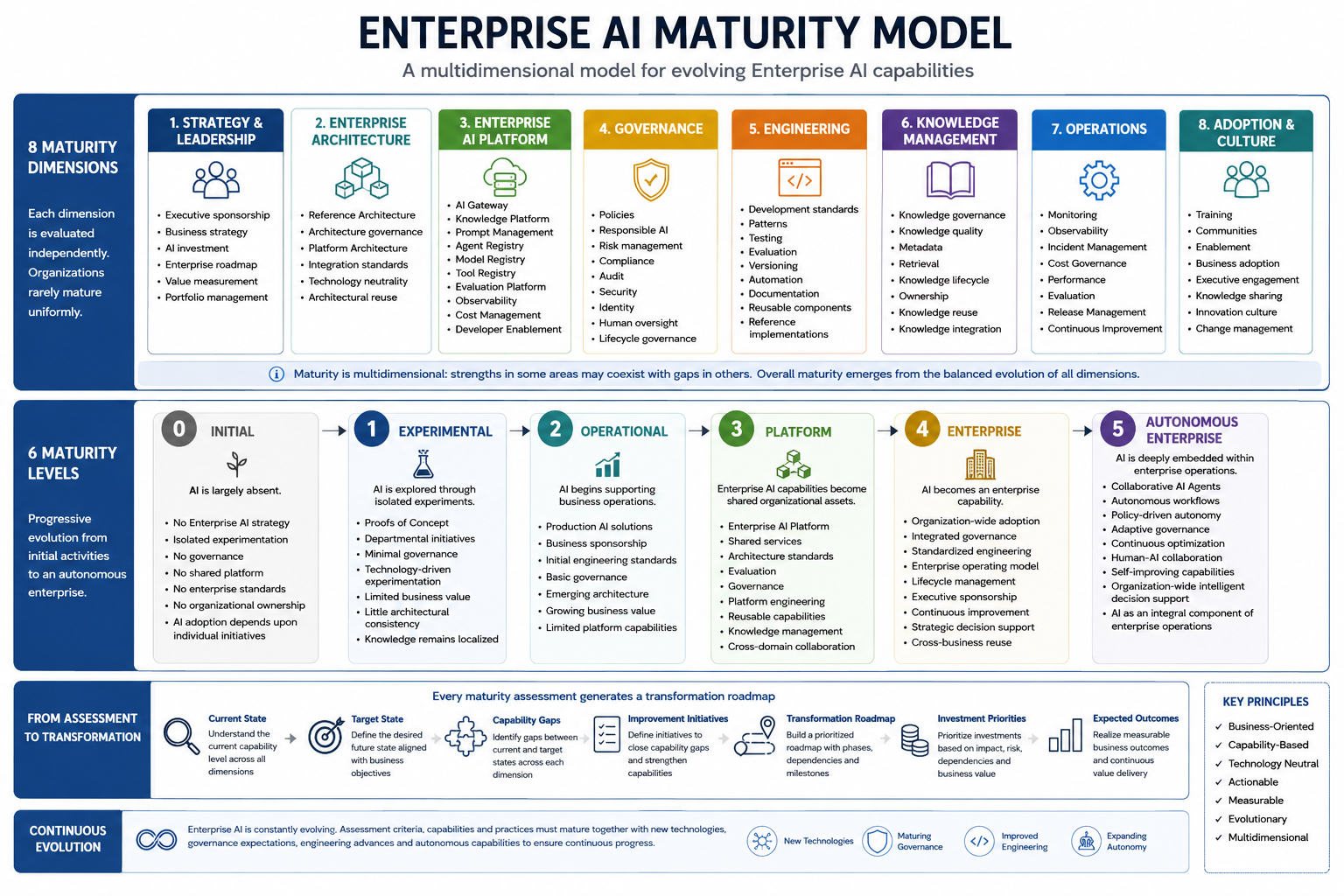
For this reason, the Enterprise AI Operating Framework evaluates maturity as a multidimensional organizational construct. Each dimension represents a critical enterprise capability that contributes to the organization's ability to design, govern, engineer, operate, and continuously evolve Enterprise AI. Although these dimensions are assessed independently, they are highly interconnected, and sustained maturity requires balanced progress across all of them.
The dimensions defined by the Enterprise AI Maturity Model provide a comprehensive framework for assessing organizational capability rather than technological sophistication. Together, they offer a structured view of the enterprise's strengths, identify capability gaps, and support the development of targeted improvement roadmaps.
1. Strategy & Leadership
The Strategy & Leadership dimension evaluates the extent to which Enterprise AI is established as a strategic organizational capability supported by executive leadership. Mature organizations treat AI as a long-term business transformation initiative rather than as a collection of isolated technology projects. Executive sponsorship, strategic alignment, and sustained investment provide the foundation upon which all other AI capabilities are built.
Representative capabilities within this dimension include executive sponsorship, alignment between AI initiatives and business strategy, investment planning, enterprise AI roadmaps, value realization and measurement, and portfolio management practices that ensure AI initiatives collectively support organizational objectives.
2. Enterprise Architecture
The Enterprise Architecture dimension evaluates the organization's ability to establish a coherent architectural foundation for Enterprise AI. Rather than allowing individual solutions to evolve independently, mature organizations define enterprise-wide architectural principles, reference architectures, integration standards, and reusable design approaches that promote consistency across the AI ecosystem.
Representative capabilities include Enterprise AI reference architectures, architecture governance processes, platform architecture, integration standards, technology-neutral architectural practices, and mechanisms that encourage architectural reuse across business units and AI initiatives.
3. Enterprise AI Platform
The Enterprise AI Platform dimension evaluates the maturity of the shared technical capabilities that enable AI to operate consistently at enterprise scale. Instead of building isolated infrastructure for individual projects, mature organizations invest in common platform services that accelerate development, simplify governance, improve operational efficiency, and reduce duplication across the enterprise.
Representative capabilities include AI Gateway services, Knowledge Platforms, Prompt Management, Agent Registries, Model Registries, Tool Registries, Evaluation Platforms, observability capabilities, cost management mechanisms, and developer enablement services that provide standardized building blocks for Enterprise AI solutions.
4. Governance
The Governance dimension evaluates the organizational mechanisms used to direct, control, and oversee Enterprise AI throughout its lifecycle. Effective governance ensures that AI initiatives operate within clearly defined policies while managing risk, maintaining regulatory compliance, protecting organizational assets, and preserving accountability for AI-driven decisions.
Representative capabilities include governance policies, Responsible AI practices, risk management, regulatory compliance, audit processes, security governance, identity and access management, human oversight mechanisms, and lifecycle governance covering the deployment, operation, and retirement of AI capabilities.
5. Engineering
The Engineering dimension evaluates the organization's ability to develop Enterprise AI solutions using standardized, repeatable, and scalable engineering practices. Mature engineering organizations move beyond experimental development by institutionalizing practices that improve quality, consistency, maintainability, and long-term sustainability across AI initiatives.
Representative capabilities include development standards, architectural and engineering patterns, testing methodologies, evaluation frameworks, version management, engineering automation, technical documentation, reusable components, and reference implementations that promote consistency across development teams.
6. Knowledge Management
The Knowledge Management dimension evaluates how effectively the organization governs, structures, maintains, and reuses enterprise knowledge as a strategic asset for Artificial Intelligence. Since knowledge represents one of the primary inputs for modern AI systems, its quality and governance have a direct impact on the reliability, accuracy, and business value of AI solutions.
Representative capabilities include knowledge governance, knowledge quality management, metadata management, information retrieval capabilities, knowledge lifecycle management, ownership models, knowledge reuse practices, and integration of enterprise knowledge across multiple business domains and AI applications.
7. Operations
The Operations dimension evaluates the organization's ability to operate Enterprise AI reliably, securely, and efficiently in production environments. Operational maturity extends beyond maintaining infrastructure to include continuous monitoring, performance management, operational governance, and mechanisms that support the ongoing evolution of AI capabilities after deployment.
Representative capabilities include monitoring, observability, incident management, cost governance, performance management, continuous evaluation, release management, and continuous improvement processes that ensure Enterprise AI remains reliable and aligned with business objectives throughout its operational lifecycle.
8. Adoption & Culture
The Adoption & Culture dimension evaluates the extent to which Enterprise AI has been embedded within the organization's people, processes, and ways of working. Sustainable maturity depends not only on technology and governance but also on the organization's ability to develop the skills, behaviors, and cultural mindset required to adopt AI responsibly and effectively.
Representative capabilities include education and training programs, communities of practice, organizational enablement initiatives, business adoption, executive engagement, knowledge sharing, innovation culture, and change management practices that encourage the successful integration of Enterprise AI into everyday business operations.
Enterprise AI Maturity Levels
The Enterprise AI Maturity Model defines a progressive path through which organizations evolve their ability to establish, govern, engineer, operate, and continuously improve Enterprise AI. Rather than representing isolated milestones, the maturity levels describe the gradual institutionalization of Enterprise AI as an organizational capability. Each level reflects the degree to which AI has become integrated into the enterprise's strategy, governance, architecture, engineering practices, operational model, and organizational culture.
Progression between maturity levels is neither automatic nor strictly linear. Organizations may exhibit characteristics associated with multiple levels simultaneously, particularly across different business units or capability dimensions. The maturity levels therefore provide a reference model for understanding organizational evolution rather than a rigid certification framework.
Level 0 — Initial
At the Initial level, Artificial Intelligence has not yet become an organizational capability. AI activities, if they exist at all, are sporadic, uncoordinated, and driven by individual curiosity rather than enterprise priorities. There is no shared vision, governance structure, or architectural foundation to support the systematic adoption of AI.
Organizations at this level typically lack an Enterprise AI strategy, operate without governance mechanisms or enterprise standards, and have no shared platform or clearly defined organizational ownership for AI. Any experimentation depends largely on isolated individual initiatives, resulting in fragmented efforts that rarely produce sustainable business value.
Level 1 — Experimental
At the Experimental level, organizations begin exploring the potential of Artificial Intelligence through isolated initiatives and proof-of-concept projects. AI is viewed primarily as an emerging technology to be evaluated rather than as a strategic organizational capability.
Experimentation is generally initiated by individual departments or innovation teams, with limited coordination across the enterprise. Governance remains minimal, architectural consistency is largely absent, and engineering practices are still evolving. Although these initiatives may demonstrate technical feasibility, business value is often limited and organizational knowledge remains localized within individual teams.
Level 2 — Operational
At the Operational level, Artificial Intelligence begins supporting business processes through production-ready solutions. Organizations move beyond experimentation and establish the initial organizational disciplines required to operate AI in real business environments.
Business sponsorship becomes more consistent, governance mechanisms start to emerge, and engineering practices become increasingly standardized. Initial architectural foundations are established, allowing organizations to deliver measurable business value while beginning to develop shared platform capabilities. Despite this progress, Enterprise AI is still primarily organized around individual solutions rather than enterprise-wide capabilities.
Level 3 — Platform
At the Platform level, organizations recognize that Enterprise AI should be supported by shared capabilities rather than isolated project implementations. AI platforms, common services, and standardized engineering practices become strategic organizational assets that accelerate delivery while improving consistency, governance, and operational efficiency.
Organizations at this level establish Enterprise AI platforms that provide reusable services such as model management, prompt management, evaluation capabilities, knowledge services, observability, and engineering tooling. Architecture standards become institutionalized, governance becomes more mature, and knowledge management practices support reuse across multiple business domains. Collaboration increasingly extends across organizational boundaries, enabling AI capabilities to be shared throughout the enterprise.
Level 4 — Enterprise
At the Enterprise level, Artificial Intelligence becomes an integrated organizational capability embedded within the enterprise operating model. AI is no longer managed as a portfolio of technology initiatives but as a strategic capability that supports business transformation across multiple organizational functions.
Governance, architecture, engineering, platform services, and operational management operate as coordinated enterprise disciplines. Standardized lifecycle management, executive sponsorship, continuous improvement processes, and enterprise-wide engineering practices enable AI capabilities to be developed, deployed, and governed consistently across the organization. Reuse of platforms, knowledge, and AI services becomes common across business units, allowing the enterprise to scale AI efficiently while maintaining consistency and control.
Level 5 — Autonomous Enterprise
At the Autonomous Enterprise level, Artificial Intelligence becomes deeply embedded within the enterprise's operational fabric and actively participates in the execution, coordination, and continuous optimization of business operations. Human expertise remains essential, but AI systems increasingly operate as trusted collaborators capable of executing defined responsibilities within established governance boundaries.
Organizations at this level deploy collaborative AI agents that coordinate across multiple business domains, execute policy-driven autonomous workflows, and continuously adapt their behavior based on organizational objectives, operational feedback, and governance constraints. Governance evolves to support increasing levels of autonomy while preserving transparency, accountability, security, and human oversight.
Rather than functioning as an independent technology layer, Artificial Intelligence becomes an integral component of the enterprise operating model. Human and AI capabilities work together to improve decision-making, optimize organizational performance, and continuously evolve enterprise capabilities, enabling the organization to operate with a level of intelligence, adaptability, and resilience that would not be achievable through traditional operating models alone.
Assessment Methodology
The Enterprise AI Maturity Model adopts a multidimensional assessment methodology in which each maturity dimension is evaluated independently. This approach recognizes that organizational capabilities do not evolve at the same pace and that Enterprise AI maturity cannot be accurately represented by a single score or by the maturity of one particular discipline.
As organizations expand their Enterprise AI capabilities, different domains naturally progress at different rates. An organization may establish highly mature engineering practices while its governance model is still evolving. Similarly, it may invest heavily in a sophisticated Enterprise AI Platform without having developed equally mature knowledge management capabilities, or it may demonstrate strong executive sponsorship while operational processes remain largely manual. These variations are a normal characteristic of organizational evolution rather than an indication of assessment inconsistency.
Evaluating each dimension independently provides a more realistic understanding of the organization's current state by exposing capability imbalances that could otherwise remain hidden behind an aggregated maturity score. This level of visibility enables leadership to identify strengths, prioritize improvement initiatives, allocate investments more effectively, and reduce organizational risks associated with uneven capability development.
The assessment methodology therefore produces a maturity profile rather than a single organizational rating. Each dimension reflects the maturity of a specific organizational capability, allowing the enterprise to understand where it has established sustainable practices and where further development is required.
An overall view of Enterprise AI maturity can subsequently be derived from the collective evolution of all dimensions. However, this overall perspective should be interpreted as a reflection of the organization's balanced capability landscape rather than as the result of isolated achievements in individual domains. Sustainable Enterprise AI maturity emerges from the coordinated development of governance, architecture, engineering, platform capabilities, operations, knowledge management, organizational adoption, and strategic leadership, all progressing together toward a common enterprise operating model.
Maturity as a Transformation Roadmap
The primary purpose of the Enterprise AI Maturity Model is not to classify organizations or assign them a maturity label. While the assessment provides a structured view of the organization's current capabilities, its greater value lies in enabling continuous organizational improvement. Maturity should therefore be viewed as a journey of capability development rather than as a destination or a benchmarking exercise.
Within the Enterprise AI Operating Framework, a maturity assessment serves as a strategic planning instrument that helps organizations understand how to evolve their Enterprise AI capabilities in a systematic and sustainable manner. Instead of focusing solely on where the organization stands today, the assessment establishes a clear direction for where it intends to be and identifies the organizational changes required to reach that future state.
Every maturity assessment should begin by establishing an objective view of the organization's current state across all maturity dimensions. This baseline provides a comprehensive understanding of existing capabilities, highlighting areas where effective practices have already been institutionalized as well as areas that remain fragmented, inconsistent, or underdeveloped. A clear understanding of the current state enables leadership to make informed decisions based on evidence rather than assumptions.
The assessment should then define a desired target state that reflects the organization's strategic ambitions, business priorities, regulatory obligations, and operational objectives. Importantly, the target state is not necessarily the highest maturity level across every dimension. Different organizations may require different maturity objectives depending on their industry, risk profile, business model, and strategic goals. The objective is to achieve the level of maturity that best supports the organization's long-term success rather than to maximize maturity for its own sake.
Once the current and target states have been established, the assessment identifies the capability gaps that separate the two. These gaps represent the organizational capabilities, governance mechanisms, engineering practices, platform services, operational processes, or cultural changes that must be developed to support the desired level of Enterprise AI maturity. By making these gaps explicit, the organization can focus its transformation efforts on the areas that will deliver the greatest strategic impact.
The identified capability gaps naturally lead to the definition of improvement initiatives. These initiatives translate assessment findings into concrete actions, such as establishing new governance structures, implementing shared platform capabilities, standardizing engineering practices, strengthening knowledge management, expanding organizational training, or introducing new operational processes. Each initiative contributes to the systematic development of one or more maturity dimensions and should be aligned with broader business transformation objectives.
Collectively, these initiatives form an Enterprise AI transformation roadmap. Rather than consisting of isolated projects, the roadmap provides a coordinated sequence of organizational changes that progressively strengthen Enterprise AI capabilities over time. The roadmap enables leadership to manage transformation as a continuous evolution of the enterprise operating model, ensuring that investments across governance, architecture, engineering, operations, and organizational enablement remain aligned and mutually reinforcing.
The roadmap also supports the prioritization of investments. Because organizational resources are always limited, the maturity model helps decision-makers determine which capabilities should be developed first based on business value, organizational risk, strategic importance, implementation dependencies, and expected return on investment. This allows Enterprise AI investments to be managed as part of a coherent transformation strategy rather than as independent technology initiatives competing for funding.
Ultimately, every maturity assessment should be linked to clearly defined business outcomes. Improvements in organizational maturity should translate into measurable benefits such as stronger governance, greater operational efficiency, improved engineering productivity, faster solution delivery, higher levels of AI adoption, reduced operational and regulatory risk, increased reuse of enterprise capabilities, and enhanced organizational agility. In this way, the maturity model connects capability development directly to business performance, ensuring that Enterprise AI remains a strategic enabler of long-term organizational value.
Viewed from this perspective, the Enterprise AI Maturity Model becomes far more than an assessment framework. It provides a structured mechanism for planning, prioritizing, and governing the organization's Enterprise AI transformation, enabling leaders to guide the continuous evolution of Enterprise AI as an enduring organizational capability rather than a collection of isolated technology initiatives.
Continuous Evolution
Enterprise Artificial Intelligence is evolving at an unprecedented pace. New foundation models, agentic architectures, reasoning techniques, orchestration platforms, governance mechanisms, and engineering practices continue to reshape how organizations design, deploy, and operate AI capabilities. At the same time, regulatory frameworks, industry standards, security requirements, and societal expectations are becoming increasingly sophisticated, requiring organizations to continuously adapt their operating models.
This dynamic environment means that organizational maturity cannot be defined by a fixed set of practices or a static assessment framework. Capabilities that represent leading practices today may become baseline expectations in the future, while entirely new disciplines will emerge as Enterprise AI continues to evolve. Consequently, a maturity model that remains unchanged over time would gradually lose its ability to provide meaningful guidance for organizational transformation.
For this reason, the Enterprise AI Maturity Model is intentionally designed as an evolving framework. Its underlying principles and organizational dimensions are intended to remain stable, providing continuity and consistency over time. However, the assessment criteria associated with those dimensions should be periodically reviewed and refined to reflect advances in technology, engineering methodologies, governance practices, operational models, and organizational learning.
As Enterprise AI platforms become more capable, engineering practices mature, and organizations adopt increasingly autonomous systems, the expectations associated with higher levels of maturity will naturally evolve. New capabilities may need to be incorporated into the model, existing evaluation criteria may require refinement, and assessment methods may become more comprehensive as the discipline itself matures. This continuous evolution ensures that the maturity model remains aligned with the realities of Enterprise AI rather than with a particular generation of technologies or implementation approaches.
The adaptive nature of the model also encourages organizations to view maturity as a process of continuous improvement rather than as a finite objective. Achieving a particular maturity level should not signal the end of the transformation journey, but rather the establishment of a foundation upon which new capabilities can be developed. As business priorities, technological opportunities, and governance expectations evolve, organizations are expected to reassess their capabilities, refine their operating models, and pursue new improvement initiatives that sustain long-term organizational competitiveness.
By evolving alongside Enterprise AI itself, the maturity model remains a relevant and effective instrument for guiding organizational development. Rather than encouraging organizations to achieve static compliance with a predefined set of requirements, it promotes the continuous strengthening of organizational capabilities, ensuring that Enterprise AI remains resilient, adaptable, and capable of delivering sustained business value in an environment of constant technological and organizational change.
Maturity as the Strategic Compass of the EAIOF
The Enterprise AI Maturity Model provides the strategic perspective through which organizations understand, evaluate, and continuously evolve their Enterprise AI capabilities. While the other domains of the Enterprise AI Operating Framework define the knowledge, structures, principles, and practices required to operate Enterprise AI, the maturity model explains how those capabilities are progressively developed and institutionalized over time. It transforms the framework from a descriptive body of knowledge into a practical instrument for organizational transformation.
Each domain of the EAIOF contributes a distinct element to this transformation journey. The Foundations establish the fundamental purpose of Enterprise AI and the organizational philosophy upon which the framework is built. The Semantic Model creates a common language that enables consistent communication across business, technology, and governance functions. The Taxonomy organizes the concepts that define the Enterprise AI landscape, while the Principles establish the enduring architectural beliefs that guide decision-making across the enterprise.
Building upon these conceptual foundations, the Reference Models describe the essential structures and relationships that characterize Enterprise AI, providing a shared architectural vision that can be adapted to different organizational contexts. The Pattern Language complements this perspective by capturing proven and reusable solutions that address recurring architectural, engineering, governance, and operational challenges. Decision Records preserve the institutional knowledge generated throughout the organization's evolution, documenting not only the decisions that were made but also the reasoning that shaped them, thereby creating an enduring organizational memory.
The Enterprise AI Maturity Model brings these domains together by providing the mechanism through which organizations assess how effectively these concepts have been adopted as organizational capabilities. Rather than measuring isolated technology implementations or individual AI projects, it evaluates the enterprise's ability to translate the knowledge and guidance provided by the EAIOF into repeatable, governed, and scalable ways of working. In doing so, it connects strategy with execution, architecture with operations, governance with engineering, and organizational learning with continuous improvement.
This perspective fundamentally changes how Enterprise AI transformation is managed. Instead of viewing progress through the number of AI solutions deployed or the sophistication of individual technologies, organizations measure success by the systematic development of the capabilities required to sustain Enterprise AI as an enterprise-wide operating model. Transformation becomes measurable, repeatable, and strategically aligned, allowing leadership to make informed decisions about priorities, investments, risks, and long-term organizational development.
For this reason, the Enterprise AI Maturity Model should be regarded as the strategic compass of the Enterprise AI Operating Framework. It provides the direction that enables organizations to navigate their Enterprise AI journey with clarity and purpose, helping them understand their current capabilities, define their desired future state, prioritize the initiatives that will create the greatest business value, and continuously strengthen the organizational disciplines required to operate Enterprise AI at scale.
Ultimately, the maturity model ensures that Enterprise AI is not treated as a series of disconnected initiatives or short-lived technology programs. Instead, it establishes a structured path through which organizations progressively build the governance, architecture, engineering, platform, operational, and cultural capabilities necessary to become truly AI-enabled enterprises. In this way, the Enterprise AI Maturity Model serves not only as an assessment framework, but also as the strategic guide that aligns every stage of the organization's Enterprise AI evolution with the long-term vision of the EAIOF.